























Desert shade shelter: two layers against the heat
In the desert the enemy is not the cold but the sun – from above and from the scorching ground. A simple cloth overhead already helps, but a roof of two layers with air between them can lower the temperature underneath noticeably. Here you learn to choose the spot, rig a double shade roof, make the ground cooler and plan the day so you rest through the worst heat – and why you should not build in the midday heat.
- 30–60 minutes, ideally in the morning or evening
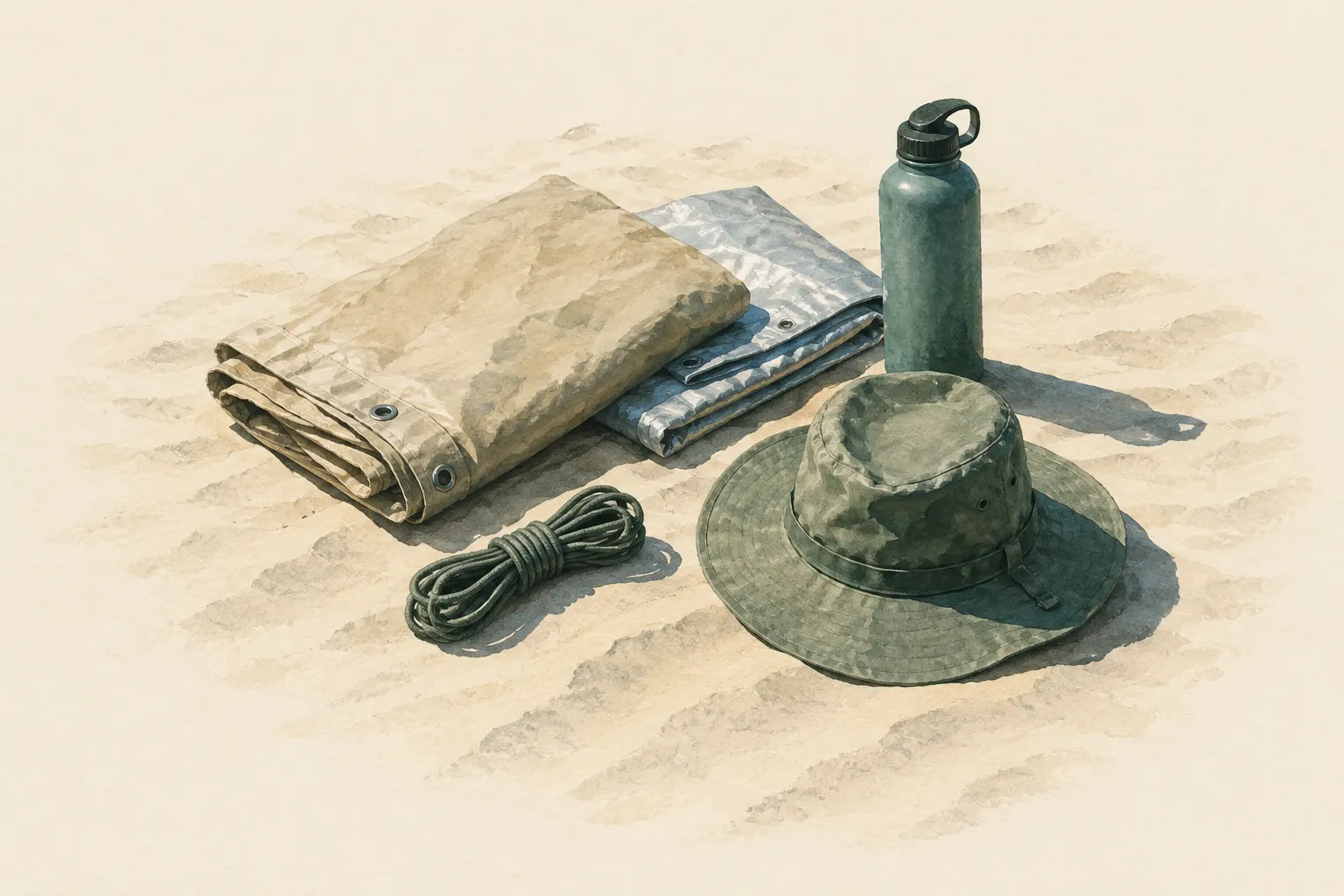
Explained simply
In the desert the sun burns from above, and the ground gets so hot you can burn yourself. That is why above all you need shade there.
It is best to stretch two cloths one above the other, with a hand's width of air between them. The top one gets hot, the lower one stays cooler, and the wind blows the heat away in between.
You build in the morning or evening. In the midday heat you lie quietly in the shade and drink.
How it works
A cloth in the sun absorbs warmth and radiates it on downwards. A second layer below only gets part of it, because the air between the layers takes up the heat and the wind carries it away. A light or silver top reflects much of the sunlight beforehand.
The ground is hottest at the surface. Even a hand's width down it is noticeably cooler, which is why the shallow hollow is worth it.
What matters
Gap between layers: 20 to 40 centimetres of air between them.
Open sides: the wind must be able to blow through.
The right time: build in the cool hours, rest at midday.
Safety: what to watch out for
Heat stroke: confusion, hot skin and vomiting are an emergency. Cool down, get into shade, call emergency services.
Dry riverbeds: never rest there – flash flood danger, even without rain nearby.
Animals: scorpions and snakes like shade. Do not turn stones over blindly; shake out shoes.
Step by step
Build in the cool hours
Build the shade roof in the early morning or in the evening. In the midday heat sit quietly in the shade of a vehicle, rock or cloth and wait.
- 1
Build in the cool hours
Build the shade roof in the early morning or in the evening. In the midday heat sit quietly in the shade of a vehicle, rock or cloth and wait.
- 2
Choose the spot
Look for a slightly raised spot, not in a dry riverbed. Use rocks, bushes or the vehicle as anchors. The long side faces north and south so the shade moves during the day but stays under the roof.
Never in a dry riverbed.
- 3
Dig a shallow hollow
Scrape out the ground under the future roof about a hand's width deep. The deeper layer is cooler than the surface.
- 4
Rig the lower layer
Stretch the first cloth about knee to hip height over the hollow, fixed to sticks, stones or the vehicle.
- 5
Upper layer with a gap
Stretch the second cloth 20 to 40 centimetres above it, light or silver side up. Air should be able to flow between the two layers.
- 6
Leave the sides open
Leave the sides open so the wind can blow through. Only put up a wall of cloth or luggage on the sunny side.
- 7
Rest, drink, wait
Lie quietly under the roof around midday, drink regularly in small sips, keep clothes and head covering on. In the evening, when it cools, use the upper layer as a blanket.
Common mistakes
- Building in the midday heat
- Only one layer directly overhead
- Resting in a dry riverbed
- Taking off clothes – they protect from sun and water loss
- Closed sides – the heat builds up
Quick view
Materials
Tarp
Two cloths, tarps or rescue blankets; the top one light-coloured
Emergency blanket
Silver side up as the top layer
Tears easily once punctured; short-term shelter only.
Conductive – keep away from power lines.
Paracord
Not a climbing or safety rope.
Trekking poles
Or sticks, stones, a vehicle or rocks as anchors
Small shovel / folding spade
For digging a shallow hollow
Suitable for
- Desert, steppe, beach without shade
- Vehicle breakdown in the heat
- Waiting for help by day
Not suitable for
- Dry riverbeds (wadis) – flash flood danger
- Strong sandstorm
- At night – then you keep warm instead of seeking shade
Prerequisites
- Two cloths or tarps
- Enough drinking water
- Build during the cool hours
Safety
- Check stones and brush before touching them: scorpions and snakes also seek shade. Shake out shoes and clothes before putting them on.
How it works
A single cloth in the sun gets hot itself and radiates heat downwards. If a second layer sits 20 to 40 centimetres below it, the air layer in between catches much of that, and the wind carries the warm air away. A light or silver top surface reflects sunlight. Because the ground is hottest at the surface, it is noticeably cooler a hand's width down.
Advantages
- Noticeably cooler than simple shade
- Little material
Disadvantages
- Needs two cloths
- Building costs sweat and water
Deep knowledge
Background
Desert peoples such as the Tuareg and Bedouin live in wide tents of dark wool or leather, open at the sides so the wind blows through. Their daily rhythm follows the heat: work in the morning and evening, rest at midday.
Military survival manuals have recommended the double roof with an air gap as the simplest means against heat for decades.
Variants
- On a vehicle
- After a breakdown, stretch the cloths from the roof rack to the ground. Inside the vehicle it gets life-threateningly hot – do not wait inside.
- Trench in sand
- In loose sand dig a shallow trench and stretch the two layers over it; the sand wall holds the edges.
Common mistakes
- Building in the midday heat
- Only one layer directly overhead
- Resting in a dry riverbed
- Taking off clothes – they protect from sun and water loss
- Closed sides – the heat builds up
Limits and risks
- No exact temperature figures
- Does not replace drinking water
Material alternatives
Derived from material properties: a substitute must have all relevant properties. Observe the notes on the substitute.
- Tarp
- Plastic sheet / large bin bag (Tears easily; never pull over the head (suffocation risk).), Emergency blanket (Tears easily once punctured; short-term shelter only.), Document folder (waterproof) (Store securely – contains sensitive personal data.), Rain poncho (When used as a shelter, it no longer protects your body from rain.), Bivy bag (Never fully close off the face.), Tent (Do not cook or heat inside the tent (fire and carbon monoxide danger).), Heavy-duty bin bag (large) (Suffocation risk: never pull plastic bags over the head or face and keep them away from small children.), Group shelter bag (Airtight – ventilate regularly.)
- Paracord
- Rope (Never use unknown or damaged rope for life-safety purposes.), Thin, soft wire (brass or galvanised steel) (Wire ends are sharp – protect eyes and fingers when bending), Tow rope or tow strap (Attach only to the towing eyes provided by the manufacturer; never stand next to it under load.)
- Trekking poles
- Sturdy sticks / poles (Do not cut live wood where prohibited.), Tent pole repair sleeve (Temporary only – have broken sections replaced at home.), Round logs (straight, sound) (Fell or take only with the forest owner's permission.), Straight, fresh hardwood stick (Only take dead wood or wood you are allowed to cut)
Results come exclusively from structured entries. No improvised instructions are generated.
Sources (3)
- Wilderness & Environmental Medicine (Wilderness Medical Society) (2019): Wilderness Medical Society Clinical Practice Guidelines for the Prevention and Treatment of Heat Illness: 2019 Update · In heat: shade, rest at midday and drink enough; heat stroke is an emergency
- World Health Organization: Heat and health (fact sheet) · Avoid direct sun, seek cool places, know the signs of heat illness
- Headquarters, Department of the Army (USA) (2002): FM 3-05.70 Survival · Shade shelter with two layers and an air gap; rest in the midday heat