























Chocolate banana and baked apple from the embers
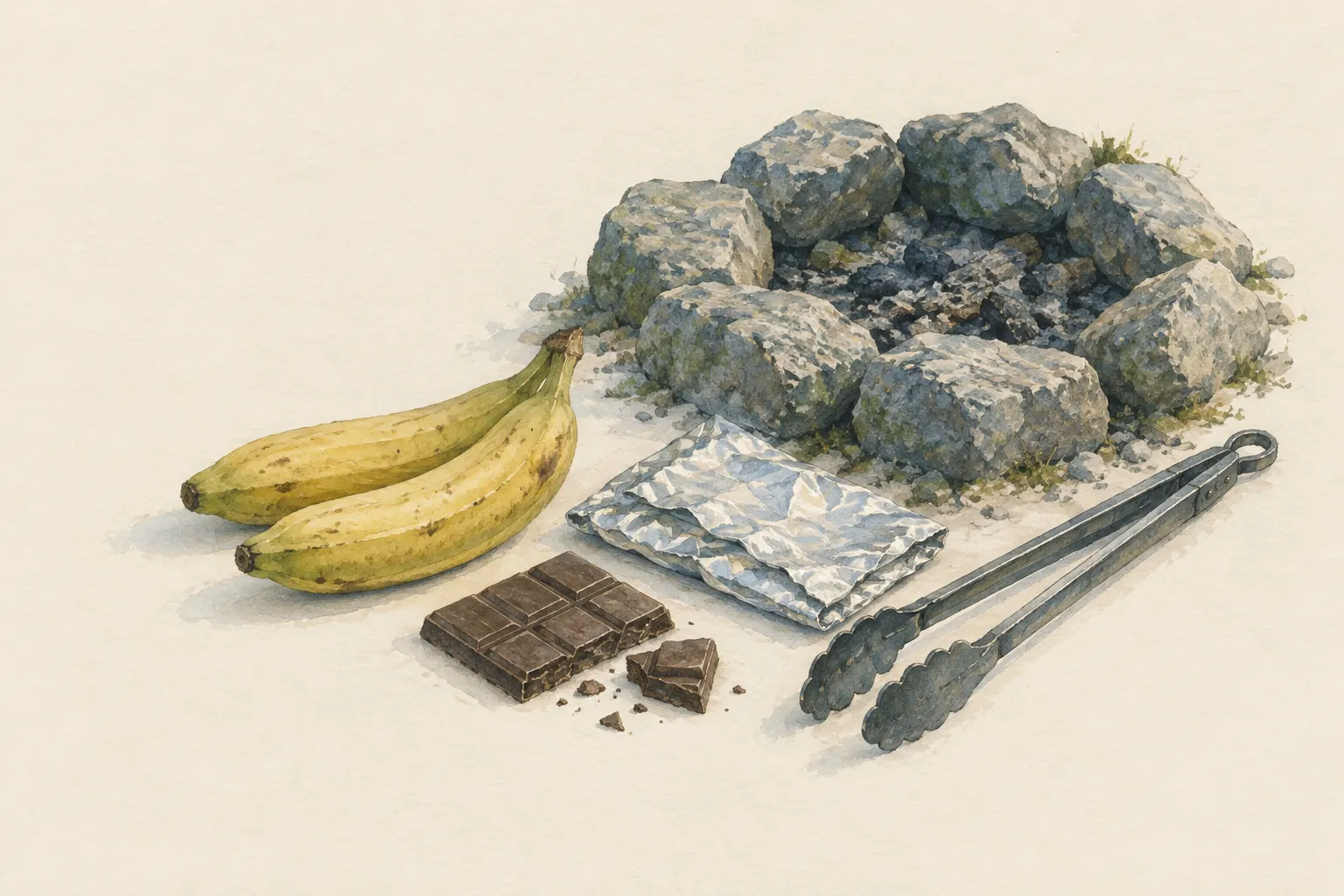
A banana is slit lengthwise in its peel, filled with pieces of chocolate, wrapped in aluminium foil and laid at the edge of the embers. After a few minutes the chocolate has melted and the banana is soft – you eat it with a spoon straight from the peel. A filled baked apple works the same way but takes longer. Ideal with children, as long as adults handle the embers and everyone knows: chocolate and steam are hot.
- Preparing embers 30–60 minutes; banana about 5–10 minutes, baked apple about 20–30 minutes
Explained simply
A chocolate banana is a small campfire miracle. You cut a banana open at the top in its peel, push pieces of chocolate inside and wrap it in aluminium foil. Then an adult lays the parcel at the edge of the embers.
The peel is like a little boat and the foil like a blanket. Inside, the banana becomes warm and soft, and the chocolate melts. After a few minutes the adult takes the parcel out with tongs.
Now comes the most important part: waiting! Melted chocolate and the steam from the foil are much hotter than they look. Let the banana cool for a few minutes, taste carefully with the spoon – and then spoon it straight out of the peel.
How it works
The banana peel is natural packaging. It keeps ash out and holds the moisture inside, so the banana warms in its own steam. The aluminium foil helps further: it protects the peel from direct embers and makes sure the melted chocolate does not run out.
Unlike dough or meat, banana and chocolate do not have to be cooked through – they can already be eaten raw. It is only about everything getting warm and soft. That is why the mild heat at the edge of the embers is quite enough. In the middle of the embers or in the flames the peel burns before the inside is warm.
The baked apple works on the same principle but takes longer because an apple is firmer and thicker. The stick test shows whether it is ready: a thin, clean stick slides in without resistance.
What really matters
Only slit the banana at the top, through the top peel and the flesh – the bottom peel stays whole, otherwise the chocolate runs out underneath. Do not overfill the slit. Small pieces of chocolate melt more evenly than large squares.
Wrap the foil double and fold it at the top into a tight seam. That way everything stays inside, and everyone can see where the top is. The parcel is not turned. If the embers are very hot, an adult pushes it further out. After about 5 to 10 minutes it is usually ready – open the foil a little at the top and look.
Good embers come from dry hardwood and take time. That is why chocolate bananas are the perfect dessert after dinner at the fire, when the flames get smaller and plenty of embers are left.
Safety: what to watch out for
Melted chocolate sticks to the skin and releases its heat for a long time. The steam that rises when you open the foil can scald face and fingers. So: only handle the parcel with tongs, open the foil away from your face and wait a few minutes. With children, an adult checks the temperature before they taste. With a burn, cool it at once with cool running water, and with large burns, burns to the face or in children call 112, in Austria also 144.
Children sit at a distance in a circle around the fire, and nobody steps over the circle. One adult looks after nothing but the embers and puts the parcels in and takes them out. Remember: embers can still glow under grey ash.
Milk chocolate contains milk, and many kinds contain nuts or traces of them. With allergies in the group, look at the pack. Fire only where it is allowed, keep water ready and put everything out completely at the end. Foil and peels go into the rubbish bag.
Good to know
For a baked apple you remove the core from the top without piercing the bottom and fill the hollow with raisins, a little sugar and – if nobody is allergic – chopped nuts. Wrapped twice in foil it needs about 20 to 30 minutes at the edge of the embers depending on size and is turned once in between. The inside gets as hot as porridge, so let it cool for a long time.
Where fire is not allowed, the foil parcel goes into a pan with a lid on the stove, over a very low flame. And a nice trick for groups: each child scratches their initial into the foil with a little stick – then there is no argument about whose banana is whose.
Step by step
Prepare the embers
In a permitted fire site, make a fire of dry hardwood and let it burn down until there are red-glowing embers with white-grey ash. With a long stick, push part of the embers into a flat bed at the edge. A grill grate over the embers also works.
Caution: Have water ready to put the fire out.
- 1
Prepare the embers
In a permitted fire site, make a fire of dry hardwood and let it burn down until there are red-glowing embers with white-grey ash. With a long stick, push part of the embers into a flat bed at the edge. A grill grate over the embers also works.
Have water ready to put the fire out.
- 2
Slit the banana
Lay the banana with the inside of its curve facing up. Slit it lengthwise with the knife, through the top peel and the flesh, but not through the bottom peel. Gently push the slit open a little – this makes a small boat.
Cut away from your body.
- 3
Fill with chocolate
Break the chocolate into small pieces and press them into the slit. Do not overfill, or the chocolate will run over. Children can do this well themselves – with clean hands.
- 4
Wrap in foil
Wrap the banana in a double layer of aluminium foil, opening facing up. Fold the edges together tightly at the top to make a seam so nothing runs out. That way you also know later where the top is.
- 5
Lay it at the edge of the embers
An adult lays the parcel with the tongs at the edge of the ember bed or on the grate, seam facing up – not in the flames. After about 5 to 10 minutes it is ready. Do not turn it, or the chocolate will run out; with very hot embers push the parcel a little further out.
- 6
Take out and open carefully
Take the parcel out with the tongs and put it on a stone or plate. Open the foil at the top with tongs or a fork, keeping your face away – hot steam rises. The chocolate should be melted and the banana soft; otherwise close the foil and put it back briefly.
- 7
Cool, spoon, clean up
Let the banana cool for a few minutes and taste carefully with the tip of the spoon. You eat it with a spoon straight from the peel. Foil and peels go in the rubbish bag and are taken home. Finally put the embers out completely with plenty of water.
Common mistakes
- Putting the parcel in the flames
- Cutting through the bottom peel – the chocolate runs out
- Turning the parcel
- Opening the foil towards your face
- Biting in at once
- Letting children reach into the embers themselves
- Leaving foil in the fire site
Quick view
Materials
Bananas (ripe but firm)
1 banana per person
Bruise easily – carry them at the top of the pack or in a box.
Chocolate (in pieces)
About 2–3 squares of chocolate in pieces per banana
Milk chocolate contains milk; many kinds contain nuts or traces of them – check the pack.
Molten chocolate is very hot and sticks to the skin.
Firm apples
For the baked apple: 1 apple per person
The inside of a baked apple gets as hot as porridge – let it cool first.
Raisins
Filling for the baked apple, 1 tbsp per apple
Small, hard pieces: choking risk for toddlers – soak them or leave them out.
Sugar and icing sugar
1 tsp per apple, to taste
Sugar burns quickly over too much heat and turns bitter; molten sugar causes severe burns.
Aluminium foil (heavy-duty)
About 30 cm per banana, folded double
Edges can be sharp; conducts heat and electricity.
Knife (fixed or locking blade)
Only adults or practised children cut
Cut away from your body.
Rules on carrying knives differ by region – check local rules.
Barbecue tongs or wooden tongs
Long tongs keep your hands away from the embers.
Leather or heat-resistant gloves
Synthetic gloves melt onto the skin – only leather or certified heat-resistant gloves.
Wet gloves conduct heat quickly.
Dry firewood
Dry hardwood for good embers
Collect only where permitted.
Lighter, matches or ferro rod
Observe local fire bans.
Water for extinguishing (bucket, canister or pot)
Have several litres ready before lighting.
Suitable for
- Dessert at the campfire
- Families, children's groups and scouts
- Ending a barbecue evening with the remaining embers
- Cooking without pot or pan
Not suitable for
- A fire ban or high wildfire danger
- Small children who do not understand that embers and foil are hot
- Nut allergy if the chocolate contains nuts
- High flames without embers – the foil burns on the outside while everything inside stays cold
Prerequisites
- A permitted fire site with embers or a grill grate
- One adult who looks after nothing but the embers
- Long tongs
- Water to put the fire out
Safety
- Children sit at a distance from the fire, and a circle around the fire site is not stepped over. Adults put the parcels into the embers and take them out. Embers can still glow under grey ash – never reach in with bare hands.
- Milk chocolate contains milk, many kinds contain nuts or traces of them. With allergies in the group, check the pack and prepare a suitable kind separately for those affected.
- Fire only where it is allowed and there is no wildfire danger – use existing fire sites, keep water ready to put it out and extinguish the fire completely at the end. Take foil scraps and peels back with you – aluminium foil does not rot and peels do not belong in nature.
How it works
The banana peel is a natural casing that keeps ash out and lets the inside cook in its own steam. The foil protects further and keeps the chocolate in the peel. At the edge of the embers the heat is mild enough for the chocolate to melt and the banana to soften before the peel chars. Because banana and chocolate are not dangerous raw, it is only about warming them – not about cooking them through as with dough or meat.
Advantages
- Simple, quick and very popular with children
- Needs no cookware
- Uses the remaining embers after dinner
- No risk from raw dough or raw meat
Disadvantages
- High scalding risk from chocolate and steam
- Needs aluminium foil that has to be taken back
- Only where fire is allowed
- Allergens in the chocolate
Deep knowledge
Background
The chocolate banana – often called a "banana boat" in English – is a classic among scouts and family camps. It shows the basic principle of cooking in the embers: a casing of peel and foil keeps ash out, and the inside warms evenly in its own steam. Bushcraft textbooks describe working with embers rather than flames as the basis of campfire cooking.
At the campfire, burns and scalds are the main danger. First aid means cooling at once with cool running water. Children are especially at risk because they are less able to judge heat.
Variants
- Filled baked apple
- Wash a firm apple and remove the core from the top with a knife or a spoon, without piercing the bottom. Fill with raisins, a little sugar and – if nobody is allergic – chopped nuts, wrap twice in foil and lay at the edge of the embers. After about 20 to 30 minutes depending on size, turned once in between, it is soft: a thin stick slides in easily. The inside is as hot as porridge – let it cool for a long time.
- Without a fire: in the pan
- Where fire is not allowed, the foil parcel goes into a pan with a lid on the stove over a very low flame. After a few minutes the chocolate has melted.
- Children's version
- An adult slits the bananas in advance, the children fill them and scratch their initial into the foil with a little stick. Then everyone waits in the seated circle until the parcels come back. For the very little ones let the banana cool on a plate and serve it with a spoon.
Common mistakes
- Putting the parcel in the flames
- Cutting through the bottom peel – the chocolate runs out
- Turning the parcel
- Opening the foil towards your face
- Biting in at once
- Letting children reach into the embers themselves
- Leaving foil in the fire site
Limits and risks
- Times are guide values – embers are never equally hot
- No information on filled chocolates or substitute products – check the pack
- Only applies where fire is allowed; otherwise the pan version
Material alternatives
Derived from material properties: a substitute must have all relevant properties. Observe the notes on the substitute.
- Aluminium foil (heavy-duty)
- Emergency blanket (Tears easily once punctured; short-term shelter only.), Signal mirror (Do not flash into the eyes of people nearby or of drivers.), High-visibility vest (Keep within reach inside the cabin, not in the boot/trunk.), Warning triangle (Whether warning triangles are mandatory, or should be placed at all on certain roads (e.g. motorways), differs between countries – check local rules.)
- Dry firewood
- Tinder (Carry in waterproof packaging.), Char cloth (charred cotton) (Store dry in a tin.), Finest-grade steel wool (Store separately from batteries – fire risk.), Fatwood (resin-rich wood) (Collect only dead wood where permitted.), Stove fuel (canister, liquid fuel, alcohol) (Store fuels apart from food and in original containers or bottles intended for them.), Petroleum jelly cotton balls (Use only pure cotton.), Cooking oil or cooking fat (tallow, lard) (Never put out burning fat with water – cover it with a lid to smother it.), Tree resin (spruce, pine) (Resin is flammable and sticks to the skin when hot – melt it only slowly over low heat.), Birch bark (from dead, fallen wood) (Never peel from living trees.)
- Lighter, matches or ferro rod
- Ferro rod (Practise before you need it.), Fire striker and hard stone (Carbon steel, not stainless.), Bow drill set (bow, spindle, hearth board, bearing block) (Use only dry wood.), Burning lens / magnifier (Never leave lying in the sun – fire risk.), Fire piston (Maintain the seal.), Pump drill (spindle, flywheel, crossbar, cord) (Fix the flywheel firmly and centrally – a loose disc can fly off.)
Results come exclusively from structured entries. No improvised instructions are generated.
Sources (6)
- Ray Mears – Hodder & Stoughton (2002): Bushcraft · Campfire cooking, using embers rather than flames
- European Resuscitation Council – Resuscitation (journal) (2021): European Resuscitation Council Guidelines 2021: First Aid · Cool burns at once with cool running water; call emergency services for severe burns
- European Parliament and Council of the European Union (2011): Regulation (EU) No 1169/2011 on the provision of food information to consumers · Allergens that must be labelled, including cereals containing gluten, milk, eggs, tree nuts, mustard, celery
- Leave No Trace Center for Outdoor Ethics: The Seven Principles of Leave No Trace (Principle 5: Minimize Campfire Impacts) · Keep fires small, use existing fire sites, put fires out completely
- Leave No Trace Center for Outdoor Ethics: The Seven Principles of Leave No Trace (Principle 5: Minimize Campfire Impacts) · Pack out waste such as foil and peels
- USDA Forest Service / Ad Council / National Association of State Foresters: Campfire Safety (Smokey Bear wildfire prevention campaign) · Attend the fire, keep children away, drown it completely with water