























Tips and tricks for the outdoor kitchen
Cooking well outdoors depends less on the recipe than on a few habits: plan meals at home and pack them ready, set up the kitchen safely outside the tent, use a windscreen correctly, keep the lid on, cut small and soak ahead, stir instead of burning, handle hot pots safely, work cleanly, control the heat at the fire, clean up with little water and protect the food from animals at night.
- Planning at home 30–60 minutes per trip; hardly any extra effort outdoors
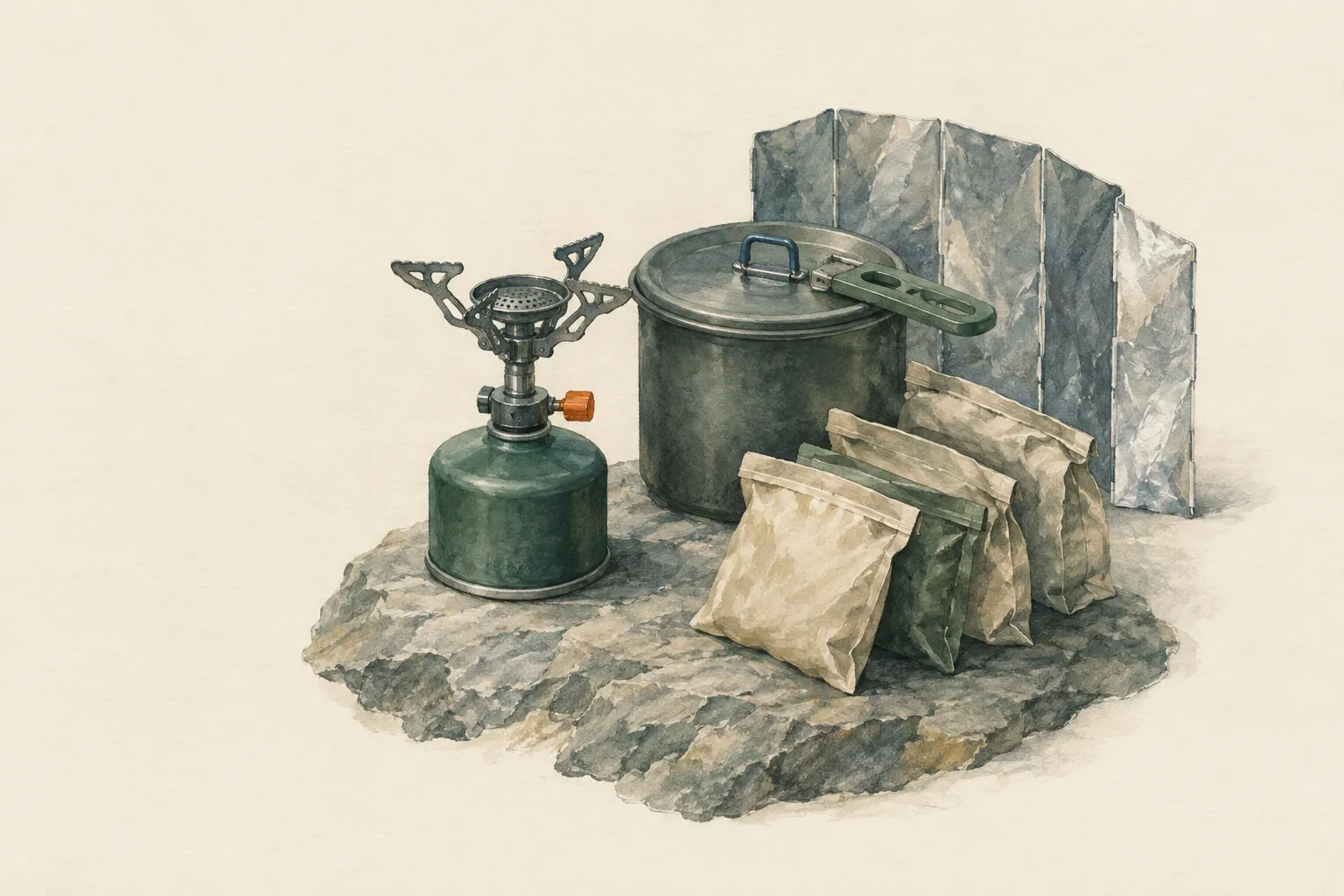
Explained simply
Cooking outdoors is fun, but it is different from the kitchen at home. There is wind that blows out the flame, little water, no fridge and sometimes curious animals. With a few tricks it still works wonderfully.
The best trick starts at home: for every meal you pack its own bag and write on it what is inside and how much water it needs. Outdoors you always cook in the open air, never in the tent – a poisonous gas could build up there or the tent could catch fire. A lid on the pot saves fuel, and a small flame with stirring stops things burning.
After the meal you clean up: scrape out the pot, wash up with little water, far away from the stream, and pack all the leftovers back in. At night all the food goes away from the tent so that a fox, a mouse or even a bear does not come to visit.
How it works
Outdoors three things are scarce: fuel, water and time. Almost every trick saves one of them. A lid keeps the steam and with it the heat in the pot instead of sending it into the air. A windscreen stops the wind blowing the flame away from the pot. Small pieces and soaked ingredients cook faster and need less fuel.
Burning is especially annoying outdoors because washing water is scarce. It happens when more heat reaches the bottom of the pot than the contents can spread – especially with thick dishes such as porridge, risotto or Schmarrn. A small flame, regular stirring right to the bottom and, if needed, a splash of water help more than any expensive pot.
At a campfire you do not control the heat with a knob but with embers and distance. More embers under the pot means more heat; further away or hung higher means less. With a keyhole fire site the fire burns on one side and constantly supplies new embers for the cooking side.
What really matters
Good planning makes cooking outdoors easy. One-pot dishes save dishes, water and fuel. Every meal goes into a labelled bag with day, amount of water, cooking time and allergens. A spare bag for an extra day gives security in case the trip takes longer.
Before lighting, everything is laid out: pot, food, water, spoon, grip. That way you never have to walk away from the burning stove or reach over it. A level, firm spot sheltered from the wind, a little away from the tent and not on dry grass, is half the safety.
Cleanliness prevents stomach aches: wash hands with water and soap, keep raw and ready food apart and only cook as much as will be eaten. The WHO sums this up in five keys: keep clean, separate raw and cooked, cook thoroughly, keep food at safe temperatures and use safe water.
Safety: what to watch out for
The most important rule: never cook in a tent, vestibule or any other enclosed space. Stoves produce carbon monoxide – a gas you can neither see nor smell, which can cause unconsciousness and kill. On top of that comes the fire risk, because tent fabric burns quickly. With headache, dizziness or nausea while cooking, get into fresh air at once and call 112, in Austria also 144.
A windscreen must never enclose a gas canister on which the stove sits directly. Otherwise heat builds up and the canister can overheat. Always leave a gap and follow the manufacturer's instructions. Canisters are only changed outdoors and away from flames.
Hot pots tip over easily on soft or sloping ground. Fill them no more than two thirds, only touch them with the grip and support them with your second hand. Children stay outside a cooking circle. With a scald, cool it at once with cool running water.
Leaving no trace and keeping animals away
Washing up is easier if you scrape out the pot right after eating and pour in a splash of hot water. Wash up about 60 m away from streams and lakes, as Leave No Trace recommends. Pour the dishwater through a sieve or cloth, put the scraps in the rubbish bag and scatter the water widely. Even biodegradable soap does not belong in the water.
Animals smell food from far away. At night, food, food scraps, rubbish and toothpaste go away from the tent – into an animal-proof container or as required locally. In bear country there are often special rules, such as mandatory bear containers. The US National Park Service explains that animals used to human food can become dangerous to people.
At a campfire the familiar rules apply: fire only where it is allowed and there is no wildfire danger, use existing fire sites, keep water ready and put everything out completely at the end.
Step by step
Plan at home and pack each meal ready
Plan simple one-pot meals: pasta, couscous, rice or lentils with sauce, vegetables and cheese or sausage. Put each meal in its own bag and label it: day, meal, how much water, cooking time and allergens. Pack one spare bag for an extra day. That way you do not have to weigh anything outdoors and you forget nothing.
- 1
Plan at home and pack each meal ready
Plan simple one-pot meals: pasta, couscous, rice or lentils with sauce, vegetables and cheese or sausage. Put each meal in its own bag and label it: day, meal, how much water, cooking time and allergens. Pack one spare bag for an extra day. That way you do not have to weigh anything outdoors and you forget nothing.
- 2
Set up a safe cooking spot – never in the tent
Find a level, firm spot outdoors, sheltered from the wind behind rocks, terrain or rucksacks and at a distance from the tent. Never put the stove on dry grass, leaves or needle litter. Lay everything out within reach before you light it: pot, food, water, spoon, grip. Never cook in the tent or vestibule – carbon monoxide and fire.
No stove in the tent or vestibule.
- 3
Use the windscreen correctly and keep the lid on
Wind blows the heat past the pot and costs a lot of fuel. Put a windscreen around flame and pot – with a little distance from the pot and a gap. If the stove sits directly on the gas canister, the canister must never be enclosed: it can overheat. Keep the lid on whenever something is cooking.
Never enclose the gas canister.
- 4
Cut small, soak ahead, stir, low flame
Small pieces cook faster than large ones. You can soak lentils, oats, couscous or dried vegetables in cold water already at the lunch break. Bring the food briefly to the boil, then turn the flame down and stir regularly right to the bottom of the pot. If a dish is as thick as porridge, add a splash of water rather than turning the flame up.
- 5
Handle hot pots safely
Only touch hot pots with the pot grip and support them with your second hand and a cloth. Fill the pot no more than two thirds. To pour off, tip the pot away from your body and kneel or crouch so nothing runs onto your legs. Children stay outside a cooking circle that everyone knows.
Never step over a burning stove.
- 6
Work cleanly
Wash your hands with water and soap before cooking and after the toilet, raw meat or raw eggs. Keep raw and ready food apart and use a separate board or knife for raw food, or wash them in between. Only cook as much as will be eaten – do not leave leftovers standing warm. With allergies, cook the allergen-free food first in clean cookware.
- 7
Control the heat at the campfire
At a fire you cook over embers, not in high flames. The simplest way: the fire burns on one side and embers for cooking lie on the other (keyhole fire site). You control the heat with the amount of embers and the distance – hang the pot higher or lower on a tripod, pull the pan to the side. Always set or hang pot and pan stably.
Tie long hair back, no loose synthetic sleeves over the fire.
- 8
Clean up with little water, protect food from animals
Scrape the pot right after eating and pour in a splash of hot water – dried-on food is much harder to wash off. Wash up about 60 m away from water, pour the dishwater through a sieve or cloth, put the scraps in the rubbish bag and scatter the water widely. At night, food, scraps, rubbish and toothpaste go away from the tent into an animal-proof container or as required locally.
Common mistakes
- Cooking in the tent or vestibule
- Enclosing the gas canister with the windscreen
- Cooking without a lid and wasting fuel
- A big flame instead of stirring – burnt pot
- Filling the pot to the brim and touching it with a bare hand
- Leaving leftovers standing warm
- Washing up in the stream
- Keeping food and rubbish in the tent at night
Quick view
Materials
Resealable food bags
One bag per meal
Use only bags intended for food; do not use with boiling water unless the manufacturer explicitly allows it.
Labels and permanent marker
Stove
Never operate inside a tent, shelter or enclosed room – carbon monoxide and fire risk.
Stove fuel (canister, liquid fuel, alcohol)
With some reserve
Store fuels apart from food and in original containers or bottles intended for them.
Store cool, well ventilated and out of children's reach.
Metal pot (stainless steel, aluminium, titanium)
With a lid
Hot – scalding risk.
Pot grip (pot lifter)
Check that the grip is seated firmly before lifting; secure heavy, full pots with both hands and a cloth.
Stove windscreen
With stoves that sit directly on top of the gas canister, never enclose the canister – it can overheat. Follow the manufacturer's instructions.
Spatula (wood or heat-resistant plastic)
Wooden spoon or turner for stirring
Metal turners scratch coated pans.
Thin plastic melts on a hot pan rim.
Soap / detergent
For hands and dishes, use sparingly
Rinse drinking-water containers thoroughly after cleaning.
Food-grade water bag
Carries water for kitchen and dishes to the cooking spot
Use only for drinking water, never for chemicals or fuel.
Rubbish bag (resealable)
For food scraps and packaging
Wildlife-resistant food container
Where required, or where bears, foxes or rodents go for food
Where specific containers are required, use only approved models – check local rules.
Water for extinguishing (bucket, canister or pot)
When cooking over a fire
Have several litres ready before lighting.
Suitable for
- Multi-day hiking, cycling and canoe trips
- Campsites with family and groups
- Anyone who has to manage with little fuel and little water
- Cooking on a stove and at the campfire
Not suitable for
- Cooking in a tent, vestibule, car or snow cave without proven ventilation
- Fire during a fire ban or drought
- Areas with their own rules on bear-resistant containers if these are not followed
Prerequisites
- Able to use a stove safely
- Knowing whether fire is allowed at the place
- Knowing the local rules on storing food
Safety
- Pots of boiling water that tip over cause severe scalds. Only fill the pot half to two thirds, put the stove on firm, level ground, secure the pot with the grip and your second hand and keep children outside the cooking circle. With a burn, cool at once with cool running water; with large burns, burns to the face or in children call 112 (in Austria also 144).
- Eat cooked food straight away and do not leave it standing warm for hours: perishable food not more than 2 hours unrefrigerated, above 32 °C not more than 1 hour. Wash hands before cooking, keep raw and ready food apart. Ask about allergies in the group beforehand.
- Fire only where it is allowed and there is no wildfire danger – use existing fire sites, keep water ready to put it out and extinguish the fire completely at the end. Wash dishes and brush teeth about 60 m away from streams and lakes, take food scraps and rubbish back with you.
How it works
Outdoors, fuel, water and time are scarce, and wind, cold and uneven ground make cooking harder than at home. Almost every trick works on one of these: planning ahead saves time and weight; lids, windscreens and small pieces save fuel; low heat and stirring prevent burning and therefore washing up; and a safe kitchen routine prevents burns, carbon monoxide poisoning and visits from animals.
Advantages
- Saves fuel, water and weight
- Less burning and less washing up
- Fewer burns and no carbon monoxide danger in the tent
- Less trouble with animals at camp
Disadvantages
- Needs planning before the trip
- Cooking outdoors in rain and wind is uncomfortable
- Animal-proof containers are heavy
Deep knowledge
Background
Textbooks for climbers and hikers such as "Mountaineering: The Freedom of the Hills" describe the stove as one of the most important and at the same time most dangerous pieces of equipment: it needs a windscreen and a stable stand but must not be run inside a closed tent. The US Centers for Disease Control and Prevention (CDC) warn against using fuel-burning devices in enclosed spaces or tents because carbon monoxide builds up unnoticed.
The Leave No Trace principles ask you to pack out rubbish and food scraps, wash up at a distance from water and store food so that wildlife cannot get at it. The US National Park Service explains that animals used to human food can become dangerous to people. The WHO sums up safe food hygiene in five keys: keep clean, separate raw and cooked, cook thoroughly, keep food at safe temperatures and use safe water.
Variants
- Finish cooking in insulation
- Bring pasta, rice or lentils briefly to the boil, then take the closed pot off the stove and wrap it in a sleeping bag, a jacket or a cooking box. The food keeps cooking in its own heat and saves fuel. Eat it straight away afterwards. More on this in the entry on retained-heat cooking.
- Kitchen duty for children
- Children can find the right bag and read it out, measure water, cut vegetables with a child-friendly knife, set the table and dry the dishes. The stove, hot pots and the fire stay with the adults.
- In cold and snow
- Gas canisters lose power in the cold; keep them in the sleeping bag or jacket at night and insulate them from the snow with a base. When making water from snow always put a little liquid water in the pot first. The kitchen stays outdoors in winter too.
Common mistakes
- Cooking in the tent or vestibule
- Enclosing the gas canister with the windscreen
- Cooking without a lid and wasting fuel
- A big flame instead of stirring – burnt pot
- Filling the pot to the brim and touching it with a bare hand
- Leaving leftovers standing warm
- Washing up in the stream
- Keeping food and rubbish in the tent at night
Limits and risks
- No fuel or cooking-time figures for particular stoves – follow the manufacturer's instructions
- Rules on food storage differ from area to area; check locally
- Does not replace an introduction to your own stove
Material alternatives
Derived from material properties: a substitute must have all relevant properties. Observe the notes on the substitute.
- Resealable food bags
- Single-wall stainless steel bottle (Heat only single-wall bottles without paint/plastic; remove the lid before heating.), Double-wall insulated bottle (Never heat directly.), PET bottle (clear, max. 2 litres) (Do not heat or place in a fire.), Food-grade water container (Only use containers that never held chemicals or fuel.), Airtight food-grade storage container (Fill only when clean and completely dry; never use containers that previously held chemicals.), Collapsible water container or bag (Protect from sharp objects.), Food-grade water bag (Use only for drinking water, never for chemicals or fuel.), Fermentation jar or crock (Use only food-grade containers of glass, food-safe glazed stoneware or food-grade plastic – no metal containers for acidic food.)
- Stove fuel (canister, liquid fuel, alcohol)
- Dry firewood (Collect only where permitted.), Tinder (Carry in waterproof packaging.), Char cloth (charred cotton) (Store dry in a tin.), Finest-grade steel wool (Store separately from batteries – fire risk.), Fatwood (resin-rich wood) (Collect only dead wood where permitted.), Petroleum jelly cotton balls (Use only pure cotton.), Cooking oil or cooking fat (tallow, lard) (Never put out burning fat with water – cover it with a lid to smother it.), Tree resin (spruce, pine) (Resin is flammable and sticks to the skin when hot – melt it only slowly over low heat.), Birch bark (from dead, fallen wood) (Never peel from living trees.)
- Metal pot (stainless steel, aluminium, titanium)
- Single-wall stainless steel bottle (Heat only single-wall bottles without paint/plastic; remove the lid before heating.)
- Food-grade water bag
- Single-wall stainless steel bottle (Heat only single-wall bottles without paint/plastic; remove the lid before heating.), Double-wall insulated bottle (Never heat directly.), PET bottle (clear, max. 2 litres) (Do not heat or place in a fire.), Food-grade water container (Only use containers that never held chemicals or fuel.), Airtight food-grade storage container (Fill only when clean and completely dry; never use containers that previously held chemicals.), Collapsible water container or bag (Protect from sharp objects.), Fermentation jar or crock (Use only food-grade containers of glass, food-safe glazed stoneware or food-grade plastic – no metal containers for acidic food.), Resealable food bags (Use only bags intended for food; do not use with boiling water unless the manufacturer explicitly allows it.)
- Wildlife-resistant food container
- Single-wall stainless steel bottle (Heat only single-wall bottles without paint/plastic; remove the lid before heating.), Double-wall insulated bottle (Never heat directly.), PET bottle (clear, max. 2 litres) (Do not heat or place in a fire.), Food-grade water container (Only use containers that never held chemicals or fuel.), Used chemical or fuel container (Never for drinking water or food – residues cannot be reliably removed.), Galvanised bucket (Do not heat: the zinc coating can release harmful fumes when heated.), Waterproof case or bag, Airtight food-grade storage container (Fill only when clean and completely dry; never use containers that previously held chemicals.), Small metal tin with lid (Burn off coated or painted tins outdoors first.), Collapsible water container or bag (Protect from sharp objects.), Food-grade water bag (Use only for drinking water, never for chemicals or fuel.), Fermentation jar or crock (Use only food-grade containers of glass, food-safe glazed stoneware or food-grade plastic – no metal containers for acidic food.), Resealable food bags (Use only bags intended for food; do not use with boiling water unless the manufacturer explicitly allows it.)
Results come exclusively from structured entries. No improvised instructions are generated.
Sources (10)
- The Mountaineers Books (2017): Mountaineering: The Freedom of the Hills, 9th edition · Running stoves outdoors, windscreens, saving fuel, not overheating canisters
- Centers for Disease Control and Prevention: Carbon Monoxide Poisoning – Prevention guidance · No fuel-burning devices in enclosed spaces or tents; carbon monoxide is invisible and odourless
- World Health Organization (WHO) (2006): Five Keys to Safer Food Manual · Five keys: keep clean, separate raw and cooked, cook thoroughly, safe temperatures, safe water
- United States Department of Agriculture – Food Safety and Inspection Service (USDA FSIS): "Danger Zone" (40 °F – 140 °F) · Perishable food not left out more than 2 hours, above 32 °C (90 °F) not more than 1 hour; danger zone 4–60 °C (40–140 °F)
- Leave No Trace Center for Outdoor Ethics: The Seven Principles of Leave No Trace (Principle 5: Minimize Campfire Impacts) · Wash dishes about 60 m (200 ft) from water, scatter dishwater, pack out waste, store food securely from wildlife
- U.S. National Park Service: Bear Safety · Store food and rubbish securely from wildlife
- Ray Mears – Hodder & Stoughton (2002): Bushcraft · Cooking over embers, controlling heat by distance and amount of embers
- European Parliament and Council of the European Union (2011): Regulation (EU) No 1169/2011 on the provision of food information to consumers · Allergens that must be labelled, including cereals containing gluten, milk, eggs, tree nuts, mustard, celery
- European Resuscitation Council – Resuscitation (journal) (2021): European Resuscitation Council Guidelines 2021: First Aid · Cool burns at once with cool running water; call emergency services for severe burns
- Leave No Trace Center for Outdoor Ethics: The Seven Principles of Leave No Trace (Principle 5: Minimize Campfire Impacts) · Keep fires small, use existing fire sites, put fires out completely