























Pan pizza from tortillas and quesadilla
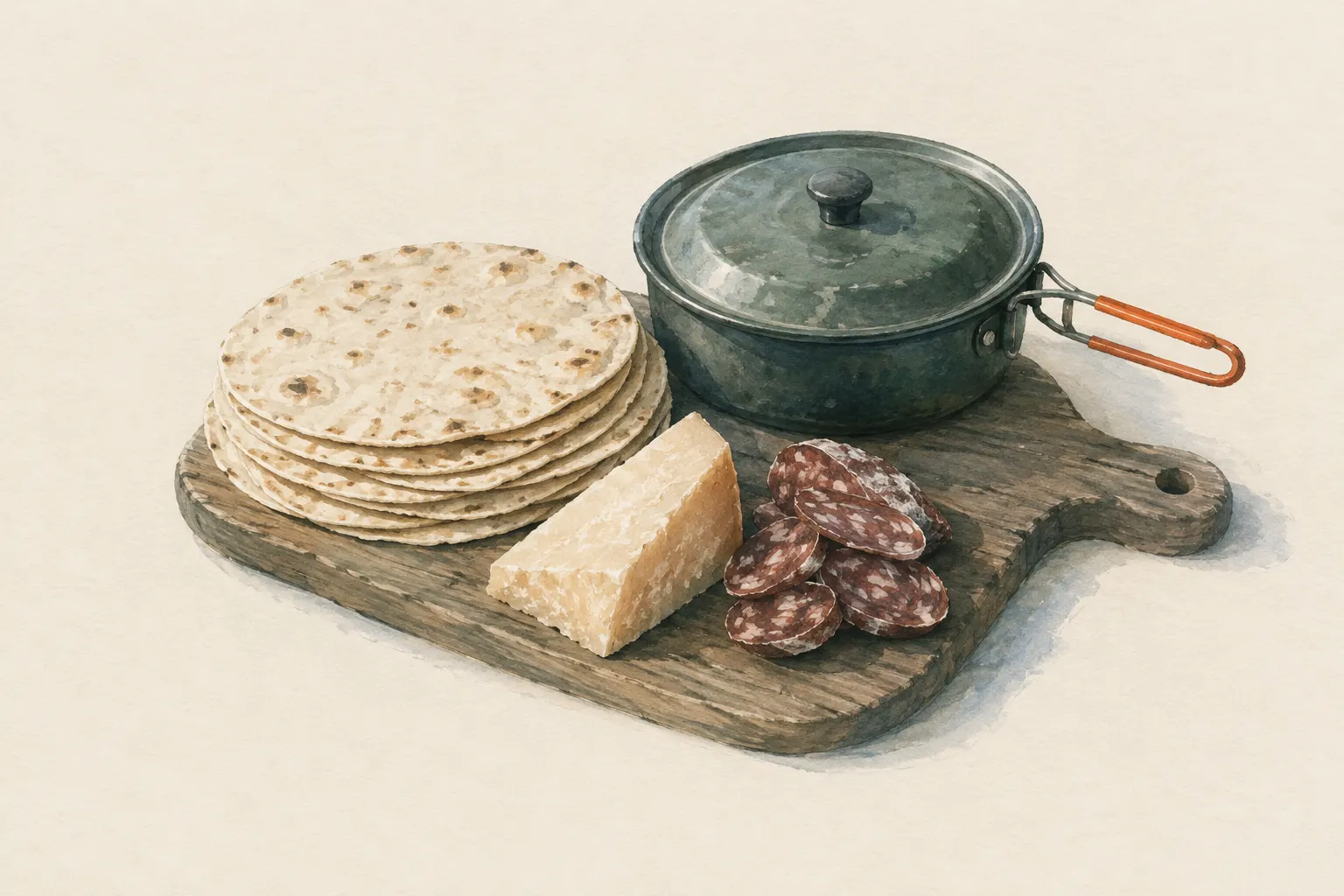
A wheat tortilla is toasted briefly in the pan, spread thinly with tomato paste, topped with hard cheese and sausage or vegetables and baked under the lid on low heat until the cheese melts. It works on a stove and over a flat bed of embers. Two tortillas on top of each other make a quesadilla. The trick: little topping, low heat, lid on – then nothing burns.
- Preparation 10 minutes; about 5–8 minutes in the pan per pizza
Explained simply
Pizza without an oven? You can do it! You take a thin flatbread, a tortilla, and put it in a pan. On top go a little tomato sauce, cheese and sausage or vegetables. Then you put a lid on the pan.
The lid is the magic trick. It holds the warm air in the pan, like a small oven. So the cheese melts on top while the base gets nice and crisp below. A small flame is important – with a big flame the base turns black before the cheese is soft.
When the cheese has melted, the pizza is ready. But careful: melted cheese is hotter than soup and sticks to your tongue. Wait a moment, blow on it – and then enjoy!
How it works
A tortilla is already baked. In the pan it only has to get warm and crisp – that is why pan pizza is so quick. The real job is melting the cheese without burning the base. From below the heat comes directly from the pan, from above only through the warm air.
Without a lid this warm air escapes at once. With a lid it builds up above the topping, and the cheese melts even over a small flame. So the rule is: low heat, lid on and patience. An upturned plate or a piece of aluminium foil will do in a pinch.
Thinly sliced topping in a single layer warms quickly. A thick heap of sausage and cheese, on the other hand, stays cold in the middle while the tortilla underneath is already burning. If you are very hungry, make two thin pizzas rather than one thick one.
What really matters
You can tell the right heat with your hand: hold it over the pan. If it becomes uncomfortably hot after a few seconds, it is right. On a stove this usually means: flame very low. At a campfire you set the pan on a stable grate or two flat stones over a flat bed of embers, never in the flames.
First toast the tortilla on one side for a minute, then turn it over. The toasted side goes up and gets the sauce – that keeps it crisp. The tomato sauce should be thick: stir tomato paste with just a splash of water and herbs. Sauce that is too wet makes the flatbread soggy.
After about two minutes lift the edge with the turner and take a look. If the underside is already dark, pull the pan off the heat for a moment. That is how you get to know your stove – each one heats differently, so all times are only guide values.
Safety: what to watch out for
Pan, handle and cheese get very hot. Only touch the handle with a pot grip or cloth, put the hot pan down with the handle turned inwards and never lift it over a child's head. With a burn, cool it at once with cool running water; with large burns, burns to the face or in children call 112, in Austria also 144.
Wheat tortillas contain gluten, cheese contains milk, and sausage often contains mustard, celery or milk. Ask about allergies in the group. For those affected, cook first in the clean pan and with a separate knife. Finished pizza is eaten straight away – food with cheese and sausage should not stand around warm for hours.
Cooking happens only outdoors, never in a tent or vestibule: stoves produce carbon monoxide, and tent fabric burns quickly. At a campfire the usual rules apply: only where it is allowed, water ready to put it out and everything fully extinguished at the end.
Good to know
Tortillas, tomato paste from a tube, hard cheese and air-dried sausage last several days without a fridge – that is why they are so popular on trips. But use up cut sausage and opened tubes soon, and in warm weather eat the cheese in the first days.
The same ingredients make a quesadilla: topping between two tortillas, or one tortilla topped on half and folded over. To turn it, slide it onto the lid, then lay the pan upside down over it and flip everything together. With children a small pizza bar is great fun: everyone tops their own, one adult bakes.
Step by step
Prepare the ingredients
Wash your hands. Cut cheese and sausage into thin slices or grate the cheese. For each person, stir 1 to 2 tablespoons of tomato paste with a splash of water and dried herbs into a spreadable sauce. Put everything within reach next to the stove before you light it.
- 1
Prepare the ingredients
Wash your hands. Cut cheese and sausage into thin slices or grate the cheese. For each person, stir 1 to 2 tablespoons of tomato paste with a splash of water and dried herbs into a spreadable sauce. Put everything within reach next to the stove before you light it.
- 2
Set up low heat
Put the stove on a flat, firm spot outdoors and turn the flame down low. At a fire, set the pan on a stable grate or two flat stones over a flat ember bed – not in the flames. Hold your hand over the pan: if it becomes uncomfortably hot after a few seconds, the heat is right.
Never cook in a tent or vestibule.
- 3
Toast the tortilla
Put a tortilla in the dry pan (wipe a steel pan with a few drops of fat first). Turn it after about a minute, when it firms up slightly and shows the first light spots. The toasted side now faces up – so it does not go soggy later.
- 4
Add a thin topping
Spread the tomato sauce thinly and leave a narrow edge free. Spread cheese and sausage or vegetables in a single layer. Less is more: a thick heap does not get warm in the middle, and dripping cheese burns onto the pan.
- 5
Lid on, be patient
Put the lid on and let the pizza bake on low heat for about 3 to 5 minutes. After 2 minutes, lift the edge with the turner: if the underside is already dark brown, take the pan off the heat for a moment or move it to the cooler side. If it smells burnt, take it off the heat at once.
- 6
Check and take out
The pizza is done when the cheese has fully melted and the base is golden brown and crisp. Slide it with the turner onto a plate, the lid or a clean board and cut it into quarters. Let it cool briefly – molten cheese sticks and burns lips and fingers.
- 7
Put the pan down safely, clean up
Put the hot pan down on a firm, non-flammable surface, handle turned inwards, away from paths and children. Turn the stove off or push the embers together. Wipe out the cooled pan with kitchen paper or a piece of tortilla and take the paper and food scraps back with you.
Common mistakes
- Too big a flame – base black, cheese still firm
- Baking without a lid
- Too much and too thick a topping
- Tomato sauce too wet – the tortilla goes soggy
- Putting the pan in the flames instead of over the embers
- Touching the hot handle without a grip
- Eating the pizza too hot
Quick view
Materials
Wheat tortillas (wraps)
2 tortillas per person
Contains gluten; for a gluten-free diet choose corn tortillas with suitable labelling.
Tomato paste (tube)
1–2 tbsp per person, stirred with a little water and dried herbs
Store opened tubes cool as stated on the pack or use them up quickly.
Hard cheese (e.g. mountain cheese)
About 40–60 g per person, thinly sliced or grated
Contains milk (allergen).
Keeps longer unrefrigerated than soft cheese, but not indefinitely – eat it early in the trip in warm weather.
Air-dried sausage or vegetables
About 30–50 g sausage in thin slices or a handful of vegetables per person
Use up cut sausage sooner.
Check the ingredients: sausage can contain mustard, celery or milk.
Butter, clarified butter or cooking oil
A few drops, only if the pan is not coated
Butter contains milk (allergen).
Never put out hot fat with water; overheated fat starts to smoke – reduce the heat at once.
Pan with a lid
With a fitting lid; an upturned plate or aluminium foil also works
Never heat coated pans strongly while empty and do not put them directly into flames or embers – the coating can be damaged.
Do not turn plastic or folding handles over the flame; they can get hot or melt.
Spatula (wood or heat-resistant plastic)
Metal turners scratch coated pans.
Thin plastic melts on a hot pan rim.
Pot grip (pot lifter)
Check that the grip is seated firmly before lifting; secure heavy, full pots with both hands and a cloth.
Stove
Or a flat ember bed with a stable grate
Never operate inside a tent, shelter or enclosed room – carbon monoxide and fire risk.
Knife (fixed or locking blade)
For cutting cheese, sausage and pizza
Cut away from your body.
Rules on carrying knives differ by region – check local rules.
Water for extinguishing (bucket, canister or pot)
When cooking over a fire
Have several litres ready before lighting.
Suitable for
- A quick dinner on trips and at the campsite
- Children who like to choose their own toppings
- Using up leftover cheese and sausage
- Cooking without an oven
Not suitable for
- High, flickering flames – it burns below while the cheese stays firm on top
- Raw meat or raw poultry as topping – it does not cook through safely on it
- Gluten-free diets with wheat tortillas
- A fire ban without a stove
Prerequisites
- A stove or a permitted fire site with embers
- A pan with a lid
- Clean hands and a clean knife
Safety
- Wheat tortillas contain gluten, cheese contains milk, sausage can contain mustard, celery or milk. With allergies in the group, bake the allergen-free pizza first in the clean pan and use separate knives.
- Eat the finished pizza straight away. Do not leave food with cheese and sausage standing warm for hours: perishable food should not be left out more than 2 hours, above 32 °C not more than 1 hour.
- Only use the stove outdoors and never inside a tent or vestibule (carbon monoxide, fire risk). Fire only where it is allowed and there is no wildfire danger – use existing fire sites, keep water ready to put it out and extinguish the fire completely at the end.
How it works
The tortilla is thin and already baked – it only has to get warm and crisp. The lid traps the rising heat above the topping, so the cheese melts from above while the heat from below only has to work gently. Over high heat the base is burnt before the cheese is soft; over low heat with a lid both happen at the same time. A little thinly sliced topping warms faster than thick chunks.
Advantages
- Ready in a few minutes
- Ingredients are light, keep well and are easy to carry
- Needs no oven
- Everyone can top their own pizza
Disadvantages
- Burns quickly over too much heat
- Only one pizza per pan at a time
- Contains several allergens
- Not suitable for embers with a coated pan
Deep knowledge
Background
Pan pizza is a classic of trail cooking because it is made from ingredients that last several days without refrigeration: baked tortillas, tomato paste from a tube, hard cheese and air-dried sausage. The quesadilla from Mexican cuisine is basically the same principle – two flatbreads, cheese in between, baked in the pan.
Outdoors the same hygiene rules apply as in the kitchen: clean hands, keep raw and ready food apart and do not leave food standing warm for long. The EU food information regulation lists cereals containing gluten, milk, mustard and celery among the allergens that must be stated on packaging.
Variants
- Quesadilla
- Topping on one tortilla, second tortilla on top, press down lightly. Bake under the lid on low heat until the cheese melts. To turn it, slide the quesadilla onto the lid, lay the pan upside down over it and flip both together. Or simply top half a tortilla and fold it over – that is easier to turn.
- Children's pizza bar
- The ingredients are ready in small bowls, each child tops their own tortilla on a board. One adult looks after pan and heat, the children stay outside the cooking circle and get their pizza cut and cooled.
- Vegetarian or dairy-free
- Instead of sausage, peppers, onions, corn from a pouch or dried tomatoes work well. Without cheese the pizza is still good with a little oil and herbs on the tomato sauce; check substitutes for allergens.
- Sweet tortilla
- Top a tortilla with a few pieces of chocolate and banana slices, fold it over and bake it under the lid on very low heat. Chocolate gets very hot quickly.
Common mistakes
- Too big a flame – base black, cheese still firm
- Baking without a lid
- Too much and too thick a topping
- Tomato sauce too wet – the tortilla goes soggy
- Putting the pan in the flames instead of over the embers
- Touching the hot handle without a grip
- Eating the pizza too hot
Limits and risks
- Quantities and times are guide values – stoves and pans heat very differently
- No information on how long particular cheeses or sausages keep without refrigeration – follow the pack
- At a fire only where it is allowed
Sources (7)
- World Health Organization (WHO) (2006): Five Keys to Safer Food Manual · Clean hands, keep raw and ready food apart, do not leave food standing warm for long
- United States Department of Agriculture – Food Safety and Inspection Service (USDA FSIS): "Danger Zone" (40 °F – 140 °F) · Perishable food not left out more than 2 hours, above 32 °C (90 °F) not more than 1 hour; danger zone 4–60 °C (40–140 °F)
- European Parliament and Council of the European Union (2011): Regulation (EU) No 1169/2011 on the provision of food information to consumers · Allergens that must be labelled, including cereals containing gluten, milk, eggs, tree nuts, mustard, celery
- The Mountaineers Books (2017): Mountaineering: The Freedom of the Hills, 9th edition · Running stoves outdoors and setting them up safely
- Centers for Disease Control and Prevention: Carbon Monoxide Poisoning – Prevention guidance · No fuel-burning devices in enclosed spaces or tents
- European Resuscitation Council – Resuscitation (journal) (2021): European Resuscitation Council Guidelines 2021: First Aid · Cool burns at once with cool running water; call emergency services for severe burns
- Leave No Trace Center for Outdoor Ethics: The Seven Principles of Leave No Trace (Principle 5: Minimize Campfire Impacts) · Keep fires small, use existing fire sites, put fires out completely