























Bread salad from stale bread
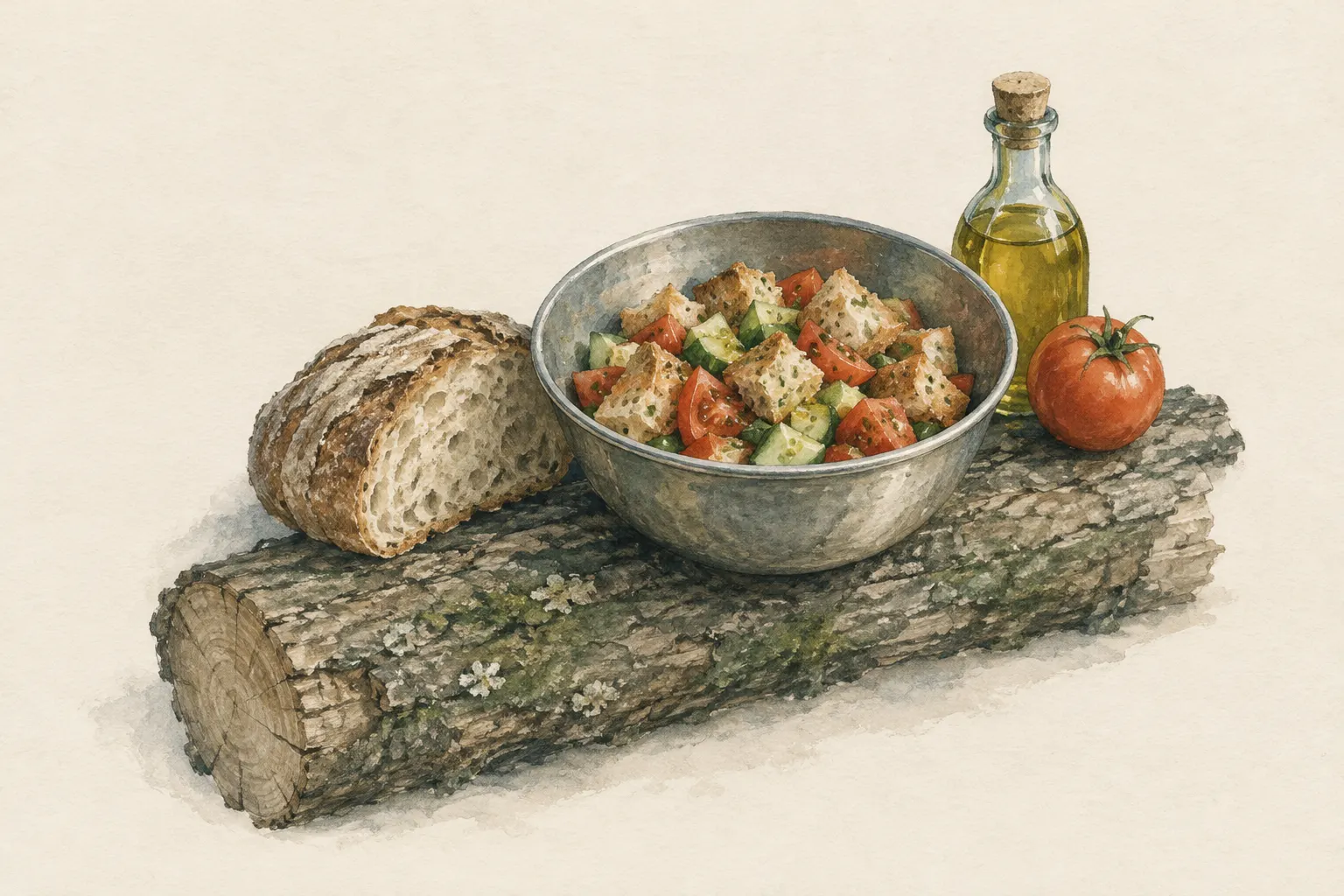
Stale, dry bread, tomatoes, cucumber, onion, olive oil, vinegar and salt make an Italian bread salad, panzanella. The bread soaks up tomato juice and dressing and turns juicy again – without any cooking. The vegetables are washed with water of drinking quality, mouldy bread does not go in, and the finished salad is eaten soon.
- Cutting 10 minutes; resting 10–15 minutes
Explained simply
Bread salad is a recipe that makes old, hard bread tasty again. In Italy it is called panzanella. You cut the bread into cubes and mix it with tomatoes, cucumber, a little onion, olive oil, vinegar and salt.
Then you wait about a quarter of an hour. During this time the bread soaks up the tomato juice and the oil like a sponge and turns soft and juicy again. You do not have to cook anything.
Two things are important: bread with mould is thrown away, even if only a small spot can be seen. And you wash the vegetables with clean drinking water, not in the stream. You eat the finished salad soon, before it goes off in the sun.
How it works
Fresh bread is soft because its starch has bound a lot of water. Over time the bread gives off water, the starch firms up and the bread turns hard. That is not the same as spoiled: old, dry bread is perfectly fine.
In the salad the bread gets liquid back. The salt draws juice out of the tomatoes, oil and vinegar are added. The dry bread soaks it all up like a sponge. After 10 to 15 minutes it is soft outside and still a little firm inside.
Fresh, soft bread works less well – it soaks up too quickly and turns mushy. Bread one to three days old with a firm crumb is ideal.
What really matters
Fresh vegetables are the tricky part of this recipe outdoors. Tomatoes and cucumbers keep for a day whole and undamaged without a fridge; cut open they spoil quickly. That is why you cut them only shortly before eating.
Onion can be too sharp for children. Cut very thin and left briefly in the dressing it gets milder – or simply leave it out. Dried herbs from a jar are a good seasoning; wild herbs from the wayside do not go in.
For a more filling meal, mix in a small tin of beans or chickpeas – and eat it all up straight away.
Safety: mould and water
Mould on bread is treacherous: what you see as a spot is only the visible part. The fine fungal threads can run far through the soft bread. Food authorities therefore advise throwing away mouldy bread completely, not just cutting off the spot.
Vegetables for raw food are not heated again. So the washing water itself must be clean. Water from streams and lakes can contain pathogens even if it looks clear. Use carried tap water or water that you have boiled or filtered and disinfected.
The finished salad belongs in the shade and is eaten soon. You do not keep leftovers for the next day. Washing up happens at least 60 metres from any water.
When it makes sense – and when it does not
Bread salad is perfect for warm summer days, short trips and the last evening when there is still bread left. It needs no stove and is therefore also possible during a fire ban.
On long trips the fresh vegetables are missing. Then sun-dried tomatoes, tinned beans and olives help. Without drinking water for washing, the vegetables are better left uncut in the bag.
Step by step
Check and cube the bread
Look at the bread from all sides. If you see green, white or black spots of mould, it goes in the bin. Good stale bread is cut into cubes about the size of a sugar lump or a little bigger.
- 1
Check and cube the bread
Look at the bread from all sides. If you see green, white or black spots of mould, it goes in the bin. Good stale bread is cut into cubes about the size of a sugar lump or a little bigger.
- 2
Wash hands and vegetables
Wash your hands. Then wash the tomatoes and cucumber with drinking water from the bottle or water bag – not in the stream. Rub them with your fingers while you do it.
No untreated stream or lake water for raw food.
- 3
Cut the vegetables
On the board, cut the tomato and cucumber into bite-sized pieces. Peel the onion and cut it into very thin strips. Children cut the soft things, an adult does the onion.
Hold with a claw grip – fingertips tucked in.
- 4
Mix the dressing
Put olive oil, vinegar and a good pinch of salt into a screw-top jar, close the lid and shake hard. Without a jar, stir everything together with a spoon directly at the bottom of the bowl.
- 5
Mix everything
Put the tomatoes, cucumber and onion into the bowl, pour the dressing over them and mix well. Then add the bread cubes. Mix carefully once more until every piece of bread has some juice.
- 6
Let it rest
Leave the salad in the shade for 10 to 15 minutes. During this time the bread soaks up the juice. Taste a piece: if it is still too hard, add a splash of water or a little more oil.
- 7
Eat soon and wash up
Eat the salad while it is fresh and do not keep leftovers for the next day. Wash the bowl at least 60 metres from any water with a little water and scatter the washing-up water widely. Take vegetable peel and onion skin with you.
Common mistakes
- Using mouldy bread or only cutting off the spot
- Washing vegetables in the stream
- Using bread that is too fresh and soft – it goes mushy
- Letting it rest too long – the bread falls apart
- Leaving the salad standing in the sun
- Keeping leftovers overnight
- Leaving onion skins behind
Quick view
Materials
Stale bread (1–3 days old, no mould)
About 100 g per person (2–3 slices), 1–3 days old
Throw away bread with mould completely – do not just cut off the spot.
Contains gluten; some bread also milk, sesame or soy.
Tomatoes, cucumber and onion (fresh)
Per person 1 large tomato, a quarter of a cucumber and a quarter of a red onion
Only for short trips: carry them whole and undamaged and only cut them just before eating.
Wash with water of drinking quality, never with stream or lake water.
Olive oil and vinegar
Per person 1–2 tablespoons of olive oil and 1 teaspoon of vinegar
Carry in small, leak-proof bottles.
Table salt
A good pinch; add pepper and dried herbs from a jar if you like
Salt improves keeping quality but does not replace heating through.
Food-grade water bag
Water of drinking quality for washing the vegetables
Use only for drinking water, never for chemicals or fuel.
Knife (fixed or locking blade)
Cut away from your body.
Rules on carrying knives differ by region – check local rules.
Bowl and small chopping board
Bowl or large pot and a board
Wash the board thoroughly after raw fish or meat before bread or vegetables go on it.
Airtight food-grade storage container
Screw-top jar or tin for shaking the dressing
Fill only when clean and completely dry; never use containers that previously held chemicals.
Suitable for
- Warm summer days when nobody wants to cook
- Using up bread left over from the last days
- Days with a fire ban
- Children as chopping helpers
Not suitable for
- Long trips without fresh vegetables
- Bread with mould
- Washing vegetables with untreated stream or lake water
- People with coeliac disease with ordinary bread
Prerequisites
- Drinking water or safely treated water for washing
- Fresh, undamaged vegetables for the same or the next day
- Bread without mould
Safety
- Only wash vegetables that are eaten raw with water of drinking quality – untreated stream or lake water can contain pathogens that would end up uncooked in the salad. Outdoors use boiled, filtered and disinfected, or carried tap water.
- Cut vegetables and the finished salad spoil quickly in warmth. Eat it soon and do not leave it standing in the sun for hours; do not keep leftovers for the next day. The knife is sharp: children only cut with an adult beside them.
- Bread contains gluten, some bread also milk, sesame or soy – check the ingredients. If you toast bread cubes in a pan, you need a stove: Never use a stove, pot or embers inside a tent, porch or vestibule: there is a risk of carbon monoxide poisoning, which you can neither smell nor see, and the tent can be in flames within seconds. Cooking happens outdoors, on level ground, at a distance from the tent.
How it works
Stale bread has lost water and become firm, but it has not gone bad. Like a sponge it soaks liquid back up: the juice of the tomatoes, the oil and the vinegar. The salt also draws extra juice out of the tomatoes. After a quarter of an hour the bread is soft outside and still a little firm inside. The vinegar adds freshness and flavour.
Advantages
- No stove and no fire needed
- Uses up stale bread instead of throwing it away
- Fresh and light on hot days
- Few, cheap ingredients
Disadvantages
- Needs fresh vegetables – only for short trips
- Needs drinking water for washing
- Must be eaten soon
- Little protein without beans or cheese
Deep knowledge
Background
Panzanella comes from Tuscany and is a classic leftovers dish: farmers made a filling summer meal from hard bread, tomatoes, onions, oil and vinegar. Similar bread salads exist all around the Mediterranean, such as fattoush in Lebanon.
For mould on bread, food authorities advise throwing away the whole loaf, because the fungal threads spread invisibly in soft foods. And for everything eaten raw, the WHO principle “use safe water and raw materials” applies.
Variants
- Kids variant
- Without onion or with very little, but with more cucumber. Cut the bread into small cubes and let it rest only briefly so it is still a little crunchy. Children may cut soft tomatoes and cucumbers themselves with a child's knife.
- Vegan – and more protein
- Panzanella is already vegan if the bread is baked without milk. For a proper meal, drain a small tin of chickpeas or white beans and mix them in – eat the opened tin up completely straight away.
- With toasted bread cubes
- Toast the bread cubes with a spoonful of oil in the pan on the stove over medium heat until golden brown, let them cool briefly, then mix them in. This keeps the salad crunchier. Stove only outdoors, turn the pan handle inwards.
- For longer trips without fresh vegetables
- Instead of fresh tomatoes and cucumber, use sun-dried tomatoes (soaked briefly in drinking water), a small tin of beans and a few olives. Then the salad is possible on the third day too.
Common mistakes
- Using mouldy bread or only cutting off the spot
- Washing vegetables in the stream
- Using bread that is too fresh and soft – it goes mushy
- Letting it rest too long – the bread falls apart
- Leaving the salad standing in the sun
- Keeping leftovers overnight
- Leaving onion skins behind
Limits and risks
- Times are kitchen guide values
- No shelf-life figures for fresh vegetables without cooling – only “short trips”
- Water treatment is described in separate entries
Material alternatives
Derived from material properties: a substitute must have all relevant properties. Observe the notes on the substitute.
- Food-grade water bag
- Single-wall stainless steel bottle (Heat only single-wall bottles without paint/plastic; remove the lid before heating.), Double-wall insulated bottle (Never heat directly.), PET bottle (clear, max. 2 litres) (Do not heat or place in a fire.), Food-grade water container (Only use containers that never held chemicals or fuel.), Airtight food-grade storage container (Fill only when clean and completely dry; never use containers that previously held chemicals.), Collapsible water container or bag (Protect from sharp objects.), Fermentation jar or crock (Use only food-grade containers of glass, food-safe glazed stoneware or food-grade plastic – no metal containers for acidic food.), Resealable food bags (Use only bags intended for food; do not use with boiling water unless the manufacturer explicitly allows it.)
- Airtight food-grade storage container
- Single-wall stainless steel bottle (Heat only single-wall bottles without paint/plastic; remove the lid before heating.), Double-wall insulated bottle (Never heat directly.), PET bottle (clear, max. 2 litres) (Do not heat or place in a fire.), Food-grade water container (Only use containers that never held chemicals or fuel.), Collapsible water container or bag (Protect from sharp objects.), Food-grade water bag (Use only for drinking water, never for chemicals or fuel.), Fermentation jar or crock (Use only food-grade containers of glass, food-safe glazed stoneware or food-grade plastic – no metal containers for acidic food.), Resealable food bags (Use only bags intended for food; do not use with boiling water unless the manufacturer explicitly allows it.)
Results come exclusively from structured entries. No improvised instructions are generated.
Sources (5)
- U.S. Department of Agriculture, Food Safety and Inspection Service (USDA FSIS): Molds on Food: Are They Dangerous? · Throw away bread and soft foods with mould, as mould spreads invisibly
- World Health Organization (WHO) (2006): Five Keys to Safer Food Manual · Use safe water and raw materials, wash fruit and vegetables; perishable food not long at room temperature
- World Health Organization (2022): Guidelines for drinking-water quality, fourth edition incorporating the first and second addenda · Drinking-water quality and pathogens in untreated surface water
- Leave No Trace Center for Outdoor Ethics: The Seven Principles of Leave No Trace (Principle 5: Minimize Campfire Impacts) · Wash up away from water, scatter washing water, pack out scraps
- European Parliament and Council of the European Union (2011): Regulation (EU) No 1169/2011 on the provision of food information to consumers · The 14 major allergens that must be labelled, including cereals containing gluten, peanuts, tree nuts, milk, egg, soy, sesame, fish, celery, mustard, sulphites