























French toast from stale bread
Hard bread becomes a sweet breakfast: dip slices briefly in egg-milk, fry them golden brown in a little fat over a medium to low flame and sprinkle with cinnamon sugar. You mix the milk from powder; the egg can be fresh (short trip) or from egg powder. What matters: the bread must be hot inside with no wet egg-milk left.
- Preparation 5 minutes; frying 5–8 minutes per panful
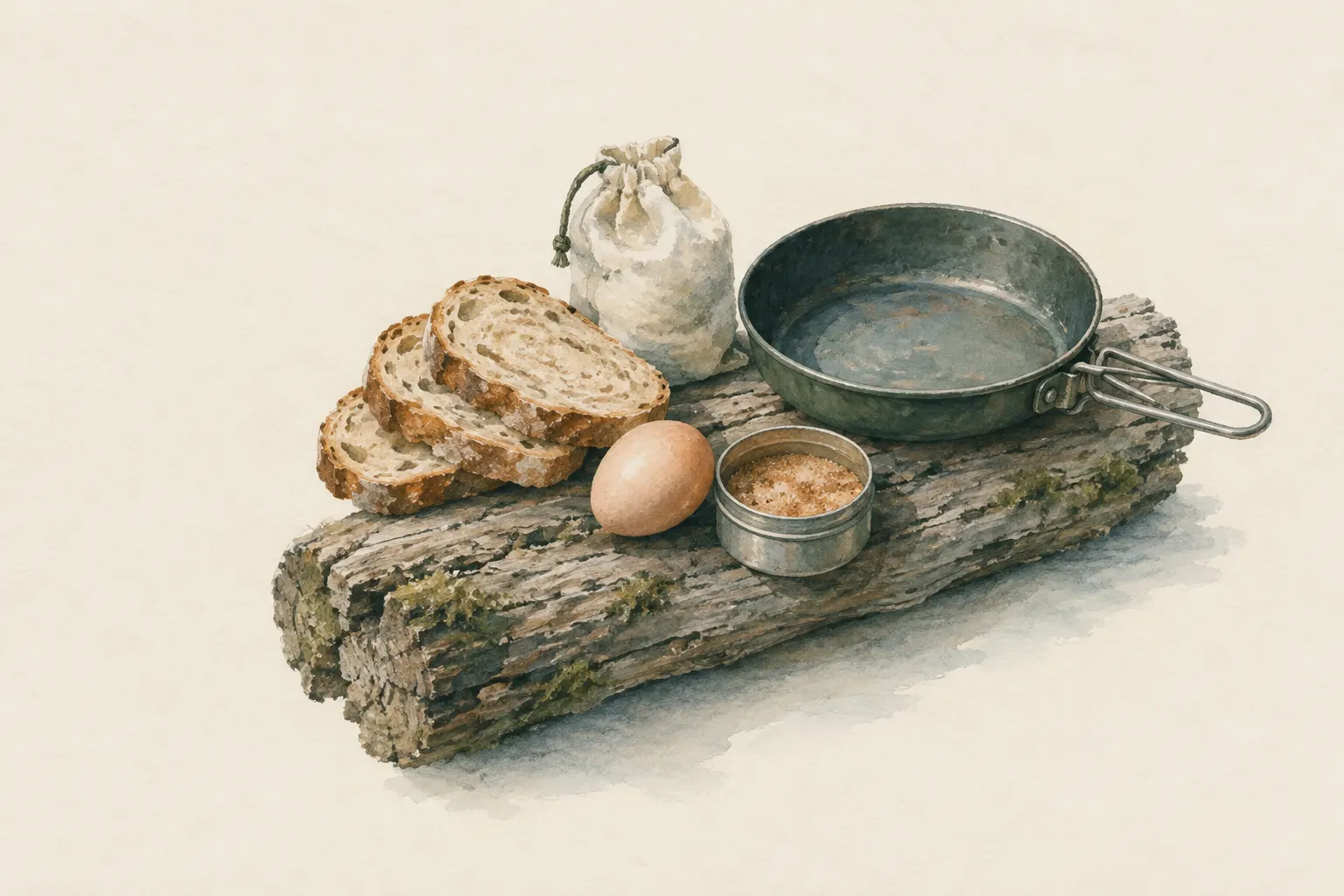
Explained simply
After a few days outdoors, bread turns hard. You do not have to throw it away: it becomes French toast! You dip the hard bread into a mixture of milk and egg. The bread soaks it up like a sponge and becomes soft again.
Then you fry the slices in the pan with a little oil until they are golden brown on both sides. Finally you sprinkle cinnamon and sugar over them. It tastes almost like cake.
Very important: the egg-milk is raw. The bread is only ready when it is hot inside and no wet egg-milk runs out. And hot fat can spit – so an adult does the frying and you sprinkle the sugar.
How it works
Fresh bread is soft and full of moisture. As it ages it loses water, and the starch in it firms up again – the bread turns hard. That is exactly why it works so well: its dry pores soak up egg-milk without the slice turning mushy at once.
In the pan, the egg inside the bread sets and holds everything together. On the outside, protein and sugar brown in the heat into a golden crust that tastes of roasting. Inside it stays soft like a pudding – but only if the heat gets through to the middle.
What really matters
Always stir milk powder into a paste with a little cold water first and then add the rest – that way there are no lumps. Per person, about 100 millilitres of milk, one egg and two slices of bread are enough.
When dipping, count slowly to three per side. Very hard bread may soak a little longer. Soaked too long, the slice falls apart when you turn it. Set the flame to medium or low: with too much heat the bread turns black outside while there is still wet egg-milk inside.
Sprinkle the sugar on only at the end. In the pan it would burn quickly, stick and turn bitter.
Safety: what to watch out for
The egg-milk is raw. Do not drink leftover egg-milk; fry it along or pour it over the last slice. The bread is done when nothing runny comes out when you press on it.
Fat is the most dangerous part of frying. It spits, and if it gets too hot it can catch fire. Always stay at the pan, lay the slices in away from your body and keep a lid ready. Smother burning fat with the lid – water would make the burning fat spray out explosively.
The stove stays outside, never in the tent or vestibule. And French toast contains several allergens at once: gluten from the bread, egg and milk. With burns, cool at once with cool running water.
When it makes sense – and when it does not
French toast is ideal on the second or third day, when the bread is hard. With egg powder and milk powder you need nothing chilled. As breakfast, dessert or a sweet supper it is very popular with children.
Without a pan it hardly works. In a storm, when the stove does not burn steadily, or when someone cannot eat egg, milk and gluten, choose something else – or the vegan variant with gluten-free bread.
Step by step
Set up a safe cooking spot
Set the stove up outdoors on firm, level ground, at least a few steps away from the tent, and shield it from the wind with a backpack or stones. Lay out all ingredients, spoons and the pot grip within reach before you light it. Children get a fixed seat at a distance.
Caution: Never cook in the tent or vestibule – carbon monoxide and fire danger.
- 1
Set up a safe cooking spot
Set the stove up outdoors on firm, level ground, at least a few steps away from the tent, and shield it from the wind with a backpack or stones. Lay out all ingredients, spoons and the pot grip within reach before you light it. Children get a fixed seat at a distance.
Never cook in the tent or vestibule – carbon monoxide and fire danger.
- 2
Mix the milk
Wash your hands. Put the milk powder into the mug, pour in a little clean, cold water first and stir it into a smooth paste. Then stir in the rest of the water until you have about 100 millilitres of milk per person and no lumps float about.
- 3
Whisk the egg-milk
Crack the egg into the milk – or stir in the egg powder – and add a small pinch of salt. Whisk everything with a fork and pour it into a flat dish, for example a pot lid or a lunch box. Then wash your hands.
- 4
Dip the bread briefly
Lay a slice of bread in the egg-milk, count slowly to three, turn it over and count to three again. Very hard bread may soak a little longer. The slice should soak up the liquid but not fall apart.
- 5
Heat fat in the pan
Light the stove, set a medium to low flame and put one to two teaspoons of fat into the pan. It is hot enough when a drop of egg-milk sizzles quietly.
The fat must not smoke. Never leave the pan alone.
- 6
Fry until golden
Lay the slices carefully in the pan with the spatula – away from your body so splashes do not reach you. Fry each side for about two to three minutes until golden brown. Then turn carefully.
- 7
Check: hot and set inside
Press the middle of the slice with the spatula: no runny egg-milk may come out. If in doubt, cut a slice open. If it is still wet inside, turn the flame lower and fry it a little longer. Then turn the stove off.
- 8
Cinnamon sugar and enjoy
Put the slices on a plate and sprinkle cinnamon and sugar over them. Let them cool for a minute – melted sugar is hotter than it looks. Eat them warm straight away and wipe the pan out with paper afterwards.
Common mistakes
- Soaking the bread too long – it falls apart in the pan
- Too high a flame – black outside, wet inside
- Putting sugar in the pan – it burns and sticks
- Drinking leftover raw egg-milk
- Pouring water onto burning fat
- Tipping milk powder into hot water – it clumps
- Touching the pan handle without a pot grip
Quick view
Materials
Bread (day-old is fine)
2 slices per person, ideally day-old or already a little hard
Throw mouldy bread away entirely, do not just cut away the spot.
Allergen: cereals containing gluten; depending on the type also soy, sesame, milk.
Fresh eggs (short trips only)
1 egg per person – only on short trips and kept cool
Raw eggs can carry salmonella – only use clean eggs without cracks and always cook them right through.
Carry them cool (cool bag, shade) and use them on the first day; for longer trips take whole-egg powder.
Allergen: egg. Wash your hands after cracking eggs.
Whole-egg powder
Instead of fresh egg: the amount for 1 egg per person as the packet says
Mix with clean water as the packet says and cook right through like fresh egg.
Store dry and airtight; do not leave mixed egg powder standing.
Allergen: egg.
Milk powder (whole milk powder)
About 100 ml of milk per person: mix the powder with clean water as the packet says
Only mix with clean water (drinking water or treated).
Use mixed milk promptly, do not leave it standing in the warmth.
Allergen: milk (also lactose).
Sugar and cinnamon
1 teaspoon of sugar and a pinch of cinnamon per person
Keep dry in a tight tin or bag – damp sugar clumps.
Cooking oil or clarified butter
1–2 teaspoons per person
Overheated fat can catch fire – never leave it alone, never put water on burning fat, put a lid on instead.
Carry it in a tight, leak-proof bottle inside a bag.
Table salt
A small pinch in the egg-milk
Salt improves keeping quality but does not replace heating through.
Light camping frying pan
The handle gets hot – use a pot grip or glove.
Light pans have hot spots over the flame: low flame, turn the pan often.
Spatula and cooking spoon
Do not leave a plastic spatula on the hot rim of the pan – it melts.
Mug with a handle
For mixing the milk
Metal mugs get very hot at the rim – careful with your lips, only fill them half full.
Stove
Never operate inside a tent, shelter or enclosed room – carbon monoxide and fire risk.
Stove fuel (canister, liquid fuel, alcohol)
Store fuels apart from food and in original containers or bottles intended for them.
Store cool, well ventilated and out of children's reach.
Soap / detergent
Rinse drinking-water containers thoroughly after cleaning.
Suitable for
- Breakfast or dessert at the campsite
- Using up bread from the day before
- Cooking with children under supervision
- Short trips and, with egg powder, longer ones
Not suitable for
- Mouldy bread
- People with egg, milk or gluten allergy (without adapting it)
- Cooking in the tent or vestibule
- Fresh eggs without cooling over several days
Prerequisites
- Able to use a stove safely
- A safe cooking spot outdoors
- Clean water for milk powder and for washing hands
- A flat dish for dipping (lid, plate, lunch box)
Safety
- The egg-milk is raw. Only eat the bread when it is golden brown outside and hot inside with no wet, runny spots. Do not drink or keep leftover egg-milk, but pour it into the pan too and fry it through.
- Allergens: cereals containing gluten (bread), egg and milk; some breads contain soy, sesame or nuts. Ask in the group beforehand.
- Eat cooked food hot straight away and do not leave it lukewarm for hours – germs multiply quickly in warm food. Without refrigeration, do not keep leftovers for later.
How it works
Stale bread is dry and soaks up liquid well without falling apart at once. The egg-milk is drawn into the pores; during frying the egg sets inside and holds the slice together, while on the outside sugar and protein brown into a crisp crust. Medium to low heat matters so the warmth reaches the middle before the outside burns.
Advantages
- Uses up hard bread instead of throwing it away
- Sweet, warm and popular with children
- The ingredients are light and keep a long time with egg powder
- Only one pan needed
Disadvantages
- Frying with fat needs attention
- Many allergens in one dish
- Light pans only fit a few slices at a time
- The pan gets greasy
Deep knowledge
Background
French toast exists in many countries – as “pain perdu” (lost bread), “arme Ritter” (poor knights) or “Pofesen”. The idea is the same everywhere: stale bread becomes soft and tasty again with egg and milk. That suits trips on which bread turns hard after a day or two.
For safety, the rules for egg dishes apply: the USDA gives 160 °F (71 °C) for egg dishes, and the WHO advises cooking food thoroughly and not leaving it unrefrigerated. When frying with fat, the most important fire safety rule is: smother burning fat with a lid, never water.
Variants
- Kids' version: bread strips for dipping
- Cut the bread into finger-thick strips beforehand. Children dip them in the egg-milk themselves and put them in a bowl; an adult fries them. The finished strips are rolled in cinnamon sugar – once they have cooled.
- Vegan version
- Instead of egg-milk, stir two tablespoons of flour smooth with about 100 millilitres of oat drink or water, a pinch of salt and cinnamon. Dip the bread briefly and fry it in oil. It sets a little less firmly but tastes just as sweet. Oat drink can contain gluten.
- Savoury with cheese
- Leave out the sugar, season the egg-milk with salt and pepper and lay a slice of long-life cheese on the bread after turning. Lid on until the cheese melts. Allergen: milk.
Common mistakes
- Soaking the bread too long – it falls apart in the pan
- Too high a flame – black outside, wet inside
- Putting sugar in the pan – it burns and sticks
- Drinking leftover raw egg-milk
- Pouring water onto burning fat
- Tipping milk powder into hot water – it clumps
- Touching the pan handle without a pot grip
Limits and risks
- Frying times are guidelines and depend on pan, flame and bread thickness
- Without a thermometer the rule is: hot inside, no wet egg-milk
- Gluten-free bread falls apart more easily – dip it more briefly
Material alternatives
Derived from material properties: a substitute must have all relevant properties. Observe the notes on the substitute.
- Stove fuel (canister, liquid fuel, alcohol)
- Dry firewood (Collect only where permitted.), Tinder (Carry in waterproof packaging.), Char cloth (charred cotton) (Store dry in a tin.), Finest-grade steel wool (Store separately from batteries – fire risk.), Fatwood (resin-rich wood) (Collect only dead wood where permitted.), Petroleum jelly cotton balls (Use only pure cotton.), Cooking oil or cooking fat (tallow, lard) (Never put out burning fat with water – cover it with a lid to smother it.), Tree resin (spruce, pine) (Resin is flammable and sticks to the skin when hot – melt it only slowly over low heat.), Birch bark (from dead, fallen wood) (Never peel from living trees.)
Results come exclusively from structured entries. No improvised instructions are generated.
Sources (7)
- United States Department of Agriculture – Food Safety and Inspection Service (USDA FSIS): Safe Minimum Internal Temperature Chart · Cook egg dishes to 160 °F (71 °C)
- United States Department of Agriculture – Food Safety and Inspection Service (USDA FSIS): Shell Eggs from Farm to Table · Keep eggs refrigerated and cook egg dishes completely
- World Health Organization (WHO) (2006): Five Keys to Safer Food Manual · Cook thoroughly, do not leave food unrefrigerated, safe water
- National Fire Protection Association (NFPA): Cooking safety tips (including what to do with a grease fire) · Stay with the pan while frying; smother burning fat with a lid, never use water
- Centers for Disease Control and Prevention: Carbon Monoxide Poisoning – Prevention guidance · Never run fuel-burning appliances in enclosed spaces such as tents – carbon monoxide is invisible and odourless
- European Parliament and Council of the European Union (2011): Regulation (EU) No 1169/2011 on the provision of food information to consumers · List of major allergens that must be labelled (incl. cereals containing gluten, milk, eggs, nuts, soy, celery)
- European Resuscitation Council – Resuscitation (journal) (2021): European Resuscitation Council Guidelines 2021: First Aid · Cool burns and scalds at once with cool running water; call emergency services for severe burns