























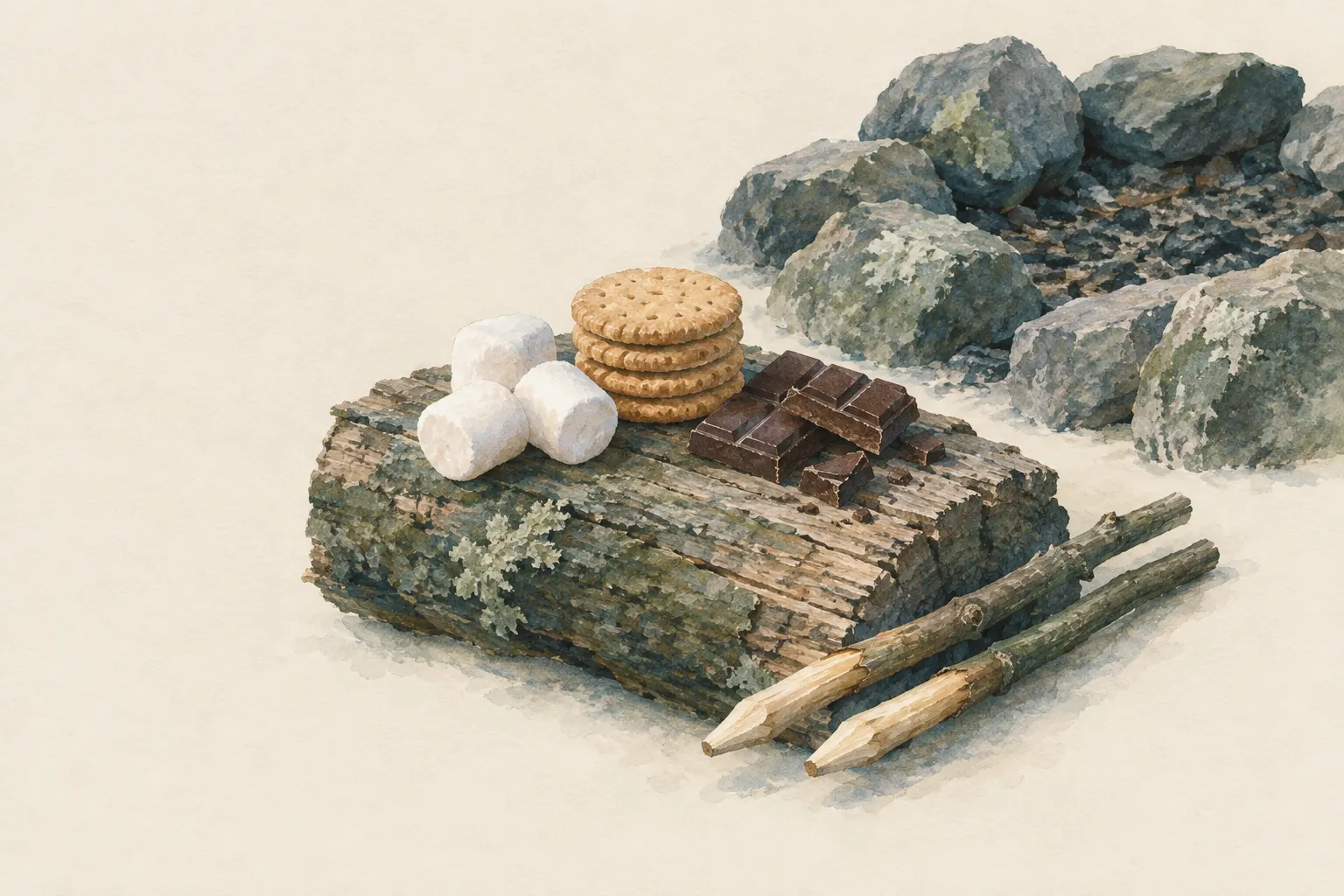
Chocolate biscuit sandwich with toasted marshmallow (“s'mores”)
A marshmallow is toasted golden brown on a peeled stick of safely non-toxic wood beside the embers – not in the flames – and then pressed between two biscuits with a piece of chocolate. The warm marshmallow makes the chocolate melt. Burning marshmallows turn into liquid, sticky sugar that burns deeply: that is why clear rules for children apply at the fire.
- Preparing embers 30–45 minutes; toasting 1–3 minutes per marshmallow
Explained simply
S'mores are a sweet campfire sandwich: a biscuit, a piece of chocolate, a warm toasted marshmallow and another biscuit on top. The name comes from the English “some more”, because after one you want the next straight away.
You put the marshmallow on a long stick and hold it beside the red embers, not in the flames. Turn it slowly until it is golden brown. Then you press it between the biscuits and pull out the stick. The warm marshmallow makes the chocolate melt.
A burning marshmallow is liquid, boiling-hot sugar that sticks to the skin. So the rule is: stay seated, hold the stick with both hands, blow out a burning marshmallow calmly instead of waving it around, and never eat straight from the stick.
How it works
A marshmallow consists mainly of sugar, water and gelatine, whipped with a lot of air. When the air warms up it expands, and the marshmallow grows. At the same time the sugar turns soft and gooey. On the surface it slowly browns – that gives the crisp, golden skin.
Embers radiate even heat. In the flames, by contrast, it is so hot that the sugar on the outside catches fire at once and turns black while the inside is still cold. That is why experienced toasters always keep a little distance beside the embers.
In the sandwich, the hot marshmallow is the oven for the chocolate. Thin chocolate melts better than thick pieces. Waiting a minute is usually enough.
What really matters
Good s'mores start with good embers. A big, flickering fire is too hot and unpredictable. Wait until the wood has burned down to red-glowing embers. You use this time to peel sticks and prepare the biscuits.
The stick must be of wood you know for certain. Some shrubs such as yew, laburnum, black locust, thuja, cherry laurel or elder are poisonous. Hazel is a good, well-known stick tree. The tip is peeled so that no bark or dirt gets onto the marshmallow.
Patience pays off: turning slowly gives an evenly golden marshmallow that is soft inside. Anyone in a hurry holds it in the flames – and then has a black, burning lump of sugar on the stick.
Safety: hot sugar and children's rules
Hot sugar is more dangerous than hot water because it sticks to the skin and keeps burning there. That is why a hot marshmallow is never put straight into the mouth. If something does stick to the skin, it is cooled at once and for a long time with cool running water and not pulled off.
There are clear rules for children: they sit or kneel at a distance, hold the stick with both hands and never run around with it. If the marshmallow burns, the stick is held still and the flame is blown out. One adult has only one job: watching the fire and the children.
At the end the fire is put out completely: plenty of water on it, stir, pour again until nothing hisses any more and no warmth rises.
When it makes sense – and when it does not
S'mores are the perfect end to a campfire evening with family or a group – and a good opportunity to teach children calm, safe behaviour at the fire.
With a fire ban, in drought or in strong wind the fire stays out – then chocolate and biscuits are eaten cold. For very small children, the foil parcel in the embers made by an adult is the better choice. Anyone who eats vegetarian or vegan needs marshmallows without gelatine.
Step by step
Prepare embers and a seating circle
Let the fire in a permitted fire site burn down until there are red-glowing embers and hardly any flames. Everyone sits in a circle at a distance. One adult watches only the fire and the children, extinguishing water stands ready.
- 1
Prepare embers and a seating circle
Let the fire in a permitted fire site burn down until there are red-glowing embers and hardly any flames. Everyone sits in a circle at a distance. One adult watches only the fire and the children, extinguishing water stands ready.
- 2
Prepare the stick
Find a long, straight stick of wood you know for certain, for example hazel. An adult peels the front 10 to 15 centimetres with the knife and carves a blunt point.
Never yew, laburnum, black locust, thuja, cherry laurel or elder.
- 3
Lay out biscuits and chocolate
On a board, lay one biscuit with a piece of chocolate on top. Put the second biscuit beside it. The board stands within reach but not right next to the embers, otherwise the chocolate melts too early.
- 4
Put the marshmallow on the stick
Push the marshmallow onto the peeled tip, about two thirds of the way in, so it does not slip off, but not all the way through.
- 5
Toast beside the embers and turn
Hold the marshmallow about a hand's width above the embers or beside them – not in the flames. Turn the stick slowly until it is golden brown all round and puffs up a little. That takes one to three minutes.
Stay seated and hold the stick with both hands.
- 6
If it burns: blow it out calmly
If the marshmallow catches fire, hold the stick still, pull it away from the fire and blow the flame out. Do not wave or swing it: burning sugar can drip off and fly through the air.
- 7
Press into the sandwich and let it cool
Put the hot marshmallow on the chocolate, press the second biscuit on top and pull out the stick. Wait about a minute until the chocolate melts and everything is no longer scorching hot. Then take a careful bite.
Never eat straight from the stick – liquid sugar burns lips.
- 8
Tidy up and put out the fire
Put the sticks together in a safe place or burn them in the embers at the end. Packaging goes in the rubbish bag. At the end the embers are put out with plenty of water, stirred and soaked again until nothing hisses any more.
Common mistakes
- Holding the marshmallow in the flames instead of beside the embers
- Waving a burning marshmallow
- Putting it straight from the stick into the mouth
- Sticks from unknown or poisonous shrubs
- Running around with the stick or pointing it at others
- Putting the chocolate too close to the fire
- Leaving the fire site warm
Quick view
Materials
Marshmallows
2 large marshmallows per person
Burning marshmallows turn into liquid, sticky sugar that sticks to the skin and burns deeply.
Usually made with gelatine (not vegetarian); some kinds contain egg – read the ingredients.
Biscuits (butter or wholemeal biscuits)
4 butter or wholemeal biscuits per person (2 sandwiches)
Contain wheat (gluten), often milk and egg.
Carry them in a firm tin, otherwise they crumble.
Chocolate
2 pieces per person (about 10–15 g), thin bar chocolate melts best
Often contains milk and soy and may contain traces of nuts – read the ingredients.
Melts in the sun and in a trouser pocket.
Sturdy sticks / poles
One stick per person, about 1–1.5 m long, of hazel or other safely non-toxic wood, tip peeled
Do not cut live wood where prohibited.
Knife (fixed or locking blade)
For peeling the stick tip – an adult does this
Cut away from your body.
Rules on carrying knives differ by region – check local rules.
Dry firewood
Dry hardwood for good embers
Collect only where permitted.
Water for extinguishing (bucket, canister or pot)
Have several litres ready before lighting.
Bowl and small chopping board
As a tray for biscuits and chocolate
Wash the board thoroughly after raw fish or meat before bread or vegetables go on it.
Suitable for
- A campfire evening with family and group
- Children of school age with clear fire rules
- Dessert after stick bread or ember potatoes
Not suitable for
- A fire ban or high wildfire danger
- A large, flickering fire without embers
- Toddlers with their own stick at the fire
- Vegetarians and vegans with ordinary marshmallows (gelatine)
Prerequisites
- A permitted fire site with embers
- One adult whose only job is the fire and the children
- Reliably known wood for the sticks – green wood only with permission
- Water for cooling and extinguishing within reach
Safety
- Only use wood you know for certain, for example hazel. Never yew, laburnum, black locust, thuja, cherry laurel or elder – these shrubs are poisonous. Peel the tip. Metal skewers get hot over the embers all the way to the handle.
- Biscuits contain gluten and often milk and egg, chocolate milk and soy, marshmallows usually gelatine and sometimes egg. Small children get small pieces and eat sitting down. Fire only where it is allowed and there is no wildfire danger – use existing fire sites, keep water ready to put it out and extinguish the fire completely at the end.
How it works
A marshmallow is whipped sugar with trapped air. In the radiant heat of the embers its surface slowly turns golden brown and crisp while the inside becomes soft and gooey and expands. In the flames, on the other hand, the sugar catches fire at once and chars outside before the inside is warm. The hot marshmallow passes its heat to the chocolate and makes it melt in the biscuit sandwich.
Advantages
- No cookware needed
- Quick, simple and a campfire highlight for children
- Few, long-lasting ingredients
- Good practice for calm, safe behaviour at the fire
Disadvantages
- Hot sugar causes deep burns
- Needs embers and a permitted fire site
- Lots of sugar, little nutritional value
- Sticky hands – plan water for washing
Deep knowledge
Background
S'mores come from North America, where they have been part of the campfire for almost a hundred years; the name comes from “some more”. Strictly speaking they use graham crackers; butter or wholemeal biscuits work just as well.
Burns from hot, sticky substances are particularly treacherous because the heat stays on the skin. First aid is still the same: cool at once and for a long time with cool running water, and call emergency services for severe burns.
Variants
- Kids variant in a foil parcel
- For younger children without their own stick: wrap a biscuit, chocolate, half a marshmallow and a second biscuit in aluminium foil. An adult lays the parcel at the edge of the embers for 2–3 minutes and takes it out with tongs. Only open it once it has cooled.
- Vegetarian and vegan
- Marshmallows without gelatine (vegan marshmallows), dark chocolate without milk and vegan biscuits. They melt a little faster – so hold them even further from the embers.
- With banana or apple
- Use two thin apple slices instead of biscuits or put a slice of banana into the sandwich. More on this in the recipe for chocolate bananas from the embers.
- Gluten-free
- Use gluten-free biscuits or rice cakes and check marshmallows and chocolate for gluten.
Common mistakes
- Holding the marshmallow in the flames instead of beside the embers
- Waving a burning marshmallow
- Putting it straight from the stick into the mouth
- Sticks from unknown or poisonous shrubs
- Running around with the stick or pointing it at others
- Putting the chocolate too close to the fire
- Leaving the fire site warm
Limits and risks
- Toasting times are guide values – the colour is what counts
- Only applies where fire is allowed
- No statement on sugar amounts for children
Material alternatives
Derived from material properties: a substitute must have all relevant properties. Observe the notes on the substitute.
- Dry firewood
- Tinder (Carry in waterproof packaging.), Char cloth (charred cotton) (Store dry in a tin.), Finest-grade steel wool (Store separately from batteries – fire risk.), Fatwood (resin-rich wood) (Collect only dead wood where permitted.), Stove fuel (canister, liquid fuel, alcohol) (Store fuels apart from food and in original containers or bottles intended for them.), Petroleum jelly cotton balls (Use only pure cotton.), Cooking oil or cooking fat (tallow, lard) (Never put out burning fat with water – cover it with a lid to smother it.), Tree resin (spruce, pine) (Resin is flammable and sticks to the skin when hot – melt it only slowly over low heat.), Birch bark (from dead, fallen wood) (Never peel from living trees.)
Results come exclusively from structured entries. No improvised instructions are generated.
Sources (5)
- European Resuscitation Council – Resuscitation (journal) (2021): European Resuscitation Council Guidelines 2021: First Aid · Cool burns at once with cool running water; call emergency services for severe burns
- Bundesinstitut für Risikobewertung (BfR) (2017): Risiko Pflanze – Einschätzung und Hinweise · Yew, laburnum, black locust, thuja, cherry laurel as poisonous shrubs and trees
- USDA Forest Service / Ad Council / National Association of State Foresters: Campfire Safety (Smokey Bear wildfire prevention campaign) · Safe campfire: distance, supervision, put it out completely
- Leave No Trace Center for Outdoor Ethics: The Seven Principles of Leave No Trace (Principle 5: Minimize Campfire Impacts) · Keep fires small, use existing fire sites, put fires out completely
- European Parliament and Council of the European Union (2011): Regulation (EU) No 1169/2011 on the provision of food information to consumers · The 14 major allergens that must be labelled, including cereals containing gluten, peanuts, tree nuts, milk, egg, soy, sesame, fish, celery, mustard, sulphites