























Popcorn in the pot
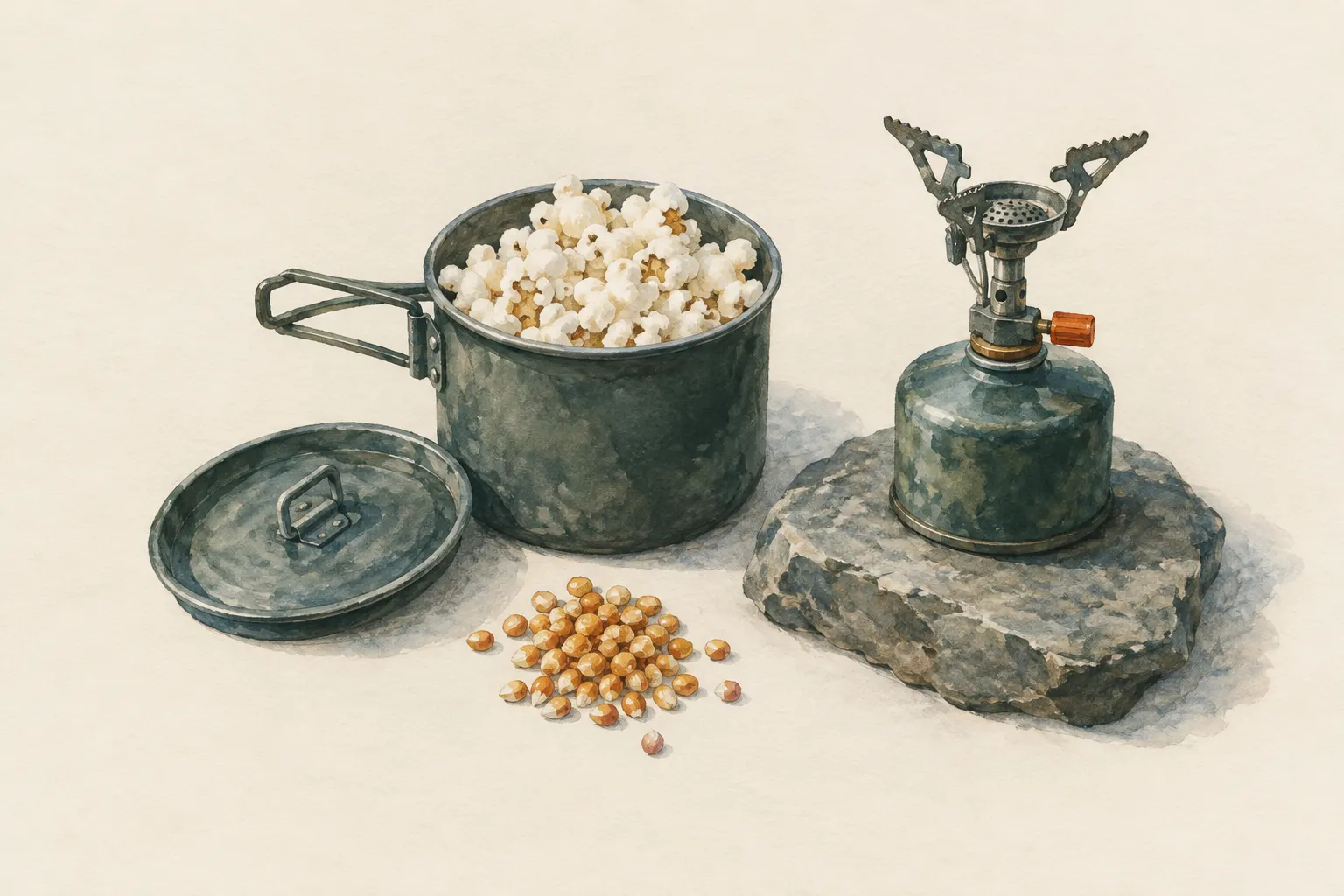
A little oil, a handful of popping corn, a pot with a lid and low to medium heat – that is all it takes. A few test kernels show when the oil is hot enough; then the rest goes in, the lid stays on and the pot is shaken again and again. The dangers are hot oil and the steam when opening the lid. Popcorn is not suitable for small children because of the choking hazard.
- About 10 minutes
Explained simply
You can make popcorn outdoors in a pot too. You need popping corn, a little oil, a pot with a lid and a stove. Inside every corn kernel there is a tiny drop of water. When the kernel gets hot, the water turns to steam – and pop! – the kernel bursts open and turns into white, fluffy popcorn.
First only three test kernels go into the hot oil. When they burst, the oil is hot enough, and the rest of the corn goes in. The lid stays on, and the pot is slid back and forth again and again so nothing burns. When it only pops now and then, it is ready.
An adult does the cooking, because hot oil and steam can burn badly. The stove always stands outside, never in the tent. And small children get no popcorn, because they can choke on the pieces and the hard kernels.
How it works
A popcorn kernel is like a tiny pressure cooker. Its hard hull is so tight that the steam from the trapped water cannot escape. The pressure rises until the hull suddenly tears open. The soft starch inside puffs up and sets into a crunchy foam.
The oil makes sure the heat reaches every kernel evenly. Without oil, the kernels touch the hot pot bottom at only a few points and burn there before they pop. The lid keeps the heat in the pot and catches the jumping kernels.
Only real popping corn pops. Sweetcorn from a tin or feed maize has a different hull through which the steam escapes – it just turns brown and hard.
What really matters
The right heat is the trick. Too little heat and the kernels dry out before they pop. Too much and the oil smokes and the popcorn burns. The three test kernels are your thermometer: when they pop, the oil is ready.
As soon as it really gets going, turn the flame down and keep sliding the pot back and forth without lifting it. When the gaps between pops get longer, the pot comes off the stove – otherwise the finished popcorn burns at the bottom while single kernels are still jumping at the top.
Seasoning comes only at the end. Sugar in hot oil turns into caramel, which is very hot, sticks to skin and burns quickly in the pot. Sprinkling salt, cinnamon sugar or paprika over the finished popcorn is safer and just as tasty.
Safety: oil, steam and carbon monoxide
If oil in the pot catches fire, water is the worst thing you can do: it turns to steam instantly and throws burning oil out. The right thing is: lid on, stove off, leave the pot where it is. Without air the flame suffocates.
When the lid is opened, hot steam shoots out. So you always lift the lid on the side facing away from you, and nobody leans over the pot. If a burn does happen, cool it at once with cool running water.
A stove uses up oxygen and produces carbon monoxide, a gas you cannot smell. In a tent or porch it can build up dangerously – and the tent can catch fire. That is why cooking always happens outside, even when it rains.
When it makes sense – and when it does not
Popcorn is a cheap, light evening snack for groups that is ready in a few minutes. The corn keeps a very long time in store, and a small bag goes a long way.
Popcorn is not suitable for small children under about four, and older children do not get the hard, unpopped kernels either. Without a pot with a lid, or with a wobbly stove, better leave it.
Step by step
Set up the stove safely
Put the stove outdoors on level, firm ground, sheltered from wind and several metres away from the tent. Lay out pot, lid, gloves, oil, corn and a bowl before you light it. Children sit about two big steps away.
Caution: Never cook in the tent, porch or vestibule.
- 1
Set up the stove safely
Put the stove outdoors on level, firm ground, sheltered from wind and several metres away from the tent. Lay out pot, lid, gloves, oil, corn and a bowl before you light it. Children sit about two big steps away.
Never cook in the tent, porch or vestibule.
- 2
Heat the oil with test kernels
Put the oil into the pot so the bottom is thinly covered, and drop in three popcorn kernels. Put the lid on and set the stove to a medium flame. Now it is time to wait and listen.
- 3
Add the rest of the corn
As soon as the three test kernels have popped, the oil is hot enough. Take the lid off away from your body, pour in the rest of the corn in one layer and put the lid straight back on.
Oil spatters – do not hold your face over the pot.
- 4
Shake the pot
Hold the handle with gloves and press the lid on firmly. Every few seconds, slide the pot briefly back and forth on the stove without lifting it up. That way the kernels move and nothing burns on the bottom.
Hold a wobbly stove steady with one hand.
- 5
Turn the heat down and listen
When it really gets going, turn the flame down. When the gaps between pops get longer – about two to three seconds – take the pot off the stove. If it smells burnt or smokes, take it off at once.
- 6
Stove off, open the lid carefully
Turn the stove off. Wait a moment until there is no more popping. Then lift the lid on the side facing away from you, so the steam does not shoot into your face.
- 7
Season, sort, tidy up
Pour the popcorn into the bowl and sprinkle salt or cinnamon sugar over it. Let it cool briefly and sort out hard, unpopped kernels. Wipe out the cooled pot with kitchen paper; take leftovers and paper with you.
Common mistakes
- Full flame from start to finish – the popcorn burns
- Putting sugar into the hot oil – it caramelises and burns
- Too much corn at once – the lid lifts off
- Opening the lid towards your face
- Touching the hot pot without a glove
- Cooking in the porch because it is raining
- Handing unpopped kernels to children
Quick view
Materials
Popping corn
2 heaped tablespoons per person (about 30 g) – makes a big bowl
Only real popping corn pops – ordinary sweetcorn or feed maize does not.
Unpopped kernels are hard: risk to teeth, choking hazard for small children.
Cooking oil for heating
About 1 tablespoon per person, heat-stable vegetable oil
Hot oil can catch fire – never put out burning oil with water, put the lid on and turn off the heat instead.
Carry it in a tight, leak-proof bottle.
Table salt
A pinch; sweet: 1 teaspoon of sugar or cinnamon sugar only after popping
Salt improves keeping quality but does not replace heating through.
Metal pot (stainless steel, aluminium, titanium)
At least 2 litres with a well-fitting lid, for 1–2 people
Hot – scalding risk.
Stove
With an adjustable flame, stable on level ground
Never operate inside a tent, shelter or enclosed room – carbon monoxide and fire risk.
Stove fuel (canister, liquid fuel, alcohol)
Store fuels apart from food and in original containers or bottles intended for them.
Store cool, well ventilated and out of children's reach.
Leather or heat-resistant gloves
Or pot gripper and a cloth – the handle gets hot
Synthetic gloves melt onto the skin – only leather or certified heat-resistant gloves.
Wet gloves conduct heat quickly.
Water for extinguishing (bucket, canister or pot)
For the surroundings – never onto burning oil
Have several litres ready before lighting.
Suitable for
- Evening snack at camp
- Groups – cheap and quick for many
- Stove or pot over embers
- Older children and teenagers watching and seasoning
Not suitable for
- Children under about four – choking hazard
- Cooking in the tent or porch
- Pots without a lid
- Wobbly stoves with tall, narrow pots
Prerequisites
- Able to operate a stove safely
- A place outdoors, level and sheltered from wind, far enough from the tent
- An adult operates the stove and pot
Safety
- When the lid is opened, hot steam shoots out and single kernels are still popping. Always lift the lid away from your face and body and do not let children look over the pot. Only touch the pot handle and lid with a glove or cloth. With a burn, cool at once with cool running water; with large burns, burns to the face or in children call 112 (in Austria also 144).
- Popcorn and especially hard, unpopped kernels are a choking hazard for small children and can damage teeth. Children under about four get no popcorn; for older children, sort out the hard kernels first. With butter, popcorn contains milk.
How it works
Inside every popcorn kernel there is a tiny drop of water, sealed in a hard, tight hull. When the kernel gets hot, the water turns into steam, the pressure rises until the hull bursts – and the soft starch inside puffs up into white, crunchy foam. The hot oil spreads the heat evenly around each kernel. The lid keeps kernels and heat in the pot; shaking stops anything burning at the bottom.
Advantages
- Cheap, light and long-lasting in the pack
- Ready quickly, even for big groups
- Fun – you can hear when it is done
- Without butter vegan and free of the most common allergens
Disadvantages
- Needs a pot with a lid
- Hot oil and steam – only with adults
- Not suitable for small children
- Burns quickly with too much heat
Deep knowledge
Background
Popcorn comes from the Americas: popping corn was burst over the fire there thousands of years ago. Only special kinds of maize pop, because their hull is hard and tight enough to hold the steam pressure for a long time.
Paediatricians count popcorn among the typical foods small children can choke on. For burning fat the same applies outdoors as in the kitchen: smother it with the lid, do not put it out with water.
Variants
- Over the embers
- Put the pot with its lid on a stable grate over a flat bed of embers, not into the flames. The heat is harder to control: to turn it down, simply push the pot to the edge of the embers. Fire only where it is allowed.
- Kids variant: seasoning masters
- The adult handles stove and pot, the children count the test kernels, listen for the gaps and season afterwards in the bowl – with salt, cinnamon or a little paprika. Only for children from about four, eaten sitting down.
- Savoury
- After popping, sprinkle with salt, paprika, curry powder or nutritional yeast flakes. It stays vegan with oil instead of butter.
- Sweet
- Sprinkle sugar, icing sugar or cinnamon sugar over the still warm popcorn only after popping, and shake. Caramel in the pot is very hot and sticky – leave that to the kitchen at home.
Common mistakes
- Full flame from start to finish – the popcorn burns
- Putting sugar into the hot oil – it caramelises and burns
- Too much corn at once – the lid lifts off
- Opening the lid towards your face
- Touching the hot pot without a glove
- Cooking in the porch because it is raining
- Handing unpopped kernels to children
Limits and risks
- Times and amounts are kitchen guide values
- Stoves differ widely – follow the manufacturer's instructions
- No recipe for caramel popcorn outdoors
Material alternatives
Derived from material properties: a substitute must have all relevant properties. Observe the notes on the substitute.
- Metal pot (stainless steel, aluminium, titanium)
- Single-wall stainless steel bottle (Heat only single-wall bottles without paint/plastic; remove the lid before heating.)
- Stove fuel (canister, liquid fuel, alcohol)
- Dry firewood (Collect only where permitted.), Tinder (Carry in waterproof packaging.), Char cloth (charred cotton) (Store dry in a tin.), Finest-grade steel wool (Store separately from batteries – fire risk.), Fatwood (resin-rich wood) (Collect only dead wood where permitted.), Petroleum jelly cotton balls (Use only pure cotton.), Cooking oil or cooking fat (tallow, lard) (Never put out burning fat with water – cover it with a lid to smother it.), Tree resin (spruce, pine) (Resin is flammable and sticks to the skin when hot – melt it only slowly over low heat.), Birch bark (from dead, fallen wood) (Never peel from living trees.)
Results come exclusively from structured entries. No improvised instructions are generated.
Sources (5)
- National Fire Protection Association (NFPA): Cooking safety tips (including what to do with a grease fire) · Smother burning fat with a lid and turn off the heat, never use water
- Centers for Disease Control and Prevention: Carbon Monoxide Poisoning – Prevention guidance · Never use stoves, grills or other fuel-burning devices in enclosed spaces or tents – carbon monoxide
- American Academy of Pediatrics (HealthyChildren.org): Choking Prevention · Popcorn as a typical choking hazard for young children
- European Resuscitation Council – Resuscitation (journal) (2021): European Resuscitation Council Guidelines 2021: First Aid · Cool burns at once with cool running water; call emergency services for severe burns
- Springer (H.-D. Belitz, W. Grosch, P. Schieberle) (2009): Food Chemistry, 4th edition · Starch and water in the cereal grain; gelatinisation and puffing of starch when heated