























No-bake energy balls
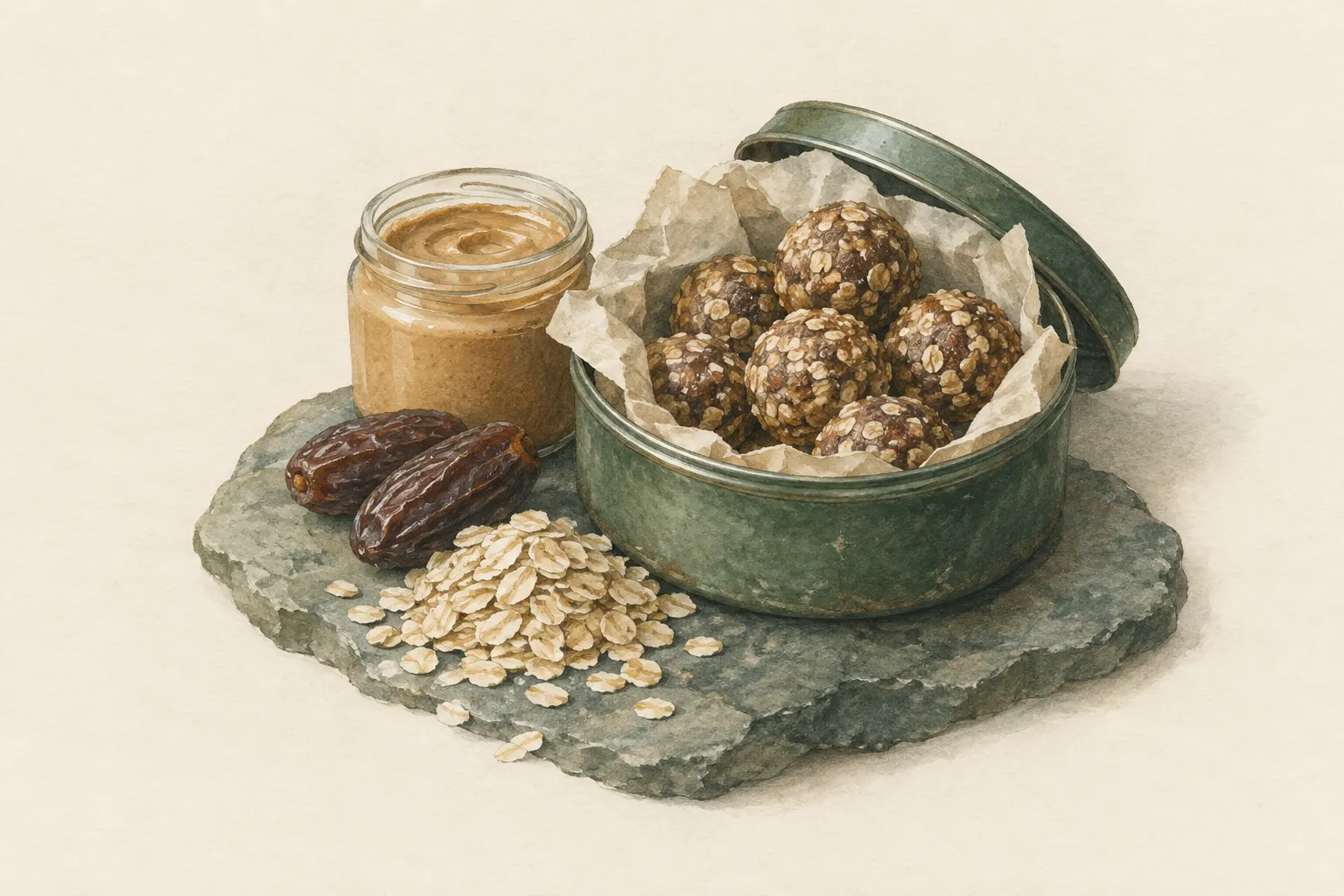
Rolled oats, nut butter, honey, finely chopped dried fruit and a little cocoa are kneaded at home into a sticky dough and rolled into walnut-sized balls – no oven at all. Once firm in the cool, they go into a tin in the backpack and give quick energy on the way. Important: no honey for babies under one year, and think of nut allergies in the group beforehand.
- Preparation 20 minutes at home; about 30 minutes in the fridge to firm up
Explained simply
Energy balls are small snack balls that you make at home without an oven. You mix rolled oats, finely chopped dates or raisins and a little cocoa. Then nut butter and honey go in. Both are sticky and hold everything together like glue.
With clean hands you roll small balls the size of a walnut. In the fridge they turn firm. Then you pack them in a tin and take them along on the hike. When you get tired, a ball quickly gives you new strength.
Two things are important: babies under one year must not eat honey – for them you use syrup. And some people get a dangerous allergy from nuts. That is why you always ask before you share your balls.
How it works
A dough normally holds together because it is baked. In energy balls, fat and sugar take over this job. The fat in the nut butter coats the oats, the thick honey or syrup glues them together. Dried fruit adds extra sugar and moisture. The colder it is, the firmer the fat becomes – that is why the balls go into the fridge.
On the trail the opposite happens: in warmth the fat softens and the balls get sticky. So the tin belongs on the inside of the pack, away from the sun. Baking paper between the layers stops everything turning into one lump.
Because fat provides about twice as much energy per gram as carbohydrate, energy balls are small and still filling. For the backpack that is ideal: little weight, lots of energy.
What really matters
The dough must have the right moisture. If it crumbles, it lacks binding – a few drops of water or a little more nut butter help. If it sticks to every finger, add more oats. It is best to test with one trial ball: if it holds together in your hand, the dough is right.
Dates and prunes are pressed open before cutting, because sometimes a hard stone is still inside. Nuts only go in finely chopped or ground, so nobody chokes on a large piece. The tin is labelled so everyone can see what is inside.
Stored cool and shaded, the balls keep for a few days. A fixed date is hard to give because it depends on the ingredients. If they smell rancid or look mouldy, they are thrown away.
Safety: honey, nuts and gluten
Honey can contain spores of a bacterium that can cause a dangerous illness in babies in their first year of life, infant botulism. Older children and adults are not affected. For families with a baby you therefore use date, maple or rice syrup.
Peanuts and tree nuts are among the most common triggers of severe allergic reactions. Anyone making them for a group or a school class asks first and, when in doubt, makes a nut-free version with sunflower seed butter – in a freshly washed bowl.
Oats are often naturally contaminated with wheat. People with coeliac disease need oats explicitly labelled gluten-free. Cocoa and chocolate can also contain traces of milk and soy – the ingredients list tells you.
When it makes sense – and when it does not
Energy balls are ideal as a snack for day trips and the first days of a longer trip, for children who like to help, and as a small emergency snack in the day pack. On the trail they need neither stove nor fire.
They are less suitable for long trips in great heat, where they go soft, and as a replacement for proper meals. For several weeks, dry trail mix keeps better.
Step by step
Wash hands and get ready
Wash your hands thoroughly with soap. Put out a bowl, a board, a knife, a tablespoon and the tin. Read the packets: does it say “peanuts”, “nuts” or “gluten” anywhere, and can everyone in your group eat that?
- 1
Wash hands and get ready
Wash your hands thoroughly with soap. Put out a bowl, a board, a knife, a tablespoon and the tin. Read the packets: does it say “peanuts”, “nuts” or “gluten” anywhere, and can everyone in your group eat that?
- 2
Chop the dried fruit
Press each date open and check whether there is still a stone inside. Cut dates or apricots into small pieces, about the size of a pea. You can leave raisins whole. Children only cut with an adult next to them and always away from the body.
Always move the knife blade away from your body and your hand.
- 3
Mix the dry ingredients
Put the oats, the chopped dried fruit and the cocoa into the bowl. Stir everything with the spoon until the cocoa is evenly spread and no white patches are left.
- 4
Knead in nut butter and honey
Add the nut butter and the honey and knead everything with clean hands or the spoon until you have a dough that sticks together. If it is too dry and crumbly, add a few drops of water or a little more nut butter. If it is too sticky, add a few more oats.
- 5
Roll the balls
Take about a tablespoon of dough and roll it between your palms into a ball the size of a walnut. If you like, roll the ball in a little cocoa or desiccated coconut so it is less sticky. About five balls per person are enough.
- 6
Let them firm up and pack them
Put the balls side by side in the tin and leave it in the fridge for about half an hour. Then put baking paper between the layers so they do not stick together. Write on the lid what is inside – for example “peanut, oats, honey”.
- 7
Carry cool and eat up
Pack the tin on the inside of the backpack, away from the sun. Eat the balls within a few days and drink with them. Before you share, ask about allergies. You take the empty tin, paper and crumbs back with you.
Common mistakes
- Using honey for a baby under one year
- Handing them out to children or friends with a nut allergy without asking
- Mixing in whole nuts or large, hard pieces
- Not checking dates for stones
- Leaving the dough too dry – the balls fall apart in the pack
- Carrying the tin on top in the sun – the balls go mushy
- Not labelling the tin
Quick view
Materials
Rolled oats
About 50 g per person (5 heaped tablespoons), ideally fine flakes
Oats contain gluten or can be contaminated with wheat – with coeliac disease only oats labelled gluten-free.
Store dry and tightly closed.
Nut butter or peanut butter
About 1 heaped tablespoon (20 g) per person; nut-free: sunflower seed butter
Peanuts and tree nuts are among the most common and most dangerous food allergens – ask in the group first.
Store cool; oil that settles on top is simply stirred back in.
Honey or syrup
1–2 teaspoons per person; for babies under 1 year and vegan: date or maple syrup
Never give honey to babies under 12 months – risk of infant botulism. Syrup is the alternative.
Very sticky – carry it in a tight tube or tin.
Dried fruit
About 30 g per person, e.g. 3 pitted dates or 1 tablespoon of raisins
Dates and prunes may still contain stones – check before cutting.
Some dried fruit is sulphured (sulphites) – the pack says so.
Cocoa powder (unsweetened)
1 teaspoon per person, a little more for rolling
Store dry, otherwise it clumps.
Bowl and small chopping board
One bowl and one board
Wash the board thoroughly after raw fish or meat before bread or vegetables go on it.
Knife (fixed or locking blade)
For cutting the dried fruit – an adult helps
Cut away from your body.
Rules on carrying knives differ by region – check local rules.
Airtight food-grade storage container
Tin with baking paper between the layers
Fill only when clean and completely dry; never use containers that previously held chemicals.
Suitable for
- Day trips and multi-day trips as a snack
- Children who help with rolling
- Situations without stove or fire
- Emergency snack in the day pack
Not suitable for
- Babies under 12 months (honey, texture)
- Groups with a peanut or tree nut allergy if nut butter is used
- People with coeliac disease if the oats are not gluten-free
- Very long trips in heat – the balls turn soft and sticky
Prerequisites
- A kitchen at home or a clean work surface
- Clean hands
- It is clear who in the group has which allergies
Safety
- Putting whole nuts or large pieces into the dough makes the balls dangerous for small children – only finely chopped or ground nuts. Check dates for stones before cutting. Children eat sitting down and in small bites.
- The balls are not heated – so wash your hands and use clean tools and fresh ingredients. Carry them cool and shaded and eat them within a few days. Take packaging, leftovers, nutshells and crumbs back with you and do not feed animals.
How it works
Nut butter brings fat, honey or syrup brings sugar and stickiness. Together they hold the dry oats and dried fruit together like glue – without any heat. In the cold the fat in the nut butter sets, which is why the balls turn firm in the fridge and soft again in warmth. Fat provides about twice as much energy per gram as carbohydrate; that is why the balls are small but filling.
Advantages
- No oven, no stove, no fire needed
- Small, light and energy-rich
- Children can do almost everything themselves
- Ingredients from the normal store cupboard
Disadvantages
- Turn soft and sticky in heat
- Keep only a few days unchilled
- With nuts and oats, many allergens in one snack
- Without a fridge they do not get properly firm
Deep knowledge
Background
Energy balls are a modern version of old trail-food ideas: dried fruit, nuts and grains are light, spoil slowly and provide a lot of energy for little weight. Fat provides about twice as much energy per gram as carbohydrate or protein – which is why a few balls are already filling.
The warning about honey for infants is not caution for its own sake: honey can contain spores of Clostridium botulinum, and babies under one year do not yet have gut flora that reliably keeps these spores in check. Health authorities therefore agree in advising against giving honey to children in their first year of life.
Variants
- Kids variant: rolling as a hands-on job
- An adult chops the dried fruit, the children mix, knead and roll. Without cocoa the balls taste milder; desiccated coconut is good for rolling. For children under about four, make very soft, flattened discs rather than firm balls – and no nut pieces.
- Vegan and baby-safe without honey
- Use date, maple or rice syrup instead of honey – or just more dates, which stick well on their own when finely chopped. That makes the balls vegan; check cocoa and chocolate for milk.
- Nut-free
- Use sunflower seed butter instead of nut butter and choose chocolate without nut traces. Tahini also works, but sesame is a major allergen itself. With a severe allergy, work in a freshly washed bowl.
- As bars
- Instead of balls, press the dough about a finger thick into a tin lined with baking paper, chill it and cut it into bars. Bars pack flatter.
Common mistakes
- Using honey for a baby under one year
- Handing them out to children or friends with a nut allergy without asking
- Mixing in whole nuts or large, hard pieces
- Not checking dates for stones
- Leaving the dough too dry – the balls fall apart in the pack
- Carrying the tin on top in the sun – the balls go mushy
- Not labelling the tin
Limits and risks
- No nutritional values – they depend strongly on the ingredients
- Unchilled shelf life only as a rough guide of “a few days”
- No recommendation for people with diabetes or special diets
Material alternatives
Derived from material properties: a substitute must have all relevant properties. Observe the notes on the substitute.
- Airtight food-grade storage container
- Single-wall stainless steel bottle (Heat only single-wall bottles without paint/plastic; remove the lid before heating.), Double-wall insulated bottle (Never heat directly.), PET bottle (clear, max. 2 litres) (Do not heat or place in a fire.), Food-grade water container (Only use containers that never held chemicals or fuel.), Collapsible water container or bag (Protect from sharp objects.), Food-grade water bag (Use only for drinking water, never for chemicals or fuel.), Fermentation jar or crock (Use only food-grade containers of glass, food-safe glazed stoneware or food-grade plastic – no metal containers for acidic food.), Resealable food bags (Use only bags intended for food; do not use with boiling water unless the manufacturer explicitly allows it.)
Results come exclusively from structured entries. No improvised instructions are generated.
Sources (6)
- Centers for Disease Control and Prevention (CDC): Botulism – prevention information (including infant botulism) · Infant botulism; do not give honey to children under 12 months
- NHS (National Health Service, United Kingdom): Foods to avoid giving babies and young children · No honey for babies under 12 months; no whole nuts or peanuts for children under 5
- European Parliament and Council of the European Union (2011): Regulation (EU) No 1169/2011 on the provision of food information to consumers · The 14 major allergens that must be labelled, including cereals containing gluten, peanuts, tree nuts, milk, egg, soy, sesame, fish, celery, mustard, sulphites
- John E. Hall – Elsevier: Guyton and Hall Textbook of Medical Physiology · Fat provides about twice as much energy per gram as carbohydrate or protein
- World Health Organization (WHO) (2006): Five Keys to Safer Food Manual · Keep clean, use safe raw materials
- Leave No Trace Center for Outdoor Ethics: The Seven Principles of Leave No Trace (Principle 5: Minimize Campfire Impacts) · Pack out rubbish, do not feed wildlife