























Mixing your own trail mix
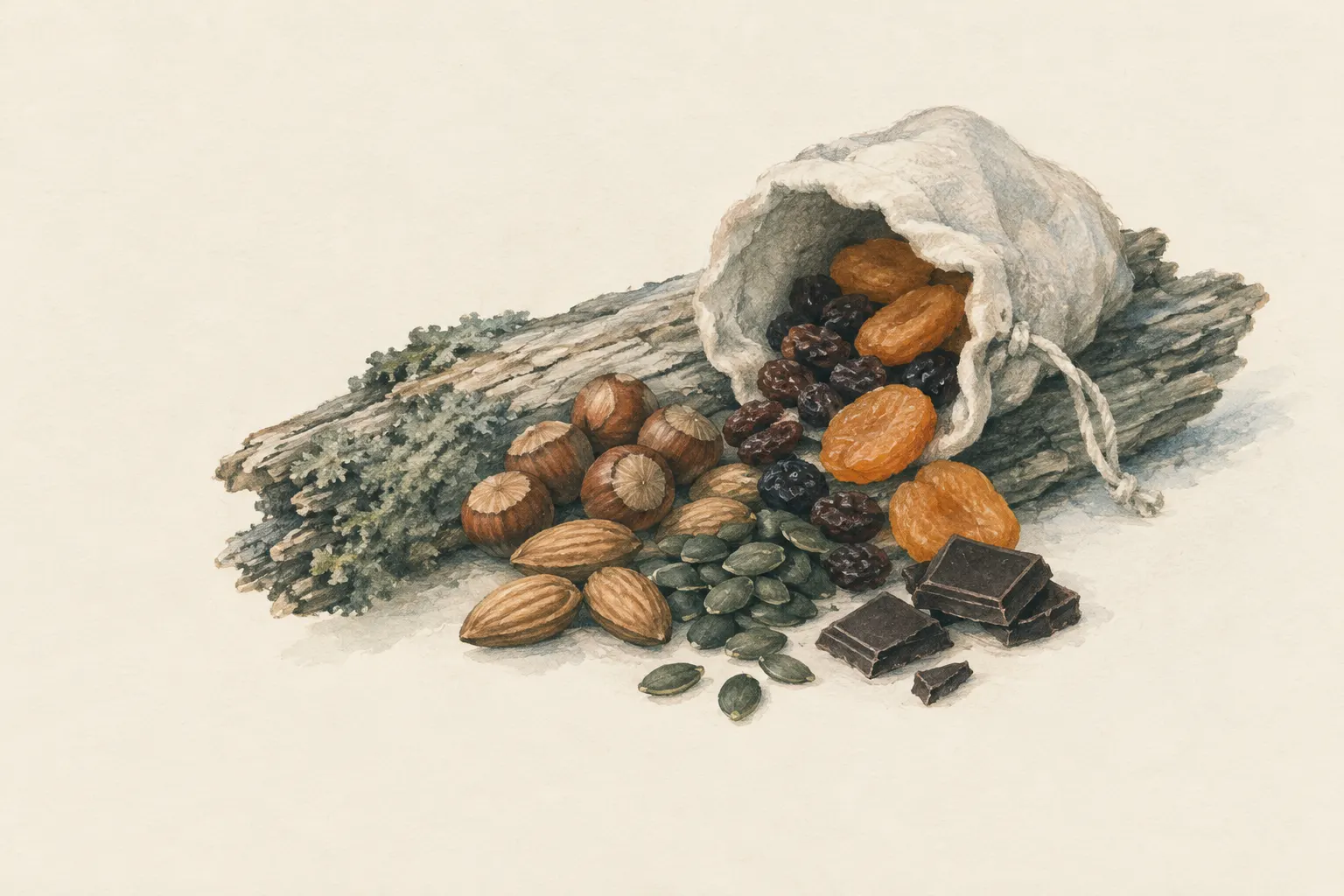
Nuts, seeds, dried fruit and a few pieces of chocolate, mixed yourself and portioned straight into day bags: this is the simplest hiking snack of all. It needs no stove, spoils slowly and fits into any jacket pocket. For small children, however, whole nuts are a choking hazard – they get their own mix without nuts.
- Mixing and portioning about 15 minutes
Explained simply
Trail mix is a colourful mix of nuts, seeds, dried fruit and a few bits of chocolate. You mix it yourself in a big bowl. Each ingredient has a job: nuts keep you full for a long time, dried fruit gives quick strength, and chocolate puts you in a good mood.
So that not everything is eaten on the first day, you fill a separate bag for each day. A good rule of thumb per day: two small handfuls of nuts and seeds, one handful of dried fruit and a few pieces of chocolate.
Very important: small children can choke on whole nuts and stop getting air. They get their own mix without nuts. And because some people are allergic to nuts, you always ask before you share.
How it works
Trail mix keeps so well because there is almost no water in it. Germs need water to grow; in dry nuts and dried fruit they find hardly any. That is why the mix does not spoil as fast as fresh food and needs no cooling.
Over time, though, the fat in the nuts changes: oxygen, light and warmth make it rancid. Rancid nuts smell and taste bitter, like old oil. Cool, dark storage and well-sealed bags with the air squeezed out help against this.
The mix of fat, protein and sugar makes sense: the sugar in the dried fruit works quickly, the fat in the nuts lasts longer. Together they carry you from break to break.
What really matters
Portioning is half the recipe. One big bag for the whole trip is tempting – and often already half empty by the evening of the first day. Day bags with name and day make sure everyone has something until the end.
Every bag should also show the allergens, such as “hazelnut, peanut, milk”. That way everyone sees at once whether they can eat it. For people with allergies and small children, you mix first in a clean bowl before the nuts come into play.
In heat, milk chocolate melts quickly and glues everything together. Sugar-coated chocolate buttons or no chocolate at all are better. And when eating, you pour the mix into your hand instead of rummaging in the bag with your fingers – that is more hygienic.
Safety: nuts and small children
Whole nuts are round, hard and exactly the size that can block a small child's airway. Health authorities therefore advise not to give children under five whole nuts or peanuts. Finely ground nuts or thinly spread nut butter are a different matter.
Older children also eat sitting down and not while running, romping or laughing. Anyone who chokes and can no longer cough, speak or breathe needs help at once – how that works is in the entry on choking.
Also: leave no crumbs and do not feed animals. Otherwise wild animals get used to people and food, and salt and chocolate are unhealthy for many animals.
When it makes sense – and when it does not
Trail mix fits almost any trip: as a snack in between, as an emergency snack in the jacket pocket or on days when there is no time for a cooking break. It is light, small and keeps for a long time.
But it does not replace meals. Anyone who eats only nuts and dried fruit for many days gets too little variety and too few vegetables. As a supplement to breakfast and dinner, however, it is hard to beat.
Step by step
Plan and wash hands
Think about how many people and days you are mixing for, and ask about allergies. Wash your hands and take a clean, dry bowl. Moisture makes the mix go off faster.
- 1
Plan and wash hands
Think about how many people and days you are mixing for, and ask about allergies. Wash your hands and take a clean, dry bowl. Moisture makes the mix go off faster.
- 2
Measure with the handful rule
Per person per day: two small handfuls of nuts and seeds, one handful of dried fruit and a few pieces of chocolate. That is about 40 g of nuts, 15 g of seeds, 30 g of dried fruit and 15 g of chocolate. A kitchen scale makes it more exact.
- 3
Cut large pieces small
Cut large apricots, figs or a bar of chocolate into pieces about the size of a hazelnut. That way everything spreads evenly. An adult helps with the cutting.
Cut on a firm board, blade away from the body.
- 4
Mix everything
Put all the ingredients into the bowl and mix them with a large spoon until every spoonful has some of everything. Make the children's mix without nuts and the allergy mix beforehand in a separate bowl.
- 5
Fill into daily portions
Fill a separate bag for each person and each day. Write the name, day and allergens on it, for example “Mia – day 2 – hazelnut, milk”. Squeeze the air out and seal the bag.
- 6
Store cool and dry
Keep the bags cool, dark and dry until the trip. In the backpack they go in a lid pocket or hip pocket so you can reach them on the way without taking the pack off – but not in full sun.
- 7
Eat and drink on the way
Eat a handful during short breaks and drink water with it. Pour the mix into your hand instead of rummaging in the bag with your fingers. You take empty bags and anything that falls on the ground back with you – animals are not fed.
Common mistakes
- Giving small children whole nuts
- Filling everything into one big bag – it is empty after a day
- Mixing the allergy mix in the same bowl without washing it
- Taking milk chocolate along in heat
- Damp bowl or damp hands – the mix turns sticky
- Mixing only sweet things – it does not keep you full for long
- Leaving crumbs and shells behind
Quick view
Materials
Nuts and seeds
About 40 g of nuts and 15 g of seeds per person per day (two small handfuls)
Whole nuts and peanuts are a choking hazard for small children – only give them finely ground or chopped.
Nuts are strong allergens; they also turn rancid over time – store cool, dark and tightly closed.
Dried fruit
About 30 g per person per day (one handful)
Dates and prunes may still contain stones – check before cutting.
Some dried fruit is sulphured (sulphites) – the pack says so.
Chocolate
About 15 g per person per day; in heat, sugar-coated chocolate buttons
Often contains milk and soy and may contain traces of nuts – read the ingredients.
Melts in the sun and in a trouser pocket.
Resealable food bags
One bag per person per day
Use only bags intended for food; do not use with boiling water unless the manufacturer explicitly allows it.
Labels and permanent marker
Name, day and allergens on each bag
Bowl and small chopping board
Large bowl for mixing
Wash the board thoroughly after raw fish or meat before bread or vegetables go on it.
Knife (fixed or locking blade)
For large apricots or chocolate
Cut away from your body.
Rules on carrying knives differ by region – check local rules.
Suitable for
- A snack for any trip, even without a cooking break
- Emergency snack in the jacket pocket
- Multi-day trips with little weight
- Teenagers and adults
Not suitable for
- Children under about five with whole nuts
- Groups with a nut or peanut allergy without a separate mix
- As the only food over many days
- Chocolate in great heat – it melts
Prerequisites
- Clean, dry bowl and bags
- It is clear who in the group has allergies
- Knowing how many days and people are to be supplied
Safety
- Nuts contain a lot of fat and turn rancid over time – store them cool, dark and tightly closed, and throw away nuts that smell rancid. Take packaging, leftovers, nutshells and crumbs back with you and do not feed animals.
How it works
Each ingredient has a job: nuts and seeds bring fat and protein and keep you full for a long time. Dried fruit brings quick sugar for the next climb. Chocolate is the motivation bonus. Because there is almost no water in it, the mix spoils slowly and is light. Fixed daily portions stop everything being eaten on the first day.
Advantages
- No stove, no fire, no cooling
- Light, small and energy-rich
- Keeps a long time if stored dry and dark
- Everyone can make their own mix
Disadvantages
- Nuts are strong allergens
- Only without whole nuts for small children
- Chocolate melts in heat
- Does not replace a proper meal
Deep knowledge
Background
The German name “Studentenfutter” (student food) is old: nuts and raisins used to be an expensive luxury that mainly wealthy students could afford. Today the mix is the classic hiking snack worldwide, called “trail mix” in English.
Nuts turn rancid because of their fats: oxygen, light and warmth slowly change them, and bitter, unpleasant-smelling substances form. That is why nuts are stored cool, dark and tightly closed. Health authorities and paediatricians explicitly warn against giving small children whole nuts, because they can choke on them.
Variants
- Children's mix without nuts
- For small children: soft dried fruit in small pieces (e.g. apple rings, raisins), unsweetened cereal flakes or puffed rice and a few chocolate buttons. No whole nuts, no hard seeds and no popcorn. From about five years, chopped nuts can be added.
- Vegan
- Trail mix is already vegan without chocolate. With dark chocolate without milk powder it stays vegan – check the ingredients.
- Savoury mix
- Roasted salted peanuts, pumpkin seeds, small pretzels and raisins. Many people prefer savoury food on hot days; drinking enough remains the most important thing.
- Nut-free mix
- Sunflower and pumpkin seeds, dried fruit, cereal flakes and nut-free chocolate. The safe standard mix for schools and groups with allergies.
Common mistakes
- Giving small children whole nuts
- Filling everything into one big bag – it is empty after a day
- Mixing the allergy mix in the same bowl without washing it
- Taking milk chocolate along in heat
- Damp bowl or damp hands – the mix turns sticky
- Mixing only sweet things – it does not keep you full for long
- Leaving crumbs and shells behind
Limits and risks
- Amounts are recipe guide values, not a nutrition plan
- No figures on individual energy needs
- No exact shelf life – it depends on the ingredients and storage
Material alternatives
Derived from material properties: a substitute must have all relevant properties. Observe the notes on the substitute.
- Resealable food bags
- Single-wall stainless steel bottle (Heat only single-wall bottles without paint/plastic; remove the lid before heating.), Double-wall insulated bottle (Never heat directly.), PET bottle (clear, max. 2 litres) (Do not heat or place in a fire.), Food-grade water container (Only use containers that never held chemicals or fuel.), Airtight food-grade storage container (Fill only when clean and completely dry; never use containers that previously held chemicals.), Collapsible water container or bag (Protect from sharp objects.), Food-grade water bag (Use only for drinking water, never for chemicals or fuel.), Fermentation jar or crock (Use only food-grade containers of glass, food-safe glazed stoneware or food-grade plastic – no metal containers for acidic food.)
Results come exclusively from structured entries. No improvised instructions are generated.
Sources (5)
- NHS (National Health Service, United Kingdom): Foods to avoid giving babies and young children · Do not give whole nuts or peanuts to children under 5 – choking hazard
- American Academy of Pediatrics (HealthyChildren.org): Choking Prevention · Nuts and hard foods as typical choking hazards for young children
- European Parliament and Council of the European Union (2011): Regulation (EU) No 1169/2011 on the provision of food information to consumers · The 14 major allergens that must be labelled, including cereals containing gluten, peanuts, tree nuts, milk, egg, soy, sesame, fish, celery, mustard, sulphites
- Springer (H.-D. Belitz, W. Grosch, P. Schieberle) (2009): Food Chemistry, 4th edition · Lipid oxidation: rancidity of fatty foods caused by oxygen, light and warmth
- Leave No Trace Center for Outdoor Ethics: The Seven Principles of Leave No Trace (Principle 5: Minimize Campfire Impacts) · Pack out rubbish, do not feed wildlife