























Backpack porridge: oats with dried fruit and nuts
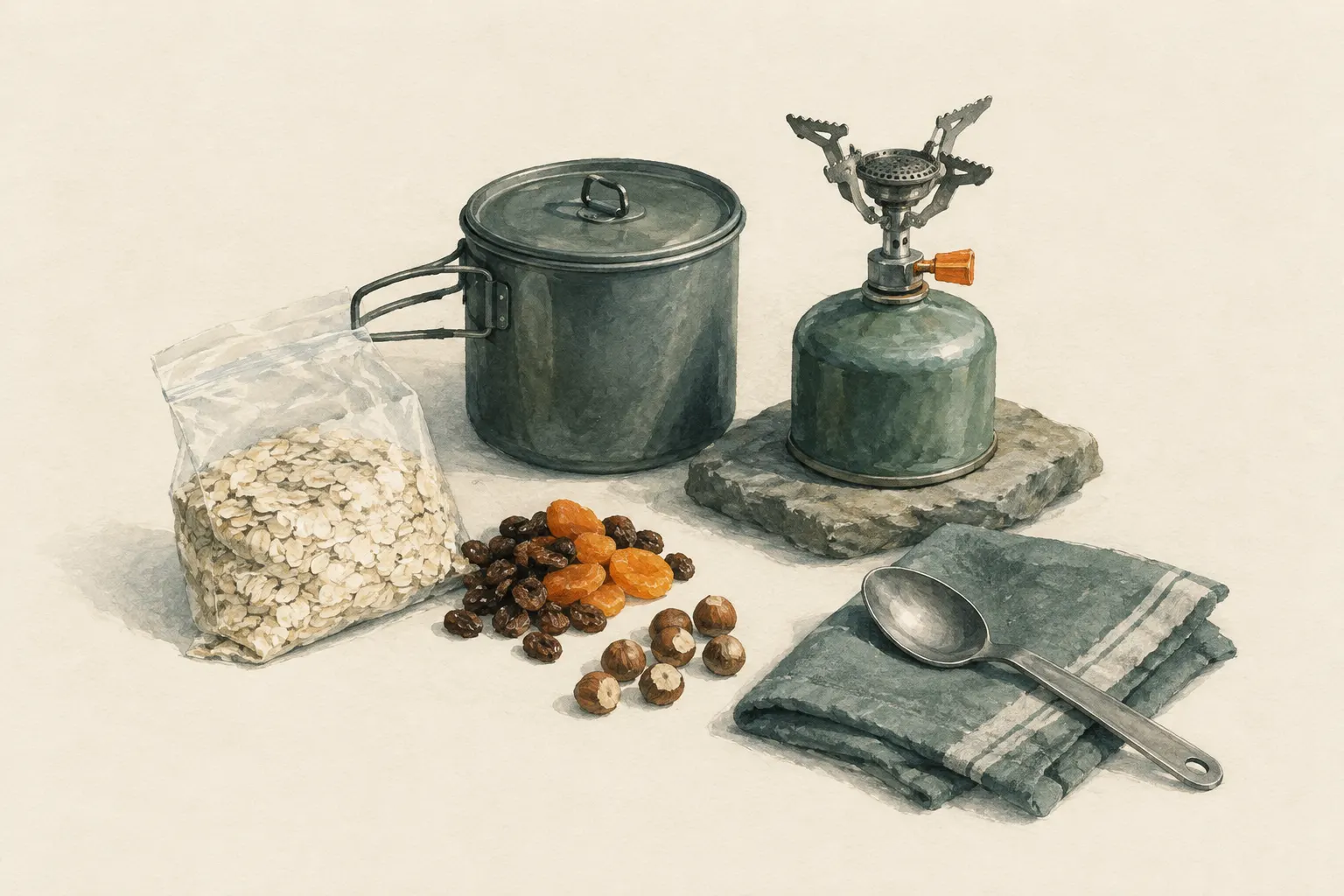
A warm breakfast in ten minutes from one pot: rolled oats, milk powder, a pinch of salt, dried fruit and nuts, mixed at home into one bag per person. Outdoors you bring water to the boil, stir in the mix and let it simmer briefly while stirring. It also works without fuel: soak the oats overnight in safe water.
- 5 minutes of packing at home; about 10 minutes outdoors, of which 3–5 minutes cooking
Explained simply
Porridge is a warm mush made of rolled oats – a really good breakfast when it is cold outside in the morning. At home you mix oats, milk powder, a pinch of salt and dried fruit into a bag for each person. You pack the nuts separately in case someone cannot eat them.
Outdoors you first boil water in the pot. Then you stir in the mix and let it bubble on a small flame for a few minutes. You have to keep stirring the whole time, otherwise the porridge sticks to the bottom of the pot and burns.
Very important: the stove always stays outside, never in the tent. And hot porridge is hotter than it looks – so blow before every spoonful. If you have no stove, you can also soak the oats in clean water in the evening. In the morning they are soft.
How it works
Rolled oats are oat grains that have been steamed and rolled flat. The thinner the flake, the faster water gets in. In hot water the starch inside swells, takes up water and thickens it – so within a few minutes you get a creamy porridge. Quick oats are done after two to three minutes, jumbo oats need a little longer.
There is a reason why the water boils first and only then do the oats go in: cold porridge that is heated slowly settles on the bottom and burns there before anything happens at the top. If, on the other hand, you stir the oats into water that is already boiling, they spread out and swell evenly.
It also works without heat, just more slowly. Soaked in water overnight, rolled oats also become soft. That is the idea behind “overnight oats”. Because the water is not boiled in this case, it must be safe from the start.
What really matters
The right amount of water: per person about 200 to 250 millilitres are enough for 60 to 80 grams of oats. More water gives a thinner porridge, less a thick one. Because you can add a splash at any time, it is better to start with a little less.
A small flame and stirring are the whole secret. On a camping stove the heat is concentrated on a small area in the middle of the pot. That is exactly where the porridge burns first. Always scrape across the bottom while stirring. If you turn the stove off after it comes to the boil and let the covered pot rest for a few minutes, the porridge finishes cooking without any more flame and you save fuel.
Milk powder goes lumpy if it falls into boiling water all at once. That is why you mix it with the dry oats at home – then it spreads by itself when you stir it in.
Safety: what to watch out for
A stove never belongs in the tent, not in the vestibule either, and not even when it is raining or freezing outside. Burning gas or petrol produces carbon monoxide, a gas you cannot see or smell and that can become dangerous even in small spaces. Tent fabric also burns very quickly. Better to cook outside in a rain jacket, under an open tarp at a distance.
Hot porridge sticks to the skin and therefore scalds particularly badly. Hold the pot handle while stirring so the pot does not slide off the stove, and keep children out of the cooking corner. If something does happen: cool the spot at once with cool running water. With large areas, on the face or with children, call 112, in Austria also 144.
This recipe contains three common allergens: milk, nuts and gluten, because oats count among the cereals containing gluten. Ask before the trip who cannot eat what. Breathing difficulty or a swollen face after eating is an emergency – call for help at once.
Tips and tricks
Soak the pot instead of scrubbing: right after eating, put a splash of hot water into the pot and put the lid on. By the time you have packed your things, the porridge has come loose. Strain out the scraps and take them with you; scatter the water far away from any stream or lake.
If you have to leave early, measure the water into the pot the evening before and put everything next to the stove. Then breakfast is ready in ten minutes while you are still half asleep.
On cold days a spoonful of oil or desiccated coconut in the porridge is a good trick: fat provides a lot of energy and keeps you full for longer. Add a warm drink, and the morning is saved.
Step by step
Portion it at home
For each person, mix into one bag: about 60–80 g of rolled oats, 2–3 heaped tablespoons of milk powder, a pinch of salt and a small handful of chopped dried fruit. Nuts go into their own small bag so people with allergies can eat without nuts. Label each bag with contents and date.
- 1
Portion it at home
For each person, mix into one bag: about 60–80 g of rolled oats, 2–3 heaped tablespoons of milk powder, a pinch of salt and a small handful of chopped dried fruit. Nuts go into their own small bag so people with allergies can eat without nuts. Label each bag with contents and date.
- 2
Set up the cooking spot outdoors
Set the stove up outdoors on level, non-combustible ground – a flat stone, gravel or bare earth – at a distance from the tent and dry grass. A windscreen helps but must not fully enclose the canister. Put spoon, bags and pot grip within reach before you light the stove.
Never cook in the tent or vestibule – carbon monoxide and fire danger.
- 3
Bring the water to the boil
Put about 200–250 ml of safe water per person into the pot, put the lid on and bring it to the boil. With the lid it is quicker and saves fuel. If you have stream or lake water, let it come to a rolling boil – that makes it safe at the same time.
- 4
Stir in the mix
Turn the flame down low and pour the oat mix slowly into the water while stirring with the spoon. That way no dry lumps form. Hold the pot handle with the pot grip while you do this so the pot does not slide off the stove.
Do not lean over the pot – the steam is hot.
- 5
Simmer while stirring
Let the porridge simmer over a small flame for about 3–5 minutes, quick oats for less. Stir all the time and scrape across the bottom of the pot, because that is where porridge burns first. If it gets too thick, add a splash of water. At high altitude it takes a little longer because water boils at a lower temperature there.
- 6
Turn off and let it stand
Turn off the stove, put the lid on and let the porridge stand for 2–3 minutes – it gets even creamier and you save fuel. Then sprinkle the nuts on top. Blow hard before the first spoonful; for children, put a portion into a mug and let it cool.
- 7
Eat up and clean up without a trace
Eat the porridge straight away while warm and scrape the pot clean with the spoon. A small splash of hot water loosens the rest; strain out food scraps and put them in the rubbish bag. Scatter the washing water far away from any stream or lake. Take all packaging and bags back with you.
Common mistakes
- Putting the oats into cold water and then heating without stirring – the bottom burns
- Too big a flame, the porridge spits and boils over
- Not stirring while it simmers
- Tipping milk powder straight into boiling water – it goes lumpy
- Mixing nuts into every portion although someone is allergic
- Using untreated stream water for the soaking variant
- Cooking in the tent or vestibule because it is cold outside
Quick view
Materials
Rolled oats (quick or jumbo)
About 60–80 g per person; quick oats cook faster than jumbo oats
Oats count among the cereals containing gluten – with coeliac disease only oats labelled gluten-free.
Store dry and tightly packed, otherwise they draw moisture and pantry pests.
Milk powder (whole or skimmed)
2–3 heaped tablespoons per person (about 20–30 g)
Contains milk – an allergen. For people with milk allergy choose a plant-based powder without milk protein.
Mixed milk spoils like fresh milk: only mix it with safe water and use it soon.
Dried fruit, nuts and seeds
A small handful each of dried fruit and nuts (about 20–30 g); pack nuts separately
Nuts and peanuts are common allergens – ask in the group beforehand and pack them separately.
Whole nuts are a choking hazard for small children – chop them finely or leave them out.
Table salt
A pinch
Salt improves keeping quality but does not replace heating through.
Food-grade water bag
About 200–250 ml of safe water per person
Use only for drinking water, never for chemicals or fuel.
Metal pot (stainless steel, aluminium, titanium)
About 0.75–1 litre for one or two people
Hot – scalding risk.
Stove
Never operate inside a tent, shelter or enclosed room – carbon monoxide and fire risk.
Stove fuel (canister, liquid fuel, alcohol)
Store fuels apart from food and in original containers or bottles intended for them.
Store cool, well ventilated and out of children's reach.
Lighter, matches or ferro rod
Observe local fire bans.
Long spoon (titanium, wood or heat-resistant plastic)
A long handle keeps your hand out of the hot steam.
Thin plastic can melt on the hot rim of the pot.
Resealable food bags
One bag per portion, labelled
Use only bags intended for food; do not use with boiling water unless the manufacturer explicitly allows it.
Airtight food-grade storage container
Screw-top container for the soaking variant
Fill only when clean and completely dry; never use containers that previously held chemicals.
Suitable for
- A quick warm breakfast on tour and at camp
- Cold mornings when you want to warm up quickly
- Families and children – mild and easy to adapt
- Little fuel and little luggage
Not suitable for
- Cooking in the tent or vestibule – never
- People with coeliac disease unless the oats are labelled gluten-free
- Groups with nut or milk allergy unless packed separately
- The soaking variant with unsafe, untreated water
Prerequisites
- Able to operate a stove safely
- A level, sheltered spot outdoors
- Safe drinking water or a way to treat water
- Knowing whether anyone in the group has allergies
Safety
- Hot porridge sticks to the skin and scalds worse than hot water, and it bubbles and spits while simmering. Small flame, stir all the time, do not lean over the pot and blow before the first spoonful. A small pot on a tall stove tips over easily. While stirring, hold the pot handle with a pot grip or glove, children stay outside the cooking corner, and nobody reaches across the flame. With a scald or burn, cool at once with cool running water; with large areas, burns to the face or in children call 112 (in Austria also 144).
- This recipe contains milk (milk powder), nuts and gluten (oats). Ask about allergies before the trip, pack nuts separately and cook first for people with allergies in a clean pot. Breathing difficulty, swelling of the face or throat, hives all over the body or circulation problems after eating can be a severe allergic reaction: call 112 at once (in Austria also 144) and, if available, use the person's adrenaline auto-injector.
- For soaked oats only use safe drinking water – after all, it is not boiled again. Treat stream or lake water first. On warm nights only stir in the milk powder in the morning and eat the porridge straight away.
- Do not leave cooked food lukewarm in the pot for hours – germs multiply quickly in it. Only cook as much as you will eat straight away; keep leftovers without cooling for at most about two hours and then bring them to a rolling boil or throw them away.
How it works
Rolled oats are flattened oat grains. When cooked, they take up water, and the starch in them swells and binds the liquid into a creamy porridge. Thin quick oats need only a few minutes for this, jumbo oats a little longer. Because the water boils first and only then do the oats go in, little burns on. Milk powder makes the porridge creamier and provides protein; dried fruit and nuts add sweetness, fat and therefore plenty of energy for the morning.
Advantages
- Light, cheap and long-lasting
- Only one pot and a few minutes of fuel
- Warm, filling and good for children
- Possible without a stove as the soaking variant
Disadvantages
- Burns quickly without stirring
- Contains several allergens
- The pot is sticky afterwards – needs a little water to clean
- The soaked variant is cold
Deep knowledge
Background
Porridge is one of the oldest warm breakfasts and is still standard food on trips today, because rolled oats are light, cheap and keep for a long time. For safety, the same basic rules apply outdoors as in the kitchen, as described by the WHO in its “Five Keys to Safer Food”: work cleanly, use safe water and do not leave cooked food lukewarm for long.
In the EU, oats, milk and tree nuts must be highlighted as allergens on packaging. That is why it is worth reading the ingredients list – especially with ready-made muesli mixes.
Variants
- Without fuel: soaked overnight
- In the evening put oats and dried fruit with about the same amount or a little more safe water into a tight screw-top container and leave it overnight in a cool place. By morning it has become a soft, cold porridge; only now stir in the milk powder, and the nuts go on top. Saves time and fuel, but is not warming on cold mornings.
- For children: chocolate and banana
- Instead of dried fruit add crumbled dried banana chips and a teaspoon of cocoa powder to the mix. Leave out nuts for small children or chop them finely, because whole nuts can get into the windpipe. Always let children's porridge cool first.
- For cold days: more energy
- A spoonful of oil, clarified butter or desiccated coconut makes the porridge noticeably richer in energy. If you feel cold a lot, make the portion a little bigger and drink something warm with it.
- With retained heat
- Bring the water with the mix to the boil only briefly, take the covered pot off the stove and wrap it in a beanie or jacket. After about 10 minutes the porridge is ready – with almost no stirring and less fuel.
- Gluten-free
- For people with coeliac disease only use oats explicitly labelled gluten-free, or use millet flakes. Use a separate, clean pot and spoon.
Common mistakes
- Putting the oats into cold water and then heating without stirring – the bottom burns
- Too big a flame, the porridge spits and boils over
- Not stirring while it simmers
- Tipping milk powder straight into boiling water – it goes lumpy
- Mixing nuts into every portion although someone is allergic
- Using untreated stream water for the soaking variant
- Cooking in the tent or vestibule because it is cold outside
Limits and risks
- Amounts and times are guidelines – adjust to the type of oats and to hunger
- No statement on babies and infants under one year
- Only applies to safe or treated water
Material alternatives
Derived from material properties: a substitute must have all relevant properties. Observe the notes on the substitute.
- Food-grade water bag
- Single-wall stainless steel bottle (Heat only single-wall bottles without paint/plastic; remove the lid before heating.), Double-wall insulated bottle (Never heat directly.), PET bottle (clear, max. 2 litres) (Do not heat or place in a fire.), Food-grade water container (Only use containers that never held chemicals or fuel.), Airtight food-grade storage container (Fill only when clean and completely dry; never use containers that previously held chemicals.), Collapsible water container or bag (Protect from sharp objects.), Fermentation jar or crock (Use only food-grade containers of glass, food-safe glazed stoneware or food-grade plastic – no metal containers for acidic food.), Resealable food bags (Use only bags intended for food; do not use with boiling water unless the manufacturer explicitly allows it.)
- Metal pot (stainless steel, aluminium, titanium)
- Single-wall stainless steel bottle (Heat only single-wall bottles without paint/plastic; remove the lid before heating.)
- Stove fuel (canister, liquid fuel, alcohol)
- Dry firewood (Collect only where permitted.), Tinder (Carry in waterproof packaging.), Char cloth (charred cotton) (Store dry in a tin.), Finest-grade steel wool (Store separately from batteries – fire risk.), Fatwood (resin-rich wood) (Collect only dead wood where permitted.), Petroleum jelly cotton balls (Use only pure cotton.), Cooking oil or cooking fat (tallow, lard) (Never put out burning fat with water – cover it with a lid to smother it.), Tree resin (spruce, pine) (Resin is flammable and sticks to the skin when hot – melt it only slowly over low heat.), Birch bark (from dead, fallen wood) (Never peel from living trees.)
- Lighter, matches or ferro rod
- Ferro rod (Practise before you need it.), Fire striker and hard stone (Carbon steel, not stainless.), Bow drill set (bow, spindle, hearth board, bearing block) (Use only dry wood.), Burning lens / magnifier (Never leave lying in the sun – fire risk.), Fire piston (Maintain the seal.), Pump drill (spindle, flywheel, crossbar, cord) (Fix the flywheel firmly and centrally – a loose disc can fly off.)
- Resealable food bags
- Single-wall stainless steel bottle (Heat only single-wall bottles without paint/plastic; remove the lid before heating.), Double-wall insulated bottle (Never heat directly.), PET bottle (clear, max. 2 litres) (Do not heat or place in a fire.), Food-grade water container (Only use containers that never held chemicals or fuel.), Airtight food-grade storage container (Fill only when clean and completely dry; never use containers that previously held chemicals.), Collapsible water container or bag (Protect from sharp objects.), Food-grade water bag (Use only for drinking water, never for chemicals or fuel.), Fermentation jar or crock (Use only food-grade containers of glass, food-safe glazed stoneware or food-grade plastic – no metal containers for acidic food.)
- Airtight food-grade storage container
- Single-wall stainless steel bottle (Heat only single-wall bottles without paint/plastic; remove the lid before heating.), Double-wall insulated bottle (Never heat directly.), PET bottle (clear, max. 2 litres) (Do not heat or place in a fire.), Food-grade water container (Only use containers that never held chemicals or fuel.), Collapsible water container or bag (Protect from sharp objects.), Food-grade water bag (Use only for drinking water, never for chemicals or fuel.), Fermentation jar or crock (Use only food-grade containers of glass, food-safe glazed stoneware or food-grade plastic – no metal containers for acidic food.), Resealable food bags (Use only bags intended for food; do not use with boiling water unless the manufacturer explicitly allows it.)
Results come exclusively from structured entries. No improvised instructions are generated.
Sources (8)
- World Health Organization (WHO) (2006): Five Keys to Safer Food Manual · Keep clean, use safe water, do not leave cooked food unrefrigerated for long
- Centers for Disease Control and Prevention: Carbon Monoxide Poisoning – Prevention guidance · Never use stoves, grills or other fuel-burning devices inside closed spaces or tents – carbon monoxide
- European Resuscitation Council – Resuscitation (journal) (2021): European Resuscitation Council Guidelines 2021: First Aid · Cool burns and scalds at once with cool running water; call emergency services for severe burns
- European Parliament and Council of the European Union (2011): Regulation (EU) No 1169/2011 on the provision of food information to consumers · List of allergens that must be declared, including cereals containing gluten (oats too), milk, tree nuts, celery
- Allergy 77(2): 357–377 (A. Muraro et al., European Academy of Allergy and Clinical Immunology) (2022): EAACI guidelines: Anaphylaxis (2021 update) · Signs of a severe allergic reaction and immediate action (adrenaline, emergency call)
- United States Department of Agriculture – Food Safety and Inspection Service (USDA FSIS): High Altitude Cooking and Food Safety · At altitude water boils at a lower temperature and cooking times get longer
- World Health Organization (2015): Boil water – Technical brief · Water brought to a rolling boil is microbiologically safe
- Leave No Trace Center for Outdoor Ethics: The Seven Principles of Leave No Trace (Principle 5: Minimize Campfire Impacts) · Pack out rubbish, scatter washing water away from water bodies, use a stove instead of a fire