























Fried rice from the pan
A quick pan dish for the stove: rice is cooked on the spot, then fried in a little oil with soaked dried vegetables, an egg is stirred in and everything is seasoned with soy sauce. Everything except the egg keeps without a fridge. Important: the rice is cooked fresh and eaten straight away – cooked rice must not sit around lukewarm for hours.
- About 30 minutes: rice 10–20 minutes, frying 5–8 minutes
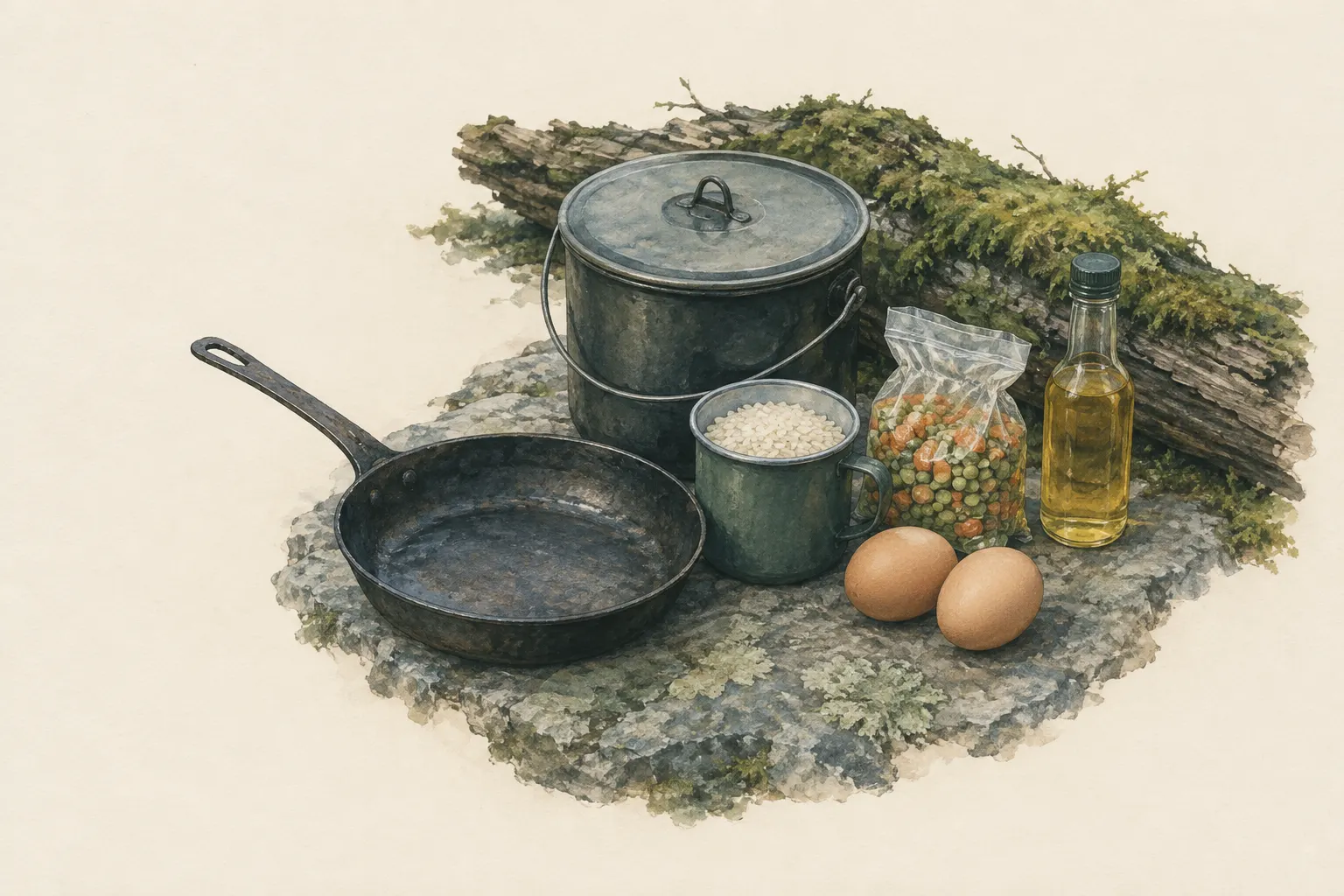
Explained simply
Fried rice is a pan dish: first you cook rice in the pot until soft. Then it goes into a pan with a little oil and vegetables, is fried until hot, and at the end you stir in an egg and add soy sauce.
You can carry almost everything for it in your backpack without a fridge: rice, dried vegetables, oil and little sachets of soy sauce. Only fresh eggs are delicate. For long trips there is egg powder.
One rule is very important: cooked rice is eaten straight away. If it stands around lukewarm for a long time, tiny germs can grow in it that cause tummy ache and vomiting. So: cook, fry, eat – and do not keep leftovers for later.
How it works
Rice grains are dry and hard. In boiling water they soak up water and become soft. You use about twice as much water as rice – with quick-cook rice the exact amount is on the packet. With a lid and a low flame this uses little fuel.
In the hot pan the moisture on the surface of the grains evaporates. That makes them stick together less, and some grains turn golden and crispy. The oil carries the flavour and stops the rice sticking to the pan.
The egg sets in the heat, as with scrambled egg, and binds the grains together. Soy sauce adds salt and a savoury flavour. Because it is very salty, one small sachet per person is enough.
Why the rice must be fresh
Rice can contain spores of a bacterium called Bacillus cereus. Spores are like tiny, very tough seeds: they even survive cooking. As long as the rice is hot or cold in the fridge, nothing happens.
But if cooked rice stands around lukewarm for hours, for example in the backpack or in the sun, the spores wake up, the bacteria multiply and form toxins. Some of these toxins are not destroyed even by frying. Anyone who eats it can get nausea and vomiting soon afterwards.
At home, fried rice is often made from the previous day's rice that was kept in the fridge. Outdoors there is no fridge. That is why you cook the rice just before frying and eat everything at once. The WHO advises not leaving cooked food at room temperature for more than two hours.
Safety at the stove
The stove always stays outdoors – never in the tent and never in the porch, not even in the rain. Burning produces carbon monoxide, a gas you can neither see nor smell. In a small space it can make people unconscious. Tent fabric also catches fire quickly. In the rain, cook under a tarp pitched high with open sides, or eat something cold.
Hot oil spits when wet vegetables go in. Drain the soaking water well. If the oil smokes, it is too hot – then turn the flame down. If fat catches fire, the lid goes on at once and the flame is turned off. Never pour water in: the burning fat would spray up.
With a burn, cool the spot at once with cool running water. With large burns, burns to the face or in children call 112, in Austria also 144.
Allergies and variations
This recipe contains several things some people are allergic to: egg, soy and usually wheat in the soy sauce, and often celery in vegetable mixes. Ask the people you are cooking for beforehand and read the ingredients list on the packets.
Without egg, the dish becomes vegan with roasted nuts or shelf-stable tofu – but nuts are a common allergen themselves. For a gluten-free version there is tamari, a soy sauce without wheat. If you only have one pot, fry everything directly in the rice pot.
Step by step
Set up a safe cooking spot
Set the stove up outdoors on firm, level ground, away from the tent, dry grass and backpacks. A windshield helps but must never fully enclose a gas canister, otherwise it gets too hot. Lay out the lid, spoon and all ingredients within reach before you light it.
Caution: Never cook in the tent or the porch.
- 1
Set up a safe cooking spot
Set the stove up outdoors on firm, level ground, away from the tent, dry grass and backpacks. A windshield helps but must never fully enclose a gas canister, otherwise it gets too hot. Lay out the lid, spoon and all ingredients within reach before you light it.
Never cook in the tent or the porch.
- 2
Soak the dried vegetables
Put the dried vegetables in a mug and pour enough clean water over them to cover them. Let them swell for about 10 minutes while the rice cooks. Freeze-dried vegetables soften faster than air-dried ones.
- 3
Cook the rice
Put about 80 to 100 g of rice per person, twice as much water and a pinch of salt into the pot. Bring to the boil, put the lid on and let it cook on the lowest flame until the water has been absorbed – with quick-cook rice for as long as the packet says. Do not set the rice aside and wait; carry on straight away.
Hold the pot with both hands and a pot grip when taking it off.
- 4
Fry the vegetables
Put the pan on the stove, add 1 tablespoon of oil per person and let it warm up on a medium flame. Pour the soaking water off the vegetables, put the vegetables in the pan and fry them for 2 to 3 minutes, stirring. Wet vegetables spit – so drain them well.
The oil must not smoke – otherwise turn the flame down.
- 5
Add the rice and fry
Put the freshly cooked rice into the pan, spread it out and leave it for a moment so it browns slightly. Then turn and stir for about 3 to 4 minutes until everything is hot and some grains turn crispy. Hold the pan firmly by the handle while you do this.
- 6
Stir in the egg
Push the rice to the side and crack the egg into the empty part of the pan. Stir the egg with the spatula until it is firm like scrambled egg, then mix it into the rice. With dried whole egg, mix the powder with a little water first. Wash your hands afterwards.
No runny egg visible any more – only then is it done.
- 7
Season and eat at once
Turn off the flame, drizzle soy sauce over it, stir and taste. Eat straight away while it is hot – careful, the rice holds heat for a long time. Do not keep leftovers for later; put them in the rubbish bag. Let the pan cool first, then wipe it out with a little water.
Common mistakes
- Cooking rice in the morning and frying it uncooled in the evening
- Cooking in the porch when it rains
- Putting wet vegetables into hot oil – it spits
- Too much oil and too big a flame
- Not cooking the egg right through
- Leaving the pan unattended on the stove
- Keeping leftovers in the warm pot for later
Quick view
Materials
Rice (quick-cook or long-grain)
Per person about 80–100 g dry rice; quick-cook rice saves fuel
Eat cooked rice soon – do not leave it lukewarm for hours, or germs can multiply and form toxins that reheating does not remove.
Store dry and out of animals' reach.
Dried vegetables (peas, carrots, pepper, corn)
Per person a handful (about 15–20 g)
Mixes often contain celery – an allergen; check the ingredients list.
Store dry and airtight.
Eggs (fresh) or dried whole egg
Per person 1 egg – fresh only on short trips, otherwise 1–2 tablespoons of dried whole egg
Allergen: egg.
Fresh eggs only on short trips, kept cool and in a rigid egg box; always cook eggs until white and yolk are firm.
Wash your hands after cracking eggs.
Cooking oil or cooking fat (tallow, lard)
Per person 1 tablespoon of cooking oil (e.g. rapeseed oil) in a leak-proof bottle
Never put out burning fat with water – cover it with a lid to smother it.
Do not mix with petrol, spirit or other highly flammable liquids.
Soy sauce in single-serve sachets
Per person 1 sachet (about 1 tablespoon)
Allergens: soy and usually wheat (gluten); tamari is often gluten-free – check the label.
Very salty – use sparingly.
Table salt
A pinch in the rice water
Salt improves keeping quality but does not replace heating through.
Collapsible water container or bag
Per person about 200 ml clean water for the rice plus a little for soaking
Protect from sharp objects.
Use only food-grade and only for water.
Metal pot (stainless steel, aluminium, titanium)
With lid, for the rice
Hot – scalding risk.
Frying pan with handle (non-stick, steel or cast iron)
Turn the handle inwards, never sticking out past the cooking spot – otherwise someone catches it.
Do not heat non-stick pans empty on high heat and do not put them straight into flames.
Metal handles get hot – use a pot holder or glove.
Fitting lid for pan or pot
If fat catches fire, put the lid on at once and turn off the heat – never water.
Tilt the lid away from you when lifting it so the steam does not rise into your face.
Spatula or wooden spoon
Do not leave plastic spatulas lying in hot fat – they melt.
Stove
Never operate inside a tent, shelter or enclosed room – carbon monoxide and fire risk.
Stove fuel (canister, liquid fuel, alcohol)
Store fuels apart from food and in original containers or bottles intended for them.
Store cool, well ventilated and out of children's reach.
Lighter, matches or ferro rod
Observe local fire bans.
Rubbish bag (resealable)
For eggshells and sachets
Suitable for
- Dinner on multi-day trips
- Cooking with stove, pan and pot
- Using up dried vegetables
- Children helping with the stirring
Not suitable for
- Rice that was cooked hours earlier and carried uncooled
- Cooking in the tent or the porch
- People with egg, soy or gluten allergy without a suitable substitute
- Very scarce water – then couscous is better
Prerequisites
- A stove you can operate safely
- A safe cooking spot outdoors
- Clean water
- With children: an adult at the stove
Safety
- If fat catches fire in the pan, never pour water in – the burning fat shoots up explosively. Put the lid (or a board) on at once, turn off the flame or push the pan off the fire, and leave the lid on for a long time. Do not carry the burning pan. With a burn or scald, cool it at once with cool running water, not with ice. With large burns, burns to the face or in children call 112 (in Austria also 144).
- The egg must be cooked right through – white and yolk firm. Take fresh eggs only on short trips and keep them cool; wash your hands after cracking them. Allergens in this recipe: egg, soy and wheat (gluten) in the soy sauce, often celery in the dried vegetables.
- Only use clean drinking water or safely treated water for cooking and for vegetables; wash your hands before cooking.
How it works
Rice absorbs water during cooking until the grains are soft. When fried in the hot pan, the moisture on the surface evaporates, the grains firm up a little and turn crispy in places, and the oil spreads the flavour. The egg sets in the heat and binds the grains. Because rice can contain spores that survive cooking, the safe way outdoors is: cook, fry, eat – without a long break in between.
Advantages
- Almost all ingredients keep without a fridge
- Filling and quick
- Easy to vary
- Good for cooking together with children
Disadvantages
- Needs pot and pan
- Fresh eggs are delicate
- Rice needs water and fuel
- Several allergens
Deep knowledge
Background
Fried rice is an everyday dish in many Asian cuisines, often made from the previous day's rice that was kept in the fridge. Outdoors there is no fridge – which is why we cook the rice fresh here.
The US Food and Drug Administration's handbook on foodborne pathogens (Bad Bug Book) describes Bacillus cereus: its spores survive cooking, and one form of the illness with nausea and vomiting is often linked to rice that stood warm too long after cooking. In its “Five Keys to Safer Food” the WHO advises not leaving cooked food at room temperature for more than two hours.
Variants
- For children
- Children may soak the vegetables, drizzle the soy sauce and stir at a distance while an adult holds the pan. Less soy sauce and a little more corn or peas make it milder.
- Vegan
- Instead of egg, add a handful of roasted peanuts or cashews (allergen: nuts!) or tofu from a shelf-stable pack. Everything else stays the same.
- Gluten-free
- Instead of normal soy sauce, use a tamari labelled gluten-free and watch for additives in the dried vegetables.
- Just one pot
- Without a pan: cook the rice, let the remaining water evaporate, add oil and vegetables straight into the pot and stir in the egg. It gets less crispy but saves weight and washing-up.
Common mistakes
- Cooking rice in the morning and frying it uncooled in the evening
- Cooking in the porch when it rains
- Putting wet vegetables into hot oil – it spits
- Too much oil and too big a flame
- Not cooking the egg right through
- Leaving the pan unattended on the stove
- Keeping leftovers in the warm pot for later
Limits and risks
- Amounts and times are guidelines – rice varieties take different times
- No instructions for meat or seafood in the rice
- Does not replace medical advice on allergies
Material alternatives
Derived from material properties: a substitute must have all relevant properties. Observe the notes on the substitute.
- Cooking oil or cooking fat (tallow, lard)
- Dry firewood (Collect only where permitted.), Tinder (Carry in waterproof packaging.), Char cloth (charred cotton) (Store dry in a tin.), Finest-grade steel wool (Store separately from batteries – fire risk.), Fatwood (resin-rich wood) (Collect only dead wood where permitted.), Stove fuel (canister, liquid fuel, alcohol) (Store fuels apart from food and in original containers or bottles intended for them.), Petroleum jelly cotton balls (Use only pure cotton.), Tree resin (spruce, pine) (Resin is flammable and sticks to the skin when hot – melt it only slowly over low heat.), Birch bark (from dead, fallen wood) (Never peel from living trees.)
- Collapsible water container or bag
- Single-wall stainless steel bottle (Heat only single-wall bottles without paint/plastic; remove the lid before heating.), Double-wall insulated bottle (Never heat directly.), PET bottle (clear, max. 2 litres) (Do not heat or place in a fire.), Food-grade water container (Only use containers that never held chemicals or fuel.), Airtight food-grade storage container (Fill only when clean and completely dry; never use containers that previously held chemicals.), Food-grade water bag (Use only for drinking water, never for chemicals or fuel.), Fermentation jar or crock (Use only food-grade containers of glass, food-safe glazed stoneware or food-grade plastic – no metal containers for acidic food.), Resealable food bags (Use only bags intended for food; do not use with boiling water unless the manufacturer explicitly allows it.)
- Metal pot (stainless steel, aluminium, titanium)
- Single-wall stainless steel bottle (Heat only single-wall bottles without paint/plastic; remove the lid before heating.)
- Stove fuel (canister, liquid fuel, alcohol)
- Dry firewood (Collect only where permitted.), Tinder (Carry in waterproof packaging.), Char cloth (charred cotton) (Store dry in a tin.), Finest-grade steel wool (Store separately from batteries – fire risk.), Fatwood (resin-rich wood) (Collect only dead wood where permitted.), Petroleum jelly cotton balls (Use only pure cotton.), Cooking oil or cooking fat (tallow, lard) (Never put out burning fat with water – cover it with a lid to smother it.), Tree resin (spruce, pine) (Resin is flammable and sticks to the skin when hot – melt it only slowly over low heat.), Birch bark (from dead, fallen wood) (Never peel from living trees.)
- Lighter, matches or ferro rod
- Ferro rod (Practise before you need it.), Fire striker and hard stone (Carbon steel, not stainless.), Bow drill set (bow, spindle, hearth board, bearing block) (Use only dry wood.), Burning lens / magnifier (Never leave lying in the sun – fire risk.), Fire piston (Maintain the seal.), Pump drill (spindle, flywheel, crossbar, cord) (Fix the flywheel firmly and centrally – a loose disc can fly off.)
Results come exclusively from structured entries. No improvised instructions are generated.
Sources (6)
- U.S. Food and Drug Administration (FDA) (2012): Bad Bug Book: Handbook of Foodborne Pathogenic Microorganisms and Natural Toxins, 2nd edition · Bacillus cereus: spores survive cooking; illness often from cooked rice left warm too long
- World Health Organization (WHO) (2006): Five Keys to Safer Food Manual · Keep clean, separate raw and cooked, cook thoroughly, do not leave cooked food at room temperature for more than two hours, use safe water
- European Parliament and Council of the European Union (2011): Regulation (EU) No 1169/2011 on the provision of food information to consumers · Major allergens that must be labelled, including cereals containing gluten, eggs, milk, soy, celery, mustard
- Centers for Disease Control and Prevention: Carbon Monoxide Poisoning – Prevention guidance · Never use stoves, grills or burners inside closed spaces or tents – carbon monoxide
- European Resuscitation Council – Resuscitation (journal) (2021): European Resuscitation Council Guidelines 2021: First Aid · Cool burns at once with cool running water; call emergency services for severe burns
- Mors L. Kochanski – Lone Pine Publishing: Bushcraft: Outdoor Skills and Wilderness Survival · Simple trail cooking with a stove and a few shelf-stable ingredients