























Hot cocoa and spiced tea for cold evenings
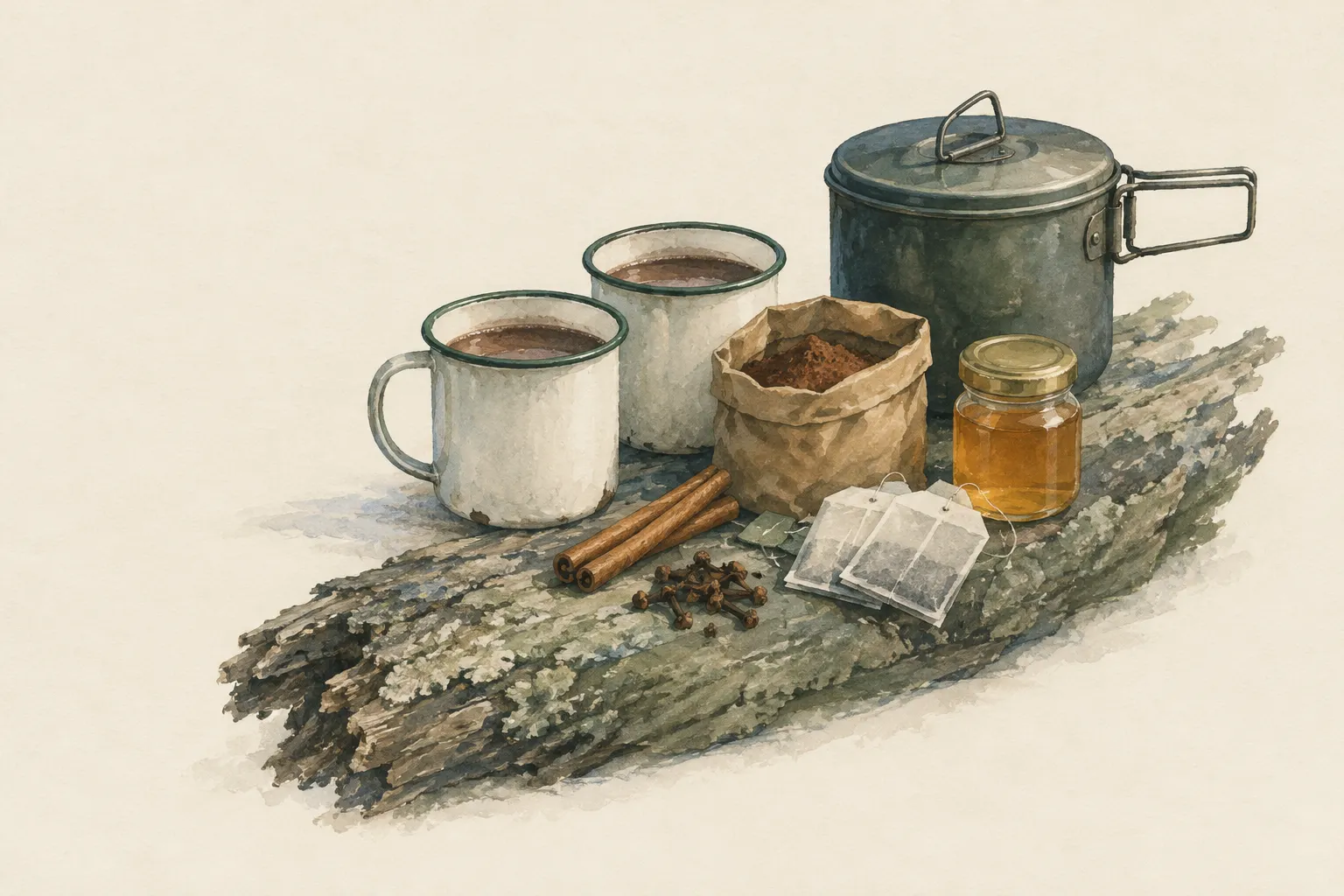
Two warm drinks from the backpack: cocoa from cocoa, milk and sugar powder, first stirred into a paste and then topped up with hot water; spiced tea from black or fruit tea with dried cinnamon, cloves and ginger, sweetened with honey. Hot drinks scald quickly – mugs only half full, children get their drink only after the lukewarm test. Alcohol does not belong in it.
- About 10 minutes
Explained simply
After a cold, wet day a hot drink feels really good. For cocoa you stir cocoa powder, milk powder and sugar with a little water into a thick mush. Then an adult pours in hot water – and you stir.
For spiced tea you boil water with a piece of cinnamon stick, cloves and dried ginger. Then a tea bag goes in. With a spoonful of honey it becomes sweet. Children get fruit tea instead of black tea.
Hot drinks scald very quickly. That is why you only fill the mug half full, drink sitting down and hold it with both hands. Before a child drinks, an adult checks with a drop on the wrist that it is only warm.
How it works
Cocoa powder is fatty and does not like water. If you tip it into hot water, the outer grains get wet at once and form a skin around dry powder – lumps form. If you first stir a paste with a little water, every grain gets wet on its own. After that everything mixes evenly.
Dried spices such as cinnamon, cloves and ginger release their flavour slowly. That is why they simmer for a few minutes. Tea leaves are different: black tea only steeps for three to four minutes, otherwise tannins are released and it tastes bitter.
What really matters
Per mug you need about 250 millilitres of clean water. Boil the water with the lid on – that is faster and saves fuel. If your water comes from a stream or lake, it must be treated safely first.
For cocoa, one to two teaspoons of cocoa, sugar and milk powder (as the packet says) go into the mug. Paste first, then hot water. For tea, put the spices in the water, let them simmer, turn off the stove and then hang the tea bag in. Stir in honey only once the water is no longer boiling.
Only use bought teas and spices. Plants you find outdoors do not belong in the mug – some look very similar to harmless herbs and are poisonous.
Safety: what to watch out for
Scalds are the biggest danger with hot drinks. Only pour into a mug that stands firmly on the ground, never into one someone is holding. Mugs only half to two-thirds full, drink sitting down, do not walk around with them. For children there is the lukewarm test: a drop on the wrist – it may only feel warm.
No honey for babies under one year: honey can contain spores of a bacterium that can make babies ill. No black tea for small children, because it contains caffeine. And no alcohol in the cocoa or tea – it does not really warm you, it only fakes warmth.
The stove stands outdoors, never in the tent or vestibule. Anyone who is very cold, shivering hard or seems confused needs more than a drink: dry clothing, shelter from the wind and help. Only someone who is awake and can swallow safely gets a warm, sweet drink.
When it makes sense – and when it does not
Warm drinks are ideal in the evening, early morning and after rain. They warm your hands, provide fluid that people often forget in the cold, and lift the mood. A vacuum flask of spiced tea is worth its weight in gold on winter trips.
But a hot drink does not replace warm clothing or first aid. Do not leave milk drinks in the flask for hours – better make them fresh. And where there is no clean water, water treatment comes first.
Step by step
Set up a safe cooking spot
Set the stove up outdoors on firm, level ground, at least a few steps away from the tent, and shield it from the wind with a backpack or stones. Lay out all ingredients, spoons and the pot grip within reach before you light it. Children get a fixed seat at a distance. Put the mugs on a level spot next to you, not on the path where someone could trip.
Caution: Never cook in the tent or vestibule – carbon monoxide and fire danger.
- 1
Set up a safe cooking spot
Set the stove up outdoors on firm, level ground, at least a few steps away from the tent, and shield it from the wind with a backpack or stones. Lay out all ingredients, spoons and the pot grip within reach before you light it. Children get a fixed seat at a distance. Put the mugs on a level spot next to you, not on the path where someone could trip.
Never cook in the tent or vestibule – carbon monoxide and fire danger.
- 2
Measure and heat water
Pour about 250 to 300 millilitres of clean water per person into the pot and bring it to the boil with the lid on – with the lid it is faster and saves fuel. If your water is not safe to drink, it must be treated first.
- 3
Stir a cocoa paste
Put cocoa, sugar and milk powder into each cocoa mug. Stir the powder with two tablespoons of cold or lukewarm water into a smooth, thick paste until no dry crumbs are left.
- 4
Pour on the cocoa
Turn the stove off. An adult holds the pot with the pot grip and slowly pours hot water onto the paste until the mug is half to two-thirds full. Stir as you pour.
Pour away from your body, the mug stands – nobody holds it in their hand.
- 5
Steep the spiced tea
For the tea, put the dried spices into the remaining water and let them simmer gently for three to five minutes. Then stove off, tea bag in and steep for three to four minutes, fruit tea a little longer. Take out the tea bag and spices.
- 6
Sweeten with honey
Pour the tea into the mugs and stir in a teaspoon of honey or sugar. Add the honey only once the tea is no longer boiling. Babies under one year get no honey.
- 7
Lukewarm test for children
Before a child gets their mug, an adult puts a drop on the inside of their own wrist. If it feels hot, wait a few minutes or add a splash of cold, clean water. Then everyone drinks sitting down and holds the mug with both hands.
- 8
Tidy up
Tea bags, leftover spices and packaging go into the rubbish bag and are taken home. Rinse the mugs with a little water and scatter the rinsing water well away from water. Do not leave cocoa leftovers standing in the mug for hours.
Common mistakes
- Tipping cocoa and milk powder straight into hot water – it clumps
- Filling mugs to the brim
- Walking around with a hot mug
- Giving children their drink without a temperature test
- Steeping tea bags too long – bitter
- Mixing in alcohol to warm up
- Throwing tea bags into nature
Quick view
Materials
Cocoa powder or drinking chocolate powder
1–2 teaspoons of cocoa per mug (or 2–3 tablespoons of ready-made drinking chocolate)
Ready mixes can contain milk, soy or traces of nuts – read the ingredient list.
Cocoa contains a little caffeine and the related substance theobromine – keep it weak for small children in the evening.
Milk powder (whole milk powder)
For about 250 ml of milk per mug as the packet says
Only mix with clean water (drinking water or treated).
Use mixed milk promptly, do not leave it standing in the warmth.
Allergen: milk (also lactose).
Sugar and cinnamon
1–2 teaspoons of sugar per mug to taste
Keep dry in a tight tin or bag – damp sugar clumps.
Tea bags and dried spices
Per person 1 tea bag, a piece of cinnamon stick, 1–2 cloves, a slice of dried ginger
Only bought teas and spices from the packet – no foraged wild plants.
Black tea contains caffeine – give children fruit tea.
Honey (in a squeeze bottle)
1 teaspoon per mug
No honey for babies under one year (risk of infant botulism).
Metal pot (stainless steel, aluminium, titanium)
About 250–300 ml of clean water per person
Hot – scalding risk.
Mug with a handle
Metal mugs get very hot at the rim – careful with your lips, only fill them half full.
Spatula and cooking spoon
A spoon for stirring
Do not leave a plastic spatula on the hot rim of the pan – it melts.
Double-wall insulated bottle
Keeps tea hot for later – not for milk drinks over hours
Never heat directly.
Stove
Never operate inside a tent, shelter or enclosed room – carbon monoxide and fire risk.
Stove fuel (canister, liquid fuel, alcohol)
Store fuels apart from food and in original containers or bottles intended for them.
Store cool, well ventilated and out of children's reach.
Suitable for
- Cold evenings and mornings at the campsite
- Warming up after rain or wind
- A cosy round with children
- Longer trips – everything dry and light
Not suitable for
- A substitute for treating hypothermia – then call for help and preserve warmth
- Honey for babies under one year
- Black tea for small children (caffeine)
- Cooking in the tent or vestibule
Prerequisites
- Able to use a stove safely
- Clean drinking water or treated water
- Mugs with handles
- A calm place to sit and drink
Safety
- Children only get their mug once an adult has done the lukewarm test: put a drop on the inside of the wrist – it should feel only warm, not hot. To get there, let the mug stand for a while or top it up with a little cold, clean water. No black tea for small children, no honey under one year.
- No alcohol in the cocoa or tea. Alcohol only gives a false feeling of warmth, impairs judgement at the stove and is off-limits for children. Anyone who is very cold, shivering hard or confused needs to be kept warm and needs help – not just a drink.
- Allergen: milk (milk powder, many cocoa mixes); ready mixes can contain soy or traces of nuts. Only use bought teas and spices, no foraged wild plants.
How it works
Cocoa and milk powder dissolve poorly in hot water: the outer grains swell at once and trap dry powder – it clumps. If you first stir a smooth paste with a little water, every grain gets wet, and after that everything mixes with hot water. With tea, dried spices release their aroma mainly in simmering water, while tea leaves should only steep briefly, otherwise the tea becomes bitter.
Advantages
- Warms hands and tummy and lifts the mood
- Also counts as fluid – important in the cold
- Very light, long-lasting ingredients
- Quick to make, little fuel
Disadvantages
- High risk of scalds, especially for children
- Cocoa with milk powder is an allergen
- Black tea contains caffeine – not for small children
- Does not replace keeping warm in hypothermia
Deep knowledge
Background
Warm drinks are doubly useful in the cold: they provide fluid, which people often forget in winter, and sugar gives quick energy. But they do not replace warm clothing or protection from wind and wet. For hypothermia, the Wilderness Medical Society guidelines recommend protecting the person from further heat loss; warm, sweet drinks are only an option for people who are awake and can swallow safely.
Honey can contain spores of the bacterium Clostridium botulinum. For adults this is harmless, but in babies the spores can germinate in the gut – so children under one year get no honey.
Variants
- Kids' version: cocoa with a cinnamon stick
- Children stir their own cocoa paste and get a cinnamon stick as a stirrer. Their cocoa is made with a little less hot water and a splash of cold water and only handed out after the lukewarm test. Instead of black tea they get fruit tea.
- Vegan and milk-free
- Stir pure baking cocoa (without milk powder) with sugar and a plant drink or simply with water. Oat drink makes it creamy – oat drink can contain gluten, soy drink contains soy. Sweeten the tea with sugar or maple syrup instead of honey.
- For the trail in a vacuum flask
- Spiced tea can be made in the morning and carried hot in a pre-warmed vacuum flask. Rinse the flask with hot water first. Better to make milk drinks fresh than keep them in the flask for hours.
Common mistakes
- Tipping cocoa and milk powder straight into hot water – it clumps
- Filling mugs to the brim
- Walking around with a hot mug
- Giving children their drink without a temperature test
- Steeping tea bags too long – bitter
- Mixing in alcohol to warm up
- Throwing tea bags into nature
Limits and risks
- No statements on caffeine amounts for children – when in doubt fruit tea
- Always mix milk powder as the packet says
- No substitute for first aid in hypothermia
Material alternatives
Derived from material properties: a substitute must have all relevant properties. Observe the notes on the substitute.
- Metal pot (stainless steel, aluminium, titanium)
- Single-wall stainless steel bottle (Heat only single-wall bottles without paint/plastic; remove the lid before heating.)
- Double-wall insulated bottle
- Single-wall stainless steel bottle (Heat only single-wall bottles without paint/plastic; remove the lid before heating.), PET bottle (clear, max. 2 litres) (Do not heat or place in a fire.), Food-grade water container (Only use containers that never held chemicals or fuel.), Airtight food-grade storage container (Fill only when clean and completely dry; never use containers that previously held chemicals.), Collapsible water container or bag (Protect from sharp objects.), Food-grade water bag (Use only for drinking water, never for chemicals or fuel.), Fermentation jar or crock (Use only food-grade containers of glass, food-safe glazed stoneware or food-grade plastic – no metal containers for acidic food.), Resealable food bags (Use only bags intended for food; do not use with boiling water unless the manufacturer explicitly allows it.)
- Stove fuel (canister, liquid fuel, alcohol)
- Dry firewood (Collect only where permitted.), Tinder (Carry in waterproof packaging.), Char cloth (charred cotton) (Store dry in a tin.), Finest-grade steel wool (Store separately from batteries – fire risk.), Fatwood (resin-rich wood) (Collect only dead wood where permitted.), Petroleum jelly cotton balls (Use only pure cotton.), Cooking oil or cooking fat (tallow, lard) (Never put out burning fat with water – cover it with a lid to smother it.), Tree resin (spruce, pine) (Resin is flammable and sticks to the skin when hot – melt it only slowly over low heat.), Birch bark (from dead, fallen wood) (Never peel from living trees.)
Results come exclusively from structured entries. No improvised instructions are generated.
Sources (7)
- European Resuscitation Council – Resuscitation (journal) (2021): European Resuscitation Council Guidelines 2021: First Aid · Cool burns and scalds at once with cool running water; call emergency services for severe burns
- Wilderness & Environmental Medicine (Wilderness Medical Society) (2019): Wilderness Medical Society Clinical Practice Guidelines for the Out-of-Hospital Evaluation and Treatment of Accidental Hypothermia: 2019 Update · In hypothermia, prevent further heat loss; warm, sweet drinks only for alert people who can swallow safely
- U.S. Food and Drug Administration (FDA) (2012): Bad Bug Book: Handbook of Foodborne Pathogenic Microorganisms and Natural Toxins, 2nd edition · Clostridium botulinum: honey as a known source of spores in infant botulism
- World Health Organization (WHO) (2006): Five Keys to Safer Food Manual · Use safe water
- Centers for Disease Control and Prevention: Carbon Monoxide Poisoning – Prevention guidance · Never run fuel-burning appliances in enclosed spaces such as tents – carbon monoxide is invisible and odourless
- European Parliament and Council of the European Union (2011): Regulation (EU) No 1169/2011 on the provision of food information to consumers · List of major allergens that must be labelled (incl. cereals containing gluten, milk, eggs, nuts, soy, celery)
- Leave No Trace Center for Outdoor Ethics: The Seven Principles of Leave No Trace (Principle 5: Minimize Campfire Impacts) · Pack out rubbish and food scraps, keep fires small and put them out completely