























Rice pudding with retained heat
Rice pudding takes a long time – on the stove that would be a lot of fuel. With retained heat it is economical: simmer short-grain rice in milk from powder for a few minutes while stirring, turn the stove off, pack the pot with its lid into an insulating cosy of sleeping bag or jacket and let it swell for a good half hour. Never with the stove or a flame in the cosy – and afterwards eat it hot at once.
- Cooking about 10 minutes; swelling in the insulation 30–40 minutes
Explained simply
Rice pudding needs half an hour or longer to get soft. If the stove burns the whole time, a lot of gas is gone afterwards. So there is a trick: you only cook the rice briefly, and the heat in the pot does the rest.
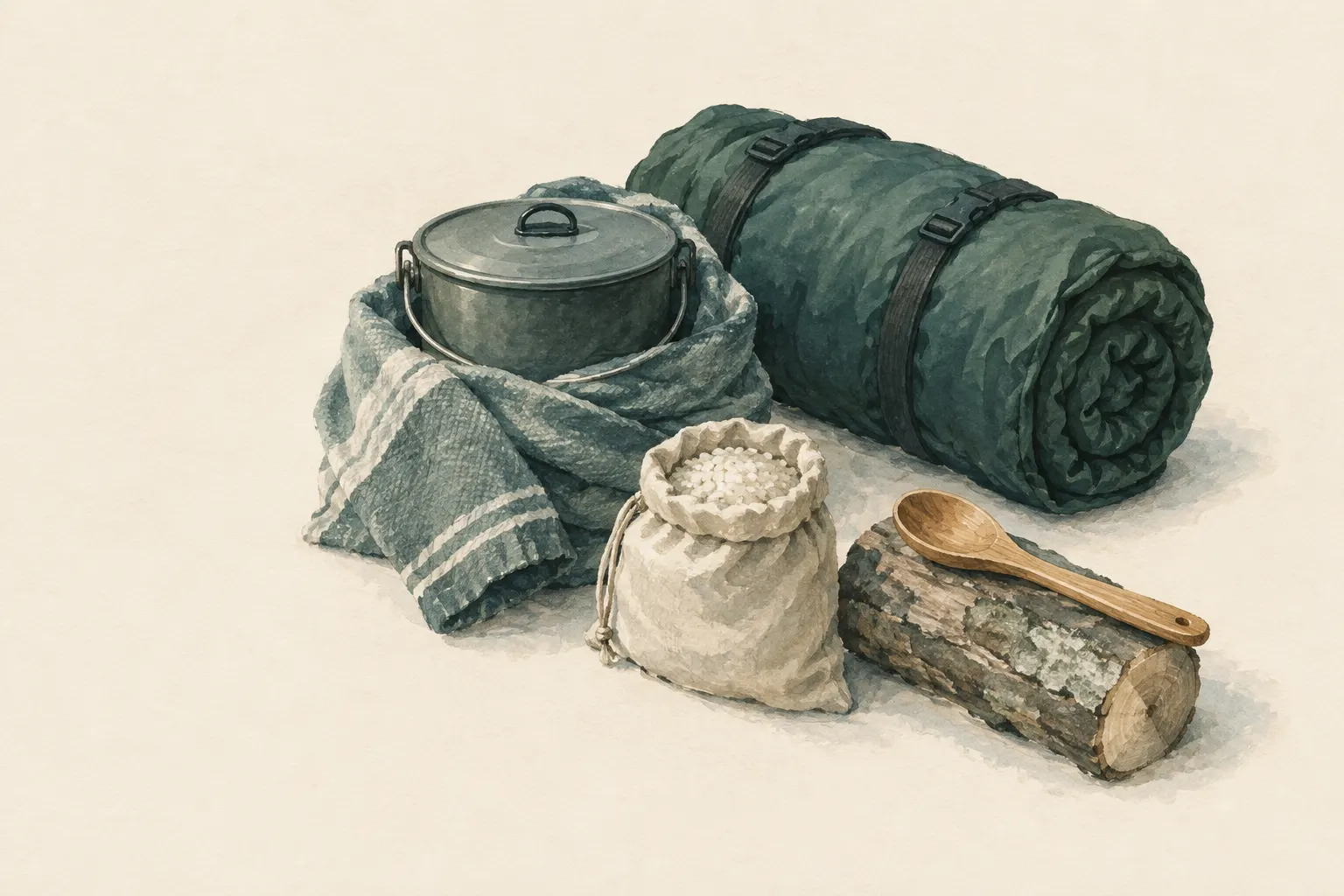
You cook rice and milk for ten minutes while stirring, turn the stove off, put the lid on firmly and wrap the pot in a towel and then in a sleeping bag or a thick jacket. Like in a hot-water bottle it stays hot in there, and the rice softens in peace.
Two rules are really important: only the pot goes into the cosy, never the stove or a flame. And the rice pudding is eaten hot straight away – not left lukewarm and not kept for tomorrow.
How it works
Rice grains soften when they are hot enough and can take up liquid. For that it does not have to bubble all the time – a high temperature is enough. A pot full of hot milk holds a lot of stored heat. If it cannot escape, the pot stays hot for a long time.
The insulation from a sleeping bag or jacket works the same way as for you at night: lots of little air pockets in down or fleece hold the warmth in. The fuller the pot, the tighter the lid and the thicker the cosy, the longer it stays hot. In wind and cold everything cools faster – then you need more insulation or a little more cooking time.
What really matters
Use short-grain rice, also called pudding rice. It releases a lot of starch and becomes creamy; long-grain rice stays grainy. Per person, allow about 60 grams of rice and 300 millilitres of milk from powder. Stir in the sugar only at the end, because sugar burns quickly on the bottom of the pot.
Before you start, build the cosy: sleeping pad or board as a base, a towel and the sleeping bag or jacket next to it – well away from the stove. After simmering everything happens quickly: stove off, lid on firmly, pot into the towel and then into the cosy. Every peek lets heat out, so keep it closed for a good half hour.
After unwrapping, check: is the rice soft and the pudding still steaming hot? If not, bring it briefly to the boil while stirring. Only then is it eaten.
Safety: what to watch out for
Only the hot pot goes into the insulation. A burning stove in a sleeping bag or tent would be life-threatening: fire danger and carbon monoxide. The stove stays outside and cools down. So that the hot pot base does not melt any synthetic fibres, wrap it in a towel first.
Rice needs special care. The bacterium Bacillus cereus is often present in rice. Its spores survive cooking. If cooked rice stands lukewarm for hours, they can grow and form a toxin that causes vomiting and does not disappear even when reheated. The WHO advises not leaving cooked food at room temperature for more than two hours. So: eat it hot, do not keep leftovers.
When you open it, hot steam rushes out. Lift the lid away from you so the steam does not rise into your face. For children, first test at the edge that it is only warm.
When it makes sense – and when it does not
Retained heat is always worthwhile when fuel is short or something has to cook for a long time – rice pudding, but also lentils or pasta. In the evening the pot can wait in the jacket while you pitch the tent.
It is a poor choice if you need your only sleeping bag dry and have no towel, or in a strong freezing wind without good insulation. At high altitude water boils at a lower temperature – there rice softens more slowly and needs more time or a second boil.
Step by step
Prepare the cooking spot and the cosy
Set the stove up outdoors on firm, level ground, at least a few steps away from the tent, and shield it from the wind with a backpack or stones. Lay out all ingredients, spoons and the pot grip within reach before you light it. Children get a fixed seat at a distance. Get the insulating cosy ready now: sleeping pad or board as a base, sleeping bag or jacket on top, and a towel – well away from the stove.
Caution: Never cook in the tent or vestibule – carbon monoxide and fire danger.
- 1
Prepare the cooking spot and the cosy
Set the stove up outdoors on firm, level ground, at least a few steps away from the tent, and shield it from the wind with a backpack or stones. Lay out all ingredients, spoons and the pot grip within reach before you light it. Children get a fixed seat at a distance. Get the insulating cosy ready now: sleeping pad or board as a base, sleeping bag or jacket on top, and a towel – well away from the stove.
Never cook in the tent or vestibule – carbon monoxide and fire danger.
- 2
Mix the milk, add the rice
Stir the milk powder smooth in the pot with a little cold, clean water and then add the rest – about 300 millilitres per person. Add the rice and a pinch of salt and stir. Add the sugar only at the end; that way less burns on.
- 3
Bring to the boil while stirring
Heat everything over a medium flame and stir constantly across the bottom. As soon as the milk rises and bubbles, turn the flame right down at once – milk boils over in seconds.
Have someone hold the pot while stirring, face away from the steam.
- 4
Simmer for five to ten minutes
Let the rice simmer quietly over the lowest flame for five to ten minutes, stirring every half minute. The pudding slowly thickens. At the end put the lid on firmly.
- 5
Stove off, wrap the pot
Turn off the stove. Wrap the closed pot in the towel, set it on the base and pack it all round in the sleeping bag or jacket – on top too. Only the pot: the stove and canister stay outside and cool down.
Never put a burning stove or flame into the insulation.
- 6
Wait 30–40 minutes
Leave the pot wrapped for a good half hour and do not open it in between – every opening lets heat escape. You can pitch the tent or fetch water in the meantime.
- 7
Check: soft and hot
Unwrap the pot and lift the lid away from you. The rice should be soft and the pudding steaming hot. If the rice is still hard or the pudding only lukewarm, bring it briefly to the boil while stirring. Then stir in the sugar.
- 8
Eat at once, keep nothing
Share out the rice pudding, sprinkle cinnamon and sugar over it and eat it straight away. For children, first test at the edge that it is only warm. Do not keep leftovers overnight. Soak the pot at once.
Common mistakes
- Packing the stove or a flame into the insulation
- Setting the pot straight onto synthetic fabric without a towel
- Lid not tight – steam soaks the sleeping bag
- Opening it too early to have a look
- Leaving rice pudding lukewarm for hours or keeping leftovers
- Cooking sugar from the start – it burns
- Long-grain instead of short-grain rice – the pudding does not get creamy
Quick view
Materials
Pudding rice (short-grain rice)
About 60 g (4 heaped tablespoons) per person
Do not leave cooked rice lukewarm for hours – germs can grow in it whose toxin survives reheating.
Store dry and out of animals' reach.
Milk powder (whole milk powder)
For about 300 ml of milk per person: powder with clean water as the packet says
Only mix with clean water (drinking water or treated).
Use mixed milk promptly, do not leave it standing in the warmth.
Allergen: milk (also lactose).
Sugar and cinnamon
1 tablespoon of sugar per person, cinnamon sugar to sprinkle
Keep dry in a tight tin or bag – damp sugar clumps.
Table salt
A pinch
Salt improves keeping quality but does not replace heating through.
Metal pot (stainless steel, aluminium, titanium)
Pot with a well-fitting lid, at most half full
Hot – scalding risk.
Spatula and cooking spoon
Do not leave a plastic spatula on the hot rim of the pan – it melts.
Sleeping bag
As an insulating cosy – or a down/fleece jacket, hay box
Do not store compressed long-term; do not pack away damp.
Insulated cooking box (hay box, thermal cooker)
Ready-made hay box or insulated pouch instead of a sleeping bag
Never put open flame or embers inside – only the hot, closed pot.
Keep the insulation clean and dry.
Apples
Apple compote or dried fruit as a topping
Wash with clean water before cutting.
Take cores and peel back with you – apple scraps are rubbish too.
Stove
Never operate inside a tent, shelter or enclosed room – carbon monoxide and fire risk.
Stove fuel (canister, liquid fuel, alcohol)
Store fuels apart from food and in original containers or bottles intended for them.
Store cool, well ventilated and out of children's reach.
Suitable for
- Camps with little fuel
- Cold evenings, while the pot waits in the jacket
- Groups and families
- Longer trips – all ingredients are dry
Not suitable for
- Sleeping bags you urgently need dry and clean for the night, without a protective cover
- People with a milk allergy (without adapting it)
- Very cold wind without good insulation – the pot cools too quickly
- Cooking in the tent or vestibule
Prerequisites
- Able to use a stove safely
- A pot with a tight-fitting lid
- An insulating cosy that may get hot (sleeping bag protected with a towel, jacket, hay box)
- Clean water for the milk
Safety
- A pot straight from the flame can melt synthetic fibres. Wrap the pot in a towel or cotton stuff sack first and set it on a sleeping pad or a board. Put the lid on firmly so no steam soaks the sleeping bag.
- Cooked rice must not stand lukewarm for hours: germs (Bacillus cereus) can grow in it whose toxin is not destroyed by reheating. After swelling, check that the rice pudding is still steaming hot and eat it at once. If it is only lukewarm, bring it back to the boil while stirring. Do not keep leftovers.
- When opening the cosy and the lid, hot steam rushes out – lift the lid away from you. With a burn or scald, cool at once with cool running water, not with ice. Carefully remove soaked clothing if it is not stuck to the skin. With large burns, burns to the face or in children call 112 (in Austria also 144).
- Allergen: milk. Rice itself is gluten-free, but ready-made toppings or plant drinks can contain gluten, soy or nuts.
How it works
Rice grains only soak up liquid and soften when they are hot enough – constant boiling is not needed for that. If the pot is well insulated after boiling, the contents stay hot for a long time because the insulation lets hardly any heat escape. During this time the rice keeps cooking gently without burning. A full pot and a tight lid matter: the more hot mass there is, the more slowly it cools.
Advantages
- Saves a lot of fuel compared with long simmering
- Does not burn in the insulation
- Hands free for other jobs while it swells
- All ingredients dry and long-lasting
Disadvantages
- Takes almost an hour in total
- Sleeping bag or jacket can get damp or stained
- Only with a tight lid and good insulation
- Lukewarm rice is a hygiene risk
Deep knowledge
Background
Retained-heat cooking is an old method: in the past, pots were put into boxes filled with hay (a “hay box”). Outdoors, a sleeping bag or down jacket takes over this job. The WHO recommends either keeping cooked food hot or cooling it quickly and not leaving it at room temperature for more than two hours.
With rice this is especially important: the bacterium Bacillus cereus is common in rice and forms heat-resistant spores. If cooked rice is left lukewarm for a long time, they can germinate and form a toxin that causes vomiting and is not destroyed by reheating. Hence the rule: eat it hot, do not keep leftovers.
Variants
- Kids' version: rice pudding buffet
- Children may build the insulating cosy and watch the waiting time with a timer or watch. Afterwards they put together their own topping from cinnamon sugar, apple compote and raisins. Let portions cool on flat plates.
- Vegan with plant drink
- Instead of milk powder, use a long-life rice, oat or soy drink; tinned coconut milk makes it especially creamy. Plant drinks burn a little faster – so an even lower flame. Watch out for the allergens in the drinks.
- With a hay box or insulated pouch
- A ready-made hay box or an insulated pot pouch replaces sleeping bag and jacket. More on this in the entry on retained-heat cooking.
Common mistakes
- Packing the stove or a flame into the insulation
- Setting the pot straight onto synthetic fabric without a towel
- Lid not tight – steam soaks the sleeping bag
- Opening it too early to have a look
- Leaving rice pudding lukewarm for hours or keeping leftovers
- Cooking sugar from the start – it burns
- Long-grain instead of short-grain rice – the pudding does not get creamy
Limits and risks
- Swelling times are guidelines – longer in cold and wind, when in doubt cook again
- No temperature reading without a thermometer: steaming hot is the goal
- Not at high altitude without adjusting – water boils at a lower temperature there and rice cooks more slowly
Material alternatives
Derived from material properties: a substitute must have all relevant properties. Observe the notes on the substitute.
- Metal pot (stainless steel, aluminium, titanium)
- Single-wall stainless steel bottle (Heat only single-wall bottles without paint/plastic; remove the lid before heating.)
- Sleeping bag
- Sleeping pad, Dry leaves, grass or conifer boughs (Collect only where allowed; no protected plants. Check for ticks and insects.), Backpack, Dry spare clothing (Carry it in waterproof packaging – wet clothing barely insulates.), Wool blanket / duvet (Keep away from candles, stoves and heaters.), Insulated cool box (Keeps cold only for a limited time; without ice packs or ice it is not a fridge.), Newspaper and cardboard (Flammable – keep away from candles, stoves, heaters and embers.), Insulated cooking box (hay box, thermal cooker) (Never put open flame or embers inside – only the hot, closed pot.), Long-stemmed thatch (reed, grass, rushes) (Extremely flammable – no open fire and no sparks nearby.), Pot insulation (pot cosy, beanie or fleece jacket) (Only around a pot that is no longer on the stove – fabric catches fire at the flame.)
- Insulated cooking box (hay box, thermal cooker)
- Sleeping pad, Dry leaves, grass or conifer boughs (Collect only where allowed; no protected plants. Check for ticks and insects.), Backpack, Dry spare clothing (Carry it in waterproof packaging – wet clothing barely insulates.), Wool blanket / duvet (Keep away from candles, stoves and heaters.), Insulated cool box (Keeps cold only for a limited time; without ice packs or ice it is not a fridge.), Sleeping bag (Do not store compressed long-term; do not pack away damp.), Newspaper and cardboard (Flammable – keep away from candles, stoves, heaters and embers.), Long-stemmed thatch (reed, grass, rushes) (Extremely flammable – no open fire and no sparks nearby.), Pot insulation (pot cosy, beanie or fleece jacket) (Only around a pot that is no longer on the stove – fabric catches fire at the flame.)
- Stove fuel (canister, liquid fuel, alcohol)
- Dry firewood (Collect only where permitted.), Tinder (Carry in waterproof packaging.), Char cloth (charred cotton) (Store dry in a tin.), Finest-grade steel wool (Store separately from batteries – fire risk.), Fatwood (resin-rich wood) (Collect only dead wood where permitted.), Petroleum jelly cotton balls (Use only pure cotton.), Cooking oil or cooking fat (tallow, lard) (Never put out burning fat with water – cover it with a lid to smother it.), Tree resin (spruce, pine) (Resin is flammable and sticks to the skin when hot – melt it only slowly over low heat.), Birch bark (from dead, fallen wood) (Never peel from living trees.)
Results come exclusively from structured entries. No improvised instructions are generated.
Sources (6)
- World Health Organization (WHO) (2006): Five Keys to Safer Food Manual · Keep cooked food hot or cool it quickly, do not leave it at room temperature for more than two hours
- U.S. Food and Drug Administration (FDA) (2012): Bad Bug Book: Handbook of Foodborne Pathogenic Microorganisms and Natural Toxins, 2nd edition · Bacillus cereus in rice: heat-resistant spores and an emetic toxin that survives heating
- Centers for Disease Control and Prevention: Carbon Monoxide Poisoning – Prevention guidance · Never run fuel-burning appliances in enclosed spaces such as tents – carbon monoxide is invisible and odourless
- United States Department of Agriculture – Food Safety and Inspection Service (USDA FSIS): High Altitude Cooking and Food Safety · At high altitude water boils at a lower temperature; cooking times get longer
- European Resuscitation Council – Resuscitation (journal) (2021): European Resuscitation Council Guidelines 2021: First Aid · Cool burns and scalds at once with cool running water; call emergency services for severe burns
- European Parliament and Council of the European Union (2011): Regulation (EU) No 1169/2011 on the provision of food information to consumers · List of major allergens that must be labelled (incl. cereals containing gluten, milk, eggs, nuts, soy, celery)