























Sausages on a stick
The simplest campfire classic: pre-cooked sausages are pushed onto a peeled hazel stick and turned over the embers until they are hot inside. What matters is a stick of safely non-toxic wood, embers instead of flames and clear rules for children at the fire. Sausages from a jar or tin need no fridge while unopened; vegetarian sausages work just the same.
- Prepare embers 30–60 minutes; sausages 5–10 minutes per stick
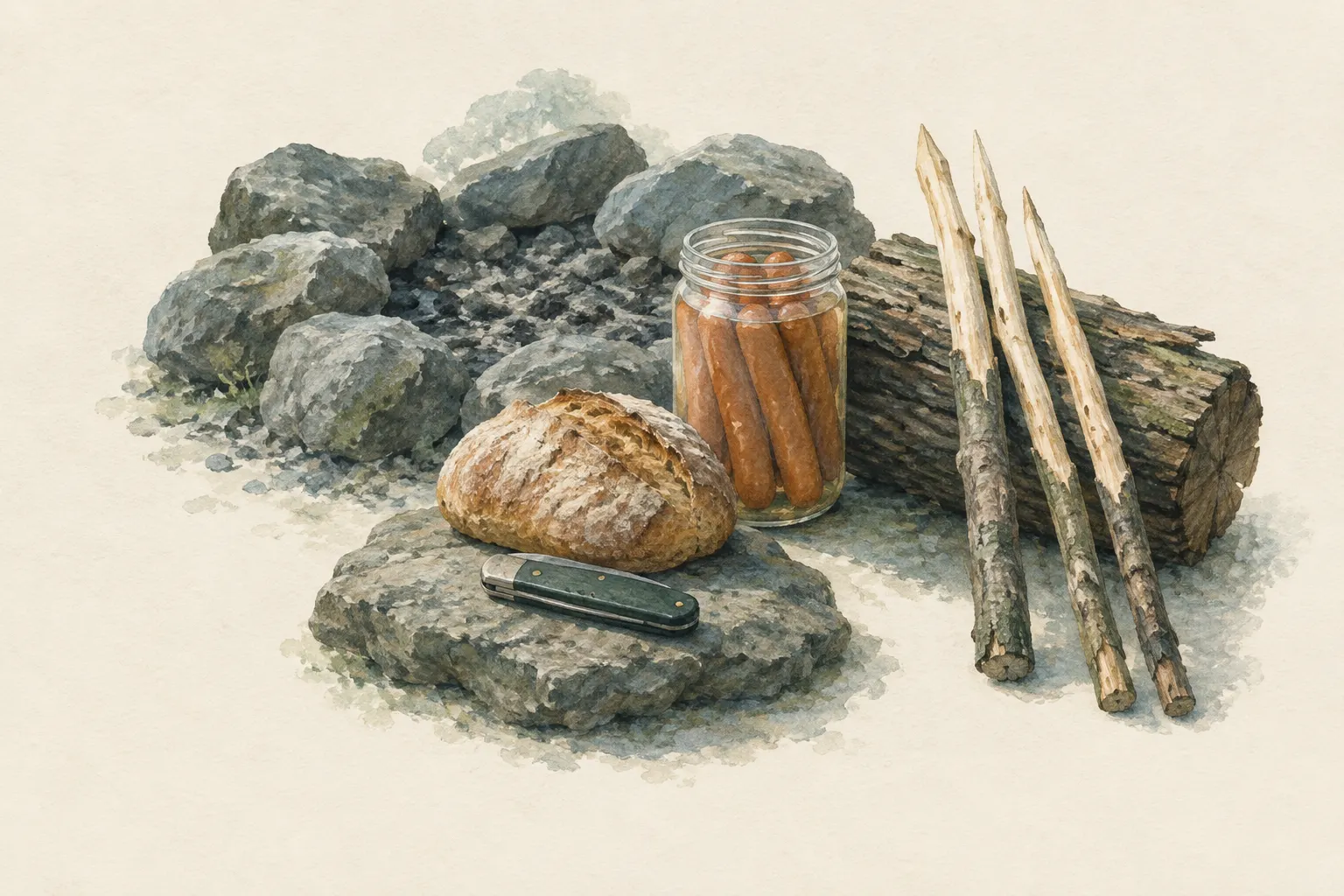
Explained simply
Sausages on a stick are the simplest food at the campfire. You push a sausage onto a long, peeled stick and turn it over the hot embers until it is brown all round and hot inside.
Not every stick is allowed. Some shrubs and trees are poisonous, for example yew. So an adult chooses a stick they know for sure – ideally from a hazel bush – and peels the tip.
There are fixed rules at the fire: you sit in your seat, hold the stick with both hands and never run around with it. The tip always points at the fire or down. And before you bite in, you blow – the sausage is very hot inside.
How it works
Sausages such as wieners or frankfurters are already cooked when you buy them. At the fire you only have to heat them right through. The skin turns brown and gets a tasty roasted flavour.
Embers give off calm, even heat – similar to an oven. Flames, on the other hand, flicker, make the skin black and sooty and let it burst while the middle is still cold. That is why you wait until the fire has burned down to embers and hold the sausage one to two hand-widths above them.
Turning gives every side the same amount of heat. After about 5 to 10 minutes the sausage is steaming. To check, break one in half: if it is hot inside, it is done.
The right stick
Because the stick touches the food, the wood must be safely non-toxic. Hazel is a good choice: the rods are straight, flexible and easy to recognise. Never use yew, laburnum, black locust, thuja, cherry laurel or elder – these shrubs and trees are poisonous.
If you do not recognise a shrub for certain, take a different stick or bring sticks from home. Fresh sticks from living shrubs are only cut with the landowner's permission. The front 15 to 20 centimetres are peeled so that no bark and no dirt gets onto the food.
A good stick is about one to one and a half metres long and as thick as a thumb. That keeps hands and face far enough from the embers, and the stick does not sag.
Children at the fire and fresh sausages
Children love sausages on a stick – and that is exactly why clear rules are needed, discussed beforehand: a fixed seat at a distance, a circle around the fire that nobody steps into, the stick never pointing at other people. If a sausage catches fire, it is blown out, not waved. One adult looks after nothing but the fire.
Sausages in a jar or tin keep unopened without a fridge and are therefore ideal for trips. Vacuum-packed sausages from the chilled shelf are perishable: they travel in the cool box and are eaten the same day. Raw bratwurst is not suitable for the stick because it easily stays raw inside.
Sausages often contain mustard, celery or milk; vegetarian sausages often soy, egg, milk or gluten. A look at the label helps everyone with allergies. And at the end the fire site is put out completely with plenty of water.
Step by step
Choose the sausages and keep them cool
Pre-cooked sausages work best. Sausages in a jar or tin keep unopened without a fridge – ideal for trips. Vacuum-packed sausages only from the cool box and on the same day. It is better to fry raw bratwurst right through in a pan.
- 1
Choose the sausages and keep them cool
Pre-cooked sausages work best. Sausages in a jar or tin keep unopened without a fridge – ideal for trips. Vacuum-packed sausages only from the cool box and on the same day. It is better to fry raw bratwurst right through in a pan.
- 2
Choose and peel the stick
Take a straight, roughly thumb-thick stick 1 to 1.5 m long of reliably known wood such as hazel. Cut green wood only with permission, otherwise bring sticks along. An adult peels the front 15 to 20 cm with the knife – away from the body – and carves a blunt point.
Never yew, laburnum, black locust, thuja, cherry laurel, elder.
- 3
Agree the rules at the fire
Explain before grilling: everyone has a fixed seat at a distance from the fire, there is a circle around the fire that nobody steps into, the stick always points at the fire or down, nobody runs around with it. One adult looks after nothing but the fire.
- 4
Wait for embers
Let the fire of dry hardwood burn down until there are plenty of red embers with white-grey ash, or rake an ember bed to the edge. High flames are no good for grilling – the sausages turn black outside and stay cold inside.
- 5
Skewer the sausages
Push the sausage lengthwise onto the peeled tip through the middle, about two-thirds of the way, so it does not slip off when turned. Small nicks in the skin stop it bursting uncontrollably. Wipe your hands afterwards before you hold the stick.
- 6
Turn over the embers
Hold the sausage one to two hand-widths above or beside the embers, never in the flames, and turn the stick slowly. After about 5 to 10 minutes the skin is browned all round and the sausage is steaming. Break one in half to check: it must be hot inside.
If the skin blackens quickly, the sausage is too close.
- 7
Cool, eat, tidy up
Pull the sausage off the stick, let it cool briefly and eat it with bread and mustard – careful, very hot inside. Put hot sticks down with the tip pointing down, do not throw them into the fire while children are sitting next to it. Take the jar, tin and packaging back with you and put the fire out completely with plenty of water at the end.
Common mistakes
- Holding sausages in the flames – black outside, cold inside
- A stick of unknown or poisonous wood
- An unpeeled, dirty stick tip
- Running around or waving the stick
- Carrying vacuum-packed sausages uncooled all day
- Only briefly warming raw bratwurst
- Biting in straight away
Quick view
Materials
Sausages (pre-cooked, in a jar, tin or vacuum pack) or vegetarian sausages
Per person 2–3 sausages (pre-cooked or vegetarian)
Sausages in a jar or tin keep unopened without a fridge; vacuum-packed ones only from a cool box and eaten the same day.
Sausages often contain mustard, celery or milk, vegetarian ones often soy, egg, milk or gluten – check the label.
Raw bratwurst is not a stick sausage: it has to be cooked right through.
Sturdy sticks / poles
One stick per person, about 1–1.5 m long, thumb-thick, of hazel or other safely non-toxic wood
Do not cut live wood where prohibited.
Knife (fixed or locking blade)
For peeling the stick tip – only an adult or a practised child
Cut away from your body.
Rules on carrying knives differ by region – check local rules.
Dry firewood
Dry hardwood for good embers
Collect only where permitted.
Lighter, matches or ferro rod
Observe local fire bans.
Water for extinguishing (bucket, canister or pot)
Have several litres ready before lighting.
Insulated cool box
Only for vacuum-packed sausages on day trips
Keeps cold only for a limited time; without ice packs or ice it is not a fridge.
Leather or heat-resistant gloves
Synthetic gloves melt onto the skin – only leather or certified heat-resistant gloves.
Wet gloves conduct heat quickly.
Rubbish bag (resealable)
For jar, tin and packaging
Suitable for
- Campfires with children, families and groups
- Cooking without any cookware
- Combining with stick bread
- Short breaks at an existing fire site
Not suitable for
- A fire ban or high wildfire danger
- Raw bratwurst – it has to be cooked right through
- Sticks from unknown or poisonous shrubs
- Very small children without constant company at the fire
Prerequisites
- A permitted fire site with good embers
- Sticks of reliably known wood – green wood only with permission
- With children: one adult who looks after nothing but the fire
- Water to put the fire out
Safety
- Children sit or kneel at a distance from the fire, hold the stick with both hands and never run around with a hot stick. The tip always points at the fire or down. If a sausage catches fire, do not wave it – blow it out. Synthetic jackets melt when hit by sparks.
- Vacuum-packed sausages are perishable: only from the cool box and on the same day. Unopened sausages in a jar or tin keep without cooling; once opened, eat them at once. Heat sausages until they are hot inside too. Allergens: often mustard, celery, milk; vegetarian sausages often soy, egg, milk or gluten.
- With a burn or scald, cool it at once with cool running water, not with ice. With large burns, burns to the face or in children call 112 (in Austria also 144). Fire only where it is allowed and there is no wildfire danger – use existing fire sites, keep water ready to put it out and extinguish the fire completely at the end. Take foil, tins and packaging back with you.
How it works
Pre-cooked sausages such as wieners or frankfurters are already cooked when you buy them. At the fire they are only heated and get a roasted skin. Embers radiate calm, even heat; in flames the skin soots and bursts while the middle stays cold. Turning all the time spreads the heat all round. A long stick keeps hands and face far enough from the heat.
Advantages
- No cookware needed
- Quick and simple
- Children love it
- Sausages in a jar keep without cooling
Disadvantages
- Needs a fire and good embers
- Risk of burns, especially for children
- Jars and tins are heavy
- Not allowed everywhere
Deep knowledge
Background
Sausages on a stick belong to every scout and family campfire in Central Europe, often together with stick bread. The rules for the wood are the same as for stick bread: because the stick touches the food, only safely non-toxic wood such as hazel will do. The German Federal Institute for Risk Assessment (BfR) lists yew, laburnum, black locust, thuja and cherry laurel among the poisonous shrubs and trees.
Outdoors the same hygiene applies as at home: keep perishables cool, heat thoroughly and do not leave cooked food standing warm for hours.
Variants
- Vegetarian and vegan sausages
- Vegetarian sausages are grilled the same way but are often softer: choose thicker kinds, push them on only half as far and turn them further away so they do not fall off. Check the label for soy, egg, milk and gluten.
- For children
- For small children, cut the sausages in half – they heat up faster. Children grill sitting down, with the stick resting on a forked branch or a stone so their arms do not get tired. Let them blow on the sausage briefly before eating.
- With stick bread
- Push a sausage onto the stick and wind a strip of stick-bread dough around it in a spiral. Then bake more slowly and further away until the dough is dry inside.
Common mistakes
- Holding sausages in the flames – black outside, cold inside
- A stick of unknown or poisonous wood
- An unpeeled, dirty stick tip
- Running around or waving the stick
- Carrying vacuum-packed sausages uncooled all day
- Only briefly warming raw bratwurst
- Biting in straight away
Limits and risks
- No cooking times for raw bratwurst or raw meat on a stick – use a pan and thermometer for that
- Times are guidelines
- Only applies where fire is allowed
Material alternatives
Derived from material properties: a substitute must have all relevant properties. Observe the notes on the substitute.
- Dry firewood
- Tinder (Carry in waterproof packaging.), Char cloth (charred cotton) (Store dry in a tin.), Finest-grade steel wool (Store separately from batteries – fire risk.), Fatwood (resin-rich wood) (Collect only dead wood where permitted.), Stove fuel (canister, liquid fuel, alcohol) (Store fuels apart from food and in original containers or bottles intended for them.), Petroleum jelly cotton balls (Use only pure cotton.), Cooking oil or cooking fat (tallow, lard) (Never put out burning fat with water – cover it with a lid to smother it.), Tree resin (spruce, pine) (Resin is flammable and sticks to the skin when hot – melt it only slowly over low heat.), Birch bark (from dead, fallen wood) (Never peel from living trees.)
- Lighter, matches or ferro rod
- Ferro rod (Practise before you need it.), Fire striker and hard stone (Carbon steel, not stainless.), Bow drill set (bow, spindle, hearth board, bearing block) (Use only dry wood.), Burning lens / magnifier (Never leave lying in the sun – fire risk.), Fire piston (Maintain the seal.), Pump drill (spindle, flywheel, crossbar, cord) (Fix the flywheel firmly and centrally – a loose disc can fly off.)
- Insulated cool box
- Sleeping pad, Dry leaves, grass or conifer boughs (Collect only where allowed; no protected plants. Check for ticks and insects.), Backpack, Dry spare clothing (Carry it in waterproof packaging – wet clothing barely insulates.), Wool blanket / duvet (Keep away from candles, stoves and heaters.), Sleeping bag (Do not store compressed long-term; do not pack away damp.), Newspaper and cardboard (Flammable – keep away from candles, stoves, heaters and embers.), Insulated cooking box (hay box, thermal cooker) (Never put open flame or embers inside – only the hot, closed pot.), Long-stemmed thatch (reed, grass, rushes) (Extremely flammable – no open fire and no sparks nearby.), Pot insulation (pot cosy, beanie or fleece jacket) (Only around a pot that is no longer on the stove – fabric catches fire at the flame.)
Results come exclusively from structured entries. No improvised instructions are generated.
Sources (7)
- Bundesinstitut für Risikobewertung (BfR) (2017): Risiko Pflanze – Einschätzung und Hinweise · Yew, laburnum, black locust, thuja, cherry laurel as poisonous shrubs and trees
- World Health Organization (WHO) (2006): Five Keys to Safer Food Manual · Keep clean, separate raw and cooked, cook thoroughly, do not leave cooked food at room temperature for more than two hours, use safe water
- European Parliament and Council of the European Union (2011): Regulation (EU) No 1169/2011 on the provision of food information to consumers · Major allergens that must be labelled, including cereals containing gluten, eggs, milk, soy, celery, mustard
- USDA Forest Service / Ad Council / National Association of State Foresters: Campfire Safety (Smokey Bear wildfire prevention campaign) · Never leave a fire unattended, keep water ready, put it out completely
- European Resuscitation Council – Resuscitation (journal) (2021): European Resuscitation Council Guidelines 2021: First Aid · Cool burns at once with cool running water; call emergency services for severe burns
- Leave No Trace Center for Outdoor Ethics: The Seven Principles of Leave No Trace (Principle 5: Minimize Campfire Impacts) · Pack out rubbish, keep fires small, use existing fire sites and put fires out completely
- Ray Mears – Hodder & Stoughton (2002): Bushcraft · Campfire cooking with embers rather than flames