























Fried potatoes with onions
Raw potatoes need no fridge: you boil them in their skins on the spot, let them steam dry, slice them and fry them golden with onions in a little oil. The trick is patience – leave them, only then turn. And for emergencies: if fat catches fire, the lid goes on and the heat goes off, never water.
- About 45–50 minutes: boiling 20–25 minutes, steaming dry 10 minutes, frying 10–15 minutes
Explained simply
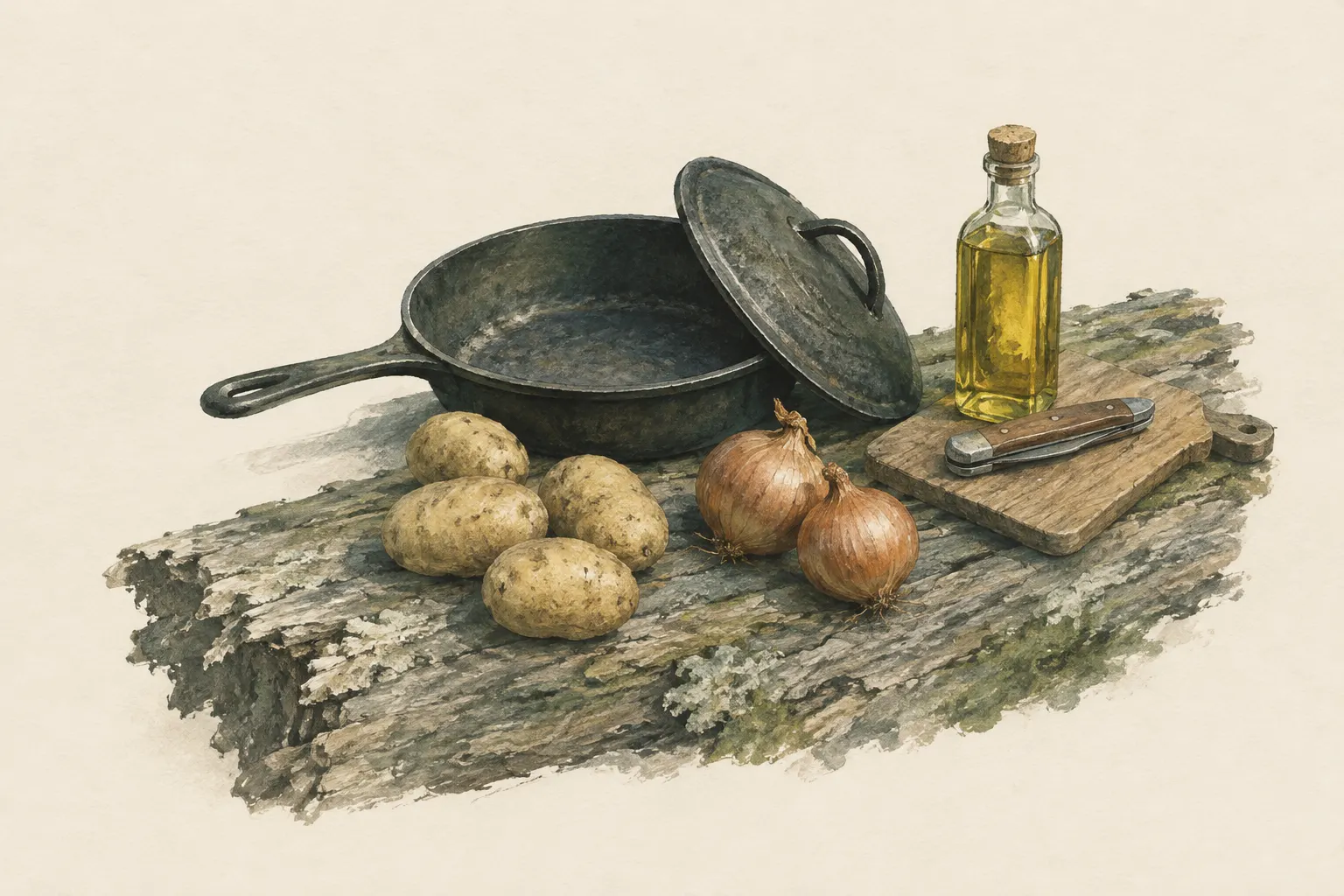
Fried potatoes are slices of boiled potato fried crispy and golden in the pan with a little oil. Onions go in at the end. The good thing: raw potatoes keep in the backpack without a fridge.
First you boil the potatoes in their skins until soft and let them steam until they are dry. Then you cut them into slices. The secret of frying is patience: leave the slices alone until they are brown underneath, only then turn them.
Hot oil can catch fire. There is one very important rule for that: never water on burning fat! Instead the lid goes on the pan and the flame is turned off. Without air the fire goes out.
How it works
During boiling the potato becomes soft inside – that takes water and time, usually 20 to 25 minutes depending on size. When frying it does not need to cook any more; that is only where the crust forms. That is why the frying afterwards is fairly quick.
A crust only forms on a dry surface. If the potato is wet, the water evaporates first, the slice steams instead of frying and the oil spits. That is why you let the boiled potatoes steam dry uncovered until they look dry.
If the slices lie side by side in a single layer, each one touches the hot bottom of the pan. Putting in too many at once or stirring constantly gives you soft, broken potatoes. Onions contain sugar and burn quickly – they only go in during the last few minutes.
What to do if fat catches fire
When oil gets very hot, it starts to smoke and can eventually catch fire by itself. That happens mainly when the flame is too big or the pan is held in open flames. So you watch the heat: if the oil smokes, turn the flame down.
If fat is burning, you must never pour water in. Water is heavier than oil, sinks to the bottom and turns to steam instantly in the heat. The steam hurls the burning fat upwards in a ball of fire – that can cause severe burns.
The right way is: lid on, flame off or pan pushed off the fire, lid left on for a long time. Without oxygen the fire is smothered. That is why the lid is always within reach when frying. You do not carry the burning pan around – burning fat easily slops out.
Cooking safely outdoors
The stove always stays outdoors – never in the tent and never in the porch, not even in the rain. Burning produces carbon monoxide, a gas you can neither see nor smell. In a small space it can make people unconscious. Tent fabric also catches fire quickly. In the rain, cook under a tarp pitched high with open sides, or eat something cold.
Green patches and sprouts on potatoes contain the natural bitter compound solanine. You cut them away generously; very green potatoes you do not use at all. Boiled potatoes from home are perishable – they only travel in the cool box and are fried the same day.
You do not pour the cooking water into a stream or lake but onto the ground far away from water. You wipe fat leftovers out of the cooled pan with paper and take them with you. With a burn, cool it at once with cool running water, and for severe burns call 112, in Austria also 144.
Step by step
Lay out the cooking spot and lid
Set the stove up outdoors on firm, level ground, away from the tent, dry grass and backpacks. A windshield helps but must never fully enclose a gas canister, otherwise it gets too hot. Lay out the lid, spoon and all ingredients within reach before you light it. The pan lid lies next to the pan the whole time: if fat catches fire, it goes on at once and the flame is turned off – never water.
Caution: Never put out burning fat with water.
- 1
Lay out the cooking spot and lid
Set the stove up outdoors on firm, level ground, away from the tent, dry grass and backpacks. A windshield helps but must never fully enclose a gas canister, otherwise it gets too hot. Lay out the lid, spoon and all ingredients within reach before you light it. The pan lid lies next to the pan the whole time: if fat catches fire, it goes on at once and the flame is turned off – never water.
Never put out burning fat with water.
- 2
Boil the potatoes in their skins
Rub the potatoes clean with clean water, cut away green patches and sprouts and choose potatoes of the same size. Put them in the pot in their skins, just cover with water, salt and boil with the lid on until a knife slides in easily – usually 20 to 25 minutes. Small potatoes cook faster.
- 3
Drain and let them steam dry
Take the pot off the stove, open the lid a crack and pour the water off away from your body – not into a stream. Let the potatoes steam dry uncovered for about 10 minutes until the surface looks dry.
Steam rises when you pour – keep your face away.
- 4
Cut
Cut the potatoes on a small board into slices about a finger wide; the skin can stay on. Peel the onion and cut it into strips or dice. When cutting, curl in the fingers of your holding hand and never cut towards your body.
- 5
Heat the oil, lay in the slices
Pan on a medium flame, 1 to 2 tablespoons of oil per person. When the oil is hot but not smoking, lay the potato slices in side by side with the spatula – ideally just one layer, so they all go crispy.
If the oil smokes, turn the flame down – it is too hot.
- 6
Leave them, then turn
Fry the slices undisturbed for 4 to 5 minutes until the underside is golden brown. Then turn them and brown the other side the same way. Altogether it takes about 10 to 15 minutes. Always hold the pan by the handle when you stir.
- 7
Add the onions and season
In the last 5 minutes add the onions and fry them along until they are soft and golden. Then salt them and add pepper or a little paprika to taste. If the onions turn black, the flame is too big.
- 8
Serve and let the pan cool
Turn off the flame, eat the fried potatoes straight from the pan or share them out onto plates and eat them warm. Put the hot pan on the ground with the handle turned in, where nobody trips over it. Only once it has cooled, wipe out the fat with paper and take it with you.
Common mistakes
- Trying to put out burning fat with water
- Putting wet potatoes into hot oil
- Too many potatoes at once – they steam instead of frying
- Stirring all the time before a crust has formed
- Adding the onions right at the start – they burn
- Pouring cooking water into the stream
- Tipping fat leftovers into the bushes
Quick view
Materials
Potatoes (waxy)
Per person about 250–300 g waxy potatoes
Cut away green patches, sprouts and eyes generously – that is where the natural bitter compound solanine sits.
Raw potatoes need no fridge, cooked ones do: keep boiled potatoes cool on the way and eat them the same day.
Onions
Per person half an onion
Curl your fingers in when cutting and cut on a firm surface.
Cooking oil or cooking fat (tallow, lard)
Per person 1–2 tablespoons of cooking oil (e.g. rapeseed oil)
Never put out burning fat with water – cover it with a lid to smother it.
Do not mix with petrol, spirit or other highly flammable liquids.
Table salt
Salt for the cooking water and for seasoning
Salt improves keeping quality but does not replace heating through.
Spice mix in small tubs (paprika, cumin, salt, pepper)
Pepper, a little paprika
Ready-made seasoning mixes can contain celery, mustard or gluten – check the ingredients list.
Keep tightly closed and dry.
Collapsible water container or bag
About 1 l clean water for up to 2 people
Protect from sharp objects.
Use only food-grade and only for water.
Metal pot (stainless steel, aluminium, titanium)
With lid, for boiling the potatoes
Hot – scalding risk.
Frying pan with handle (non-stick, steel or cast iron)
Turn the handle inwards, never sticking out past the cooking spot – otherwise someone catches it.
Do not heat non-stick pans empty on high heat and do not put them straight into flames.
Metal handles get hot – use a pot holder or glove.
Fitting lid for pan or pot
Within reach the whole time – in case of a fat fire
If fat catches fire, put the lid on at once and turn off the heat – never water.
Tilt the lid away from you when lifting it so the steam does not rise into your face.
Spatula or wooden spoon
Do not leave plastic spatulas lying in hot fat – they melt.
Knife (fixed or locking blade)
For cutting, with a small board
Cut away from your body.
Rules on carrying knives differ by region – check local rules.
Stove
Never operate inside a tent, shelter or enclosed room – carbon monoxide and fire risk.
Stove fuel (canister, liquid fuel, alcohol)
Store fuels apart from food and in original containers or bottles intended for them.
Store cool, well ventilated and out of children's reach.
Lighter, matches or ferro rod
Observe local fire bans.
Suitable for
- Dinner at camp
- Trips with potatoes in the pack (keep without cooling)
- Side dish with sausages or a fried egg
- Groups – potatoes are cheap
Not suitable for
- Very limited fuel or water
- Cooking in the tent or the porch
- Wobbly stoves with a large, heavy pan
- Ultralight trips – potatoes are heavy
Prerequisites
- A stove or good embers with a stable spot for the pan
- Able to use a knife safely
- About one litre of clean water
- A fitting lid
Safety
- Hot oil spits when wet potatoes go in – so let them steam dry and slide the slices in with the spatula, away from your body. Pour the cooking water off away from your body. With a burn or scald, cool it at once with cool running water, not with ice. With large burns, burns to the face or in children call 112 (in Austria also 144).
- Cut green patches, sprouts and eyes away from potatoes generously and do not use very green potatoes. Only take boiled potatoes from home in a cool box and fry them the same day. Eat cooked food straight away while it is hot. Do not leave leftovers lukewarm in the pot or in the sun for hours – germs can multiply. Whatever is not eaten within about two hours and cannot be cooled goes into the rubbish bag.
How it works
Potatoes cook through inside while boiling; frying is only about the crust. For that, the surface must be dry: steamed-dry potatoes brown, wet ones only steam and spit. If the slices lie still in the hot fat, a golden crust forms. Stirring all the time breaks them up. Onions contain sugar and burn faster – they only go in at the end.
Advantages
- Raw potatoes keep for a long time without cooling
- Cheap and very filling
- Vegan with oil
- A classic almost everyone likes
Disadvantages
- Potatoes are heavy
- Needs water, fuel and time
- Hot fat is a fire hazard
- Two pieces of cookware needed
Deep knowledge
Background
Fried potatoes are among the best-known home-cooked dishes in Germany and Austria (where they are also called “geröstete Erdäpfel”). Outdoors they have one advantage: raw potatoes need no fridge.
Potatoes contain the natural bitter compound solanine in green patches and sprouts; these parts are cut away. Burning fat is a typical cause of cooking fires – water turns to steam in it instantly and hurls burning fat out. That is why a fat fire is smothered: lid on, heat off.
Variants
- For children
- Children can rub the potatoes clean and cut the boiled, cooled potatoes with a blunt knife. An adult handles the hot oil; children watch from a distance and may season at the end.
- Vegan and with egg
- With oil the basic recipe is vegan. If you like, crack one egg per person into the pan at the end and let it cook right through (farmer's breakfast).
- On the embers
- Instead of a stove: put a cast-iron pan on a stable grate or flat stones over an ember bed. Embers give more even heat than flames; never hold the pan in high flames, because the fat catches fire more easily then.
- Pre-boiled at home
- For a day trip you can boil the potatoes the evening before, let them cool in the fridge and carry them in a cool box. That saves water and fuel outdoors, and you only need to fry them.
Common mistakes
- Trying to put out burning fat with water
- Putting wet potatoes into hot oil
- Too many potatoes at once – they steam instead of frying
- Stirring all the time before a crust has formed
- Adding the onions right at the start – they burn
- Pouring cooking water into the stream
- Tipping fat leftovers into the bushes
Limits and risks
- Times are guidelines – they depend on potato size, stove and altitude
- No instructions for deep-frying in lots of fat
- Applies to waxy potatoes; floury ones fall apart more easily
Material alternatives
Derived from material properties: a substitute must have all relevant properties. Observe the notes on the substitute.
- Cooking oil or cooking fat (tallow, lard)
- Dry firewood (Collect only where permitted.), Tinder (Carry in waterproof packaging.), Char cloth (charred cotton) (Store dry in a tin.), Finest-grade steel wool (Store separately from batteries – fire risk.), Fatwood (resin-rich wood) (Collect only dead wood where permitted.), Stove fuel (canister, liquid fuel, alcohol) (Store fuels apart from food and in original containers or bottles intended for them.), Petroleum jelly cotton balls (Use only pure cotton.), Tree resin (spruce, pine) (Resin is flammable and sticks to the skin when hot – melt it only slowly over low heat.), Birch bark (from dead, fallen wood) (Never peel from living trees.)
- Collapsible water container or bag
- Single-wall stainless steel bottle (Heat only single-wall bottles without paint/plastic; remove the lid before heating.), Double-wall insulated bottle (Never heat directly.), PET bottle (clear, max. 2 litres) (Do not heat or place in a fire.), Food-grade water container (Only use containers that never held chemicals or fuel.), Airtight food-grade storage container (Fill only when clean and completely dry; never use containers that previously held chemicals.), Food-grade water bag (Use only for drinking water, never for chemicals or fuel.), Fermentation jar or crock (Use only food-grade containers of glass, food-safe glazed stoneware or food-grade plastic – no metal containers for acidic food.), Resealable food bags (Use only bags intended for food; do not use with boiling water unless the manufacturer explicitly allows it.)
- Metal pot (stainless steel, aluminium, titanium)
- Single-wall stainless steel bottle (Heat only single-wall bottles without paint/plastic; remove the lid before heating.)
- Stove fuel (canister, liquid fuel, alcohol)
- Dry firewood (Collect only where permitted.), Tinder (Carry in waterproof packaging.), Char cloth (charred cotton) (Store dry in a tin.), Finest-grade steel wool (Store separately from batteries – fire risk.), Fatwood (resin-rich wood) (Collect only dead wood where permitted.), Petroleum jelly cotton balls (Use only pure cotton.), Cooking oil or cooking fat (tallow, lard) (Never put out burning fat with water – cover it with a lid to smother it.), Tree resin (spruce, pine) (Resin is flammable and sticks to the skin when hot – melt it only slowly over low heat.), Birch bark (from dead, fallen wood) (Never peel from living trees.)
- Lighter, matches or ferro rod
- Ferro rod (Practise before you need it.), Fire striker and hard stone (Carbon steel, not stainless.), Bow drill set (bow, spindle, hearth board, bearing block) (Use only dry wood.), Burning lens / magnifier (Never leave lying in the sun – fire risk.), Fire piston (Maintain the seal.), Pump drill (spindle, flywheel, crossbar, cord) (Fix the flywheel firmly and centrally – a loose disc can fly off.)
Results come exclusively from structured entries. No improvised instructions are generated.
Sources (6)
- Springer (H.-D. Belitz, W. Grosch, P. Schieberle) (2009): Food Chemistry, 4th edition · Solanine (glycoalkaloids) in green potato parts as a natural toxin
- World Health Organization (WHO) (2006): Five Keys to Safer Food Manual · Keep clean, separate raw and cooked, cook thoroughly, do not leave cooked food at room temperature for more than two hours, use safe water
- Centers for Disease Control and Prevention: Carbon Monoxide Poisoning – Prevention guidance · Never use stoves, grills or burners inside closed spaces or tents – carbon monoxide
- European Resuscitation Council – Resuscitation (journal) (2021): European Resuscitation Council Guidelines 2021: First Aid · Cool burns at once with cool running water; call emergency services for severe burns
- Leave No Trace Center for Outdoor Ethics: The Seven Principles of Leave No Trace (Principle 5: Minimize Campfire Impacts) · Pack out rubbish, keep fires small, use existing fire sites and put fires out completely
- Ray Mears – Hodder & Stoughton (2002): Bushcraft · Cooking at camp with a pan over embers