























Upgrading instant noodles
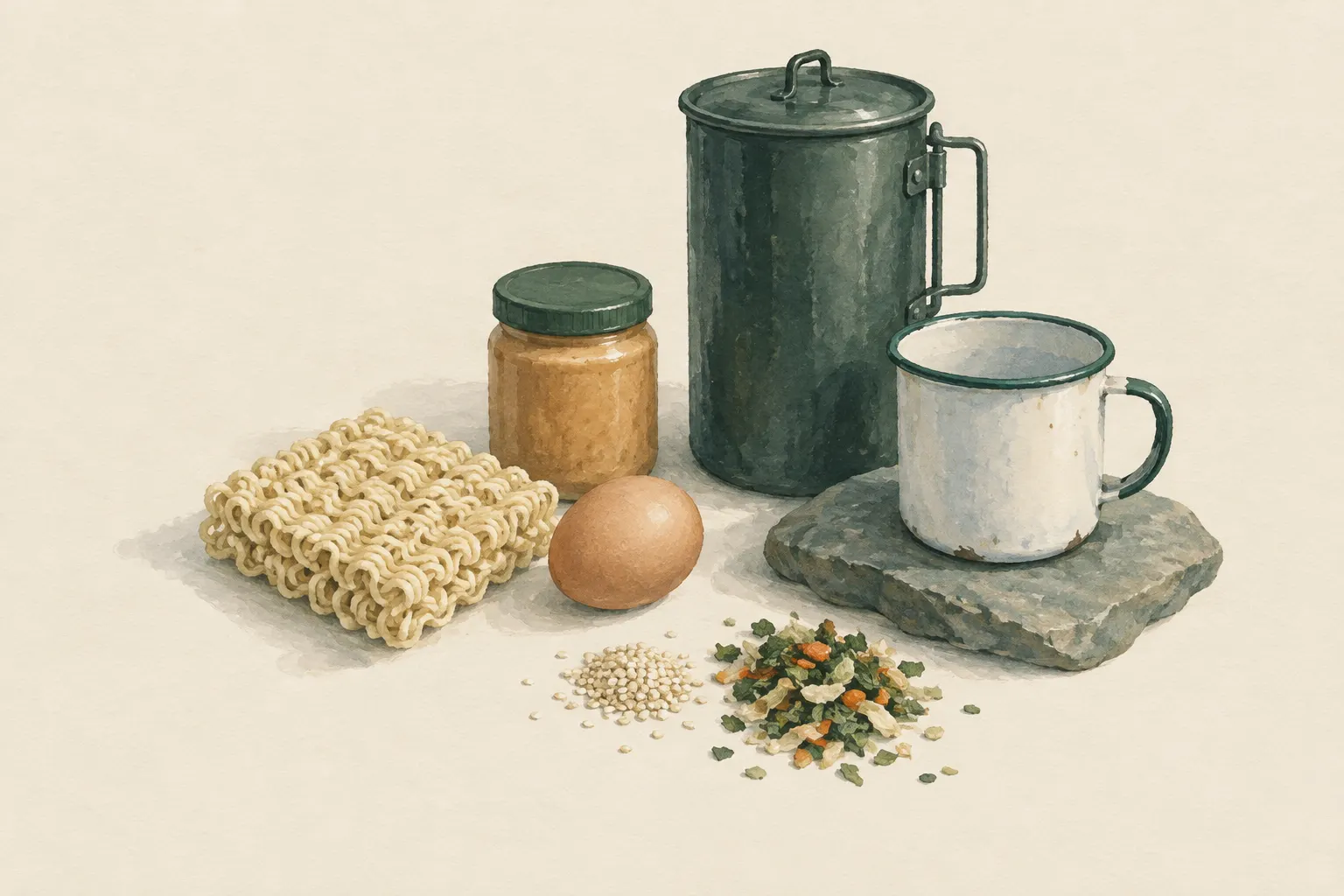
With a few ingredients a pack of instant noodles becomes a proper meal: an egg or tofu for protein, dried vegetables and a spoonful of peanut butter or sesame for a creamy broth. Ready in under 10 minutes with little fuel. Two things to watch: the flavour sachet is very salty – half is usually enough – and the egg must be cooked right through.
- 8–10 minutes in total
Explained simply
Instant noodles are quick to make, but on their own they do not keep you full for long. With a few extras they become a proper meal: an egg or tofu, some dried vegetables and a spoonful of peanut butter for a creamy soup.
The little flavour sachet contains a lot of salt. Use only half first and then taste. The peanut butter gives so much flavour that you usually do not need more.
An egg must stay in the boiling soup until it is firm and pale everywhere. Beforehand you crack it into a mug and check that it smells fine. And very important: ask everyone whether anyone is allergic to peanuts, sesame or egg.
How it works
Instant noodles are cooked at the factory and then dried, often fried in fat. That is why they need only three minutes in boiling water. They provide mainly carbohydrate and fat, but little protein and hardly any vegetables.
The extras fill exactly these gaps. Egg or tofu bring protein, which keeps you full for a long time and feeds the muscles after a day's walk. Dried vegetables need a few minutes in boiling water to soften – that is why they go into the pot before the noodles. Peanut butter or sesame add fat and a nutty taste.
A beaten egg that runs slowly into boiling soup sets into fine strands. That way it cooks quickly and evenly. A whole, cracked egg in the soup takes longer – then you have to watch closely until the yolk is firm too.
Salt and allergens
The World Health Organization recommends that adults eat less than 5 g of salt a day, and children even less. Much of the salt comes from processed foods. In the EU, the nutrition table on the pack shows how much salt a portion of instant noodles contains. Half a sachet, topped up with peanut butter, sesame or herbs, is a good start.
This soup can contain many allergens at once: wheat with gluten in the noodles, egg, peanut, sesame, soy in the tofu or seasoning and often celery, sometimes also fish or crustaceans in the sachet. In the EU these allergens must be highlighted in the ingredient list. Read it before you cook for others.
Peanuts and sesame can trigger very severe allergic reactions. Signs are breathing trouble, swelling of the face or throat, hives all over the body or dizziness. Then call 112 at once and use the adrenaline auto-injector if there is one.
Safety: what to watch out for
A stove always belongs outside – never in the tent, never in the vestibule, never in the car. Burning gas or spirit produces carbon monoxide. You cannot see or smell this gas; it makes you tired and can knock you out. On top of that, tent fabric catches fire within seconds. If it rains, cook under a tarp with open sides or wait.
The most common accidents when cooking outdoors are scalds. A narrow stove with a full pot tips over easily. Put it on firm, level ground, hold the pot by its handle while stirring and only let children near the stove together with an adult. With a scald, cool it at once with cool running water; with large wounds, burns to the face or in children call 112, in Austria also 144.
Eggs and tofu are fresh foods: only for short trips, carried cool and used the same day. Wash your hands after cracking the egg. Thin noodle soup slops easily – children get it in a mug with a handle and wait until it stops steaming.
Step by step
Set up a safe cooking spot
Put the stove outside on firm, level ground or a flat stone – well away from the tent, dry grass and leaves. A windscreen keeps the flame steady but must not enclose the stove completely. Lay everything out before you light it: pot with lid, cooking spoon, water, ingredients. A narrow, tall pot works well for noodle soup.
Caution: Never cook inside the tent or vestibule.
- 1
Set up a safe cooking spot
Put the stove outside on firm, level ground or a flat stone – well away from the tent, dry grass and leaves. A windscreen keeps the flame steady but must not enclose the stove completely. Lay everything out before you light it: pot with lid, cooking spoon, water, ingredients. A narrow, tall pot works well for noodle soup.
Never cook inside the tent or vestibule.
- 2
Prepare the ingredients
Crack the egg into a mug and check its smell and look – or dice the tofu. Lay out the dried vegetables, peanut butter or sesame and the flavour sachet. Ask everyone whether anyone has an allergy.
Wash your hands after handling raw egg.
- 3
Bring water and vegetables to the boil
Pour the amount of water given on the pack into the pot, add the dried vegetables, put the lid on and bring it to the boil. Let the vegetables boil for 2 to 3 minutes so they soften.
- 4
Add the noodles
Put the noodle block into the boiling water. After about a minute, loosen the noodles with a fork or the spoon. Low flame so nothing boils over.
- 5
Stir in egg or tofu and cook
Pour the egg slowly into the boiling soup while stirring gently so that fine strands of egg form. Let everything boil for 1 to 2 more minutes until the egg is firm and pale everywhere. Simply add tofu and heat it through.
No runny egg visible any more? Only then is it done.
- 6
Off the heat and season
Turn off the stove. First stir half of the flavour sachet and a spoonful of peanut butter into the hot broth until it is creamy. Taste and only add more seasoning if it is really needed. Sprinkle with sesame.
- 7
Eat carefully
Fill a bowl or mug with the soup and let it cool briefly – broth and noodles are very hot. Children do not eat straight from the pot.
- 8
Tidy up
Egg shell, flavour sachet and packaging go into the rubbish bag. Swirl the pot out with a little warm water and drink the water or scatter it well away from water.
Common mistakes
- Using the whole flavour sachet – very salty
- Letting the egg set only briefly – still runny inside
- Carrying eggs uncooled over several warm days
- Stirring peanut butter into the group's soup without asking about allergies
- Too much water – the broth gets watery
- Leaving sachets and egg shells behind
Quick view
Materials
Instant noodles (with flavour sachet)
Per person 1 pack (only half the flavour sachet)
The flavour sachet contains a lot of salt – half is usually enough.
Usually contain wheat (gluten); the sachet can contain celery, soy or fish.
Clean drinking or treated water
Per person about 400–500 ml, as on the pack
Treat water from streams or lakes first – also for rinsing vegetables and beans.
Carry enough for cooking, drinking and washing up.
Fresh egg in an egg box
Per person 1 egg – only on short trips, carried cool
Only for short trips: carry cool and unbreakable, use the same day.
Always cook egg right through until white and yolk are firm; wash your hands afterwards.
Smoked or plain tofu (vacuum-packed)
Instead of egg: per person about 50 g, diced
Is a chilled product: only for short day trips with a cool bag, use up as soon as it is opened.
Contains soy.
Dried vegetables (soup mix, peas, carrots, leek)
Per person 1 handful (about 10–15 g)
Soup vegetable mixes often contain celery.
Store dry and tightly closed.
Peanut butter (no added sugar) or tahini
Per person 1 tablespoon
Peanuts and sesame are common, sometimes severe allergy triggers – ask who is eating first.
A tube or tight tub so nothing leaks.
Sesame seeds or sesame oil
Per person 1 teaspoon of sesame seeds or a few drops of sesame oil
Sesame is an allergen that must be declared.
Stove
Never operate inside a tent, shelter or enclosed room – carbon monoxide and fire risk.
Stove fuel (canister, liquid fuel, alcohol)
Store fuels apart from food and in original containers or bottles intended for them.
Store cool, well ventilated and out of children's reach.
Metal pot (stainless steel, aluminium, titanium)
With lid, about 0.75–1 litre per person
Hot – scalding risk.
Bowl or large mug with spoon
A mug to crack the egg into and a bowl to eat from
Children eat from their own bowl – not straight from the hot pot.
Long cooking spoon (wood or heat-resistant plastic)
A long handle keeps your hand out of the hot steam.
Suitable for
- A quick dinner after a long day
- Lightweight trips – noodles weigh little
- Little fuel available
- Children who like noodle soup
Not suitable for
- Peanut, sesame, soy, egg or gluten allergy without adapted ingredients
- People who should eat little salt, with the full sachet
- Raw eggs on long, warm trips
- Cooking in a tent or vestibule – never
Prerequisites
- Able to use the stove safely, or an adult helps
- A permitted, safe cooking spot outside
- Fresh egg or tofu only on a short trip with cool transport
Safety
- Only take eggs on short trips, cool and unbreakable. Crack it into a mug first and check: if it smells bad or the shell is dirty or cracked, do not use it. Leave the egg in the boiling soup until white and yolk are completely firm. Wash or sanitise your hands afterwards.
- The flavour sachet contains a lot of salt. The pack says how much salt a portion has. The WHO recommends that adults eat less than 5 g of salt a day in total, children even less. So use half the sachet first and add flavour with peanut butter, sesame or herbs. In great heat with heavy sweating a little more salt can make sense – still drink enough.
- Eat cooked food hot straight away. Do not leave leftovers without cooling for more than two hours – and never overnight in the lukewarm pot. Anything left over is heated until it is steaming hot all through before eating, or it is thrown away. Pack food and rubbish animal-proof at night.
How it works
Instant noodles are already pre-cooked and dried, which is why they are soft in three minutes. On their own they provide mainly carbohydrate and fat, but little protein and hardly any vegetables. An egg or tofu adds protein, dried vegetables add colour and fibre, and peanut butter or sesame make the broth creamy and filling. Because peanut butter and spices already give a lot of flavour, you need less of the salty sachet.
Advantages
- Very fast and needs little fuel
- Light and cheap
- Much more nourishing with a few extras
- Children like it
Disadvantages
- Lots of salt in the sachet
- Many possible allergens
- Fresh egg or tofu only for short trips
- Not filling for long on its own
Deep knowledge
Background
Instant noodles are among the most popular trail meals worldwide because they are light and cook quickly. The World Health Organization recommends that adults eat less than 5 g of salt a day and points out that much of the salt comes from processed foods. In the EU the nutrition table on the pack states how much salt a portion contains.
In the EU, 14 main allergens must be highlighted in the ingredient list, including cereals containing gluten, eggs, peanuts, soy, sesame, celery, fish and crustaceans. According to the chart of the US food safety agency USDA FSIS, eggs and egg dishes should be cooked right through (egg dishes 71 °C / 160 °F).
Variants
- Children's noodle soup
- Only a third to a half of the flavour sachet, no chilli, but small peas and carrots from the dried vegetables. Break the noodles into small pieces in the pack before cooking so they can be eaten with a spoon.
- Vegan
- Tofu instead of egg, peanut butter or tahini for creaminess. Check whether the noodles and the sachet are vegan – some contain egg, fish or meat extract.
- Without nuts and sesame
- Instead of peanut butter and sesame, stir in a knob of butter or a spoonful of oil and dried herbs. With severe allergies only use products whose ingredient list you have read yourself.
Common mistakes
- Using the whole flavour sachet – very salty
- Letting the egg set only briefly – still runny inside
- Carrying eggs uncooled over several warm days
- Stirring peanut butter into the group's soup without asking about allergies
- Too much water – the broth gets watery
- Leaving sachets and egg shells behind
Limits and risks
- No substitute for balanced meals on long trips
- Salt needs with heavy sweating vary – no fixed recommendation
- No figure for how long eggs keep without cooling – day trips only
Material alternatives
Derived from material properties: a substitute must have all relevant properties. Observe the notes on the substitute.
- Stove fuel (canister, liquid fuel, alcohol)
- Dry firewood (Collect only where permitted.), Tinder (Carry in waterproof packaging.), Char cloth (charred cotton) (Store dry in a tin.), Finest-grade steel wool (Store separately from batteries – fire risk.), Fatwood (resin-rich wood) (Collect only dead wood where permitted.), Petroleum jelly cotton balls (Use only pure cotton.), Cooking oil or cooking fat (tallow, lard) (Never put out burning fat with water – cover it with a lid to smother it.), Tree resin (spruce, pine) (Resin is flammable and sticks to the skin when hot – melt it only slowly over low heat.), Birch bark (from dead, fallen wood) (Never peel from living trees.)
- Metal pot (stainless steel, aluminium, titanium)
- Single-wall stainless steel bottle (Heat only single-wall bottles without paint/plastic; remove the lid before heating.)
Results come exclusively from structured entries. No improvised instructions are generated.
Sources (8)
- World Health Organization (WHO): Salt reduction (fact sheet) · WHO recommendation for adults to eat less than 5 g of salt a day; much of the salt comes from processed foods
- European Parliament and Council of the European Union (2011): Regulation (EU) No 1169/2011 on the provision of food information to consumers · Allergens that must be declared, including gluten, egg, peanut, soy, sesame, celery, fish, crustaceans; salt content in the nutrition declaration
- United States Department of Agriculture – Food Safety and Inspection Service (USDA FSIS): Safe Minimum Internal Temperature Chart · Cook egg dishes to 71 °C (160 °F)
- Allergy 77(2): 357–377 (A. Muraro et al., European Academy of Allergy and Clinical Immunology) (2022): EAACI guidelines: Anaphylaxis (2021 update) · Signs of a severe allergic reaction and immediate action (adrenaline, emergency call)
- World Health Organization (WHO) (2006): Five Keys to Safer Food Manual · Wash hands after raw food, cook thoroughly, do not leave cooked food standing for hours
- Centers for Disease Control and Prevention: Carbon Monoxide Poisoning – Prevention guidance · Never use stoves or other fuel-burning devices inside tents or closed spaces – carbon monoxide
- European Resuscitation Council – Resuscitation (journal) (2021): European Resuscitation Council Guidelines 2021: First Aid · Cool burns and scalds at once with cool running water; call emergency services for severe burns
- Leave No Trace Center for Outdoor Ethics: The Seven Principles of Leave No Trace (Principle 5: Minimize Campfire Impacts) · Pack out rubbish, scatter washing water away from water, keep fires small or use a stove